


Recovery from surgery can be a slow process of regaining full strength, mobility and personal energy. We are vulnerable physically and even emotionally, so the right support can make a big difference to achieving a full recovery to health and wellness on every personal and professional dimension. Dedicated facilities for orthopaedic rehabilitation promise to make this period of time as comfortable and effective as possible. They provide one-to-one pain management, comfortable surroundings for recuperation and comprehensive physiotherapy classes.
There are only a few such private specialist physical rehabilitation facilities in the UK, once we exclude specialist clinics for addiction or neuro-rehab. (See Exhibit One.)

These are small and targeted at prosperous patients who pay out-of-pocket. Yet we do have an ageing population and more surgical packages paid personally than ever before, so surely there could be a strong business case for more ambitious offerings than NHS-paid care?
We will discuss public provision as a substitute and complement to private provision later in this article. The biggest opportunity for private is knee rehabilitation, which has younger patients who require a more complex program to regain full function. Some Retirement Villages offer rehab, with hydrotherapy, including chains such as Richmond and Audley. The high-end nursing home chains can also provide rehab, though in practice this is for more elderly patients and has a similar proposition to their respite offerings.
We have seen the success of specialist clinic in other segments, especially in ophthalmology and orthopaedic surgery itself. Is there a similar case for post-operative rehab?
The Clavadel in Surrey is a success story, which since its establishment in 2014 has reached revenue of £5m. (See Exhibit Two.) It is a 32-bed facility in Guildford with ~80+% average occupancy and stays of 5-14 days. Patients are typically transferred from both Central London and local hospitals and receive an individualised treatment plan for their stay, with a nightly fee of ~£400. Its founder Charles Geoghegan remains its Director, though we understand it received investment from VAMED in 2022.
Headquartered in Vienna, Austria, VAMED (FY22 revenue: €2.3bn) is a multinational rehabilitation provider for patients recovering from medical conditions, injuries, or surgeries. VAMED also has some sites with both surgery and aftercare. In May 2024, PAI Partners announced it was to acquire a 67% stake from a partial divestment by listed company Fresenius, which is expected to complete in H2 2024 subject to final board and regulatory approvals. The deal is led by Stefano Drago of its Mid-Market Fund Team.
VAMED had earlier entered the U.K. through a joint venture with Circle Health in 2017. The rehab provision would be on the small end for VAMED at 120 beds but was a major new development for the U.K. The new build was allocated space on the new hospital site on the former BBC Pebble Mill location in Birmingham. VAMED was expected to operate the rehab facility but sold its shares to Circle Health at the end of 2019. Circle Health was then already led by current CEO Paolo Pieri but had yet to make its transformational acquisition of the far larger BMI Healthcare, backed by the Centene Corporation and Medical Properties Trust in January 2020.
VAMED may be glad that they got cold feet and decided instead to invest into the existing Clavadel to learn more about the national market. The service was to be operated by a different subsidiary (Circle Rehabilitation Services Limited) and the original planning permission plans showed their intention to have >100 inpatient beds over part of the first and third floors, and most of the second floor.
The latest reported revenues wouldn’t justify more than a third of that capacity, though it won’t have reached maturity already and might justify 50-60 beds in due course. New hospital sites are notoriously slow to achieve maturity as surgeons slowly adjust their working patterns and referral habits, but there are no recent benchmarks for a similar service in the U.K. apart from the Clavadel above.
A very different offering, with a value proposition based on musculo-skeletal or cardiac rehabilitation for better quality of life, might take even longer in an undeveloped market. We don’t immediately see such remaining ambition in their Circle Health corporate communications. These emphasize more traditional reassurance and less anxiety or concern about regaining strength and movement after surgery, rather than a lifestyle choice.
The Companies House accounts for the subsidiary Circle Rehabilitation Service Ltd are publicly available, even if only published nearly twelve months later. Circle Health reported £3.17m revenue and an operating loss of £5.54m for its subsidiary in calendar year 2022. For the first full year of trading on the Birmingham site in 2021, they had reported similar £5.46m operating losses on annual revenue of £1.87m. It is possible that this includes costs which should be allocated to the main Circle Birmingham hospital. However, we believe they should be accurate, as that they have kept the legal entity and are motivated to maintain separate accounting to aide financial transparency and make it easier to sell a stake to an operating partner subsequently.
Rehabilitation success factors
Intensive rehab requires specialist equipment, which is a hydrotherapy pool at minimum. An aquatic treadmill has a smaller physical footprint but doesn’t provide all the benefits of a pool. World-class facilities will also do gait support work with a separate balancing trainer and robotic trainer as well. Resistance training can also benefit from the the specialist machines that allow recreation of common activities, such as golf swings. Software monitors patient performance to assess outcomes and inform the rehab process.
The purpose-built Clavadel has good equipment, and the crucial hydrotherapy pool and spacious lift (elevator) of which surgeons we have spoken bemoaned the relative paucity in London itself, outside some limited hospital supply. The Clavadel has demonstrated that the private demand is there, at least on a small-scale: patients will pay for the service, see the benefits, and recommend the treatment they get from a specialist facility.
Another successful example is the Lynden Hill Clinic, which has been operating far longer in Berkshire, west of London, since it was founded in 1993 by Dr Faysal Zeerah of Bahrain. It is still privately owned. (See Exhibit Three.)
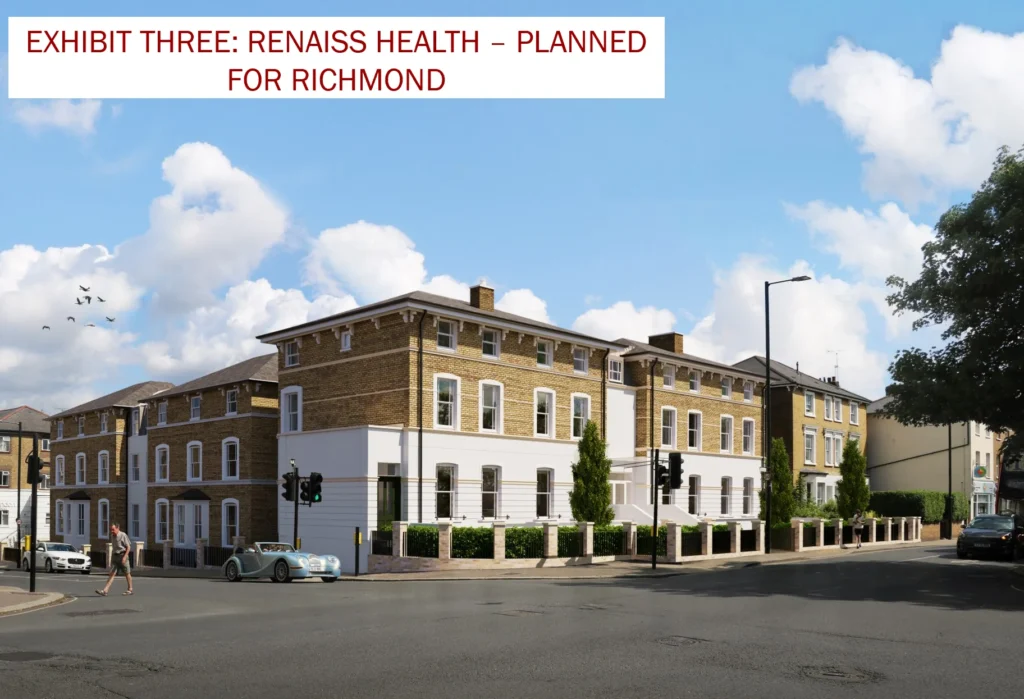
Newcomer Renaiss Health is planning to open in early 2025 in Richmond-upon-Thames, backed by Bridge Fund Management. The renovated hotel will support physiotherapy, hydrotherapy and occupational therapy with high-quality accommodation. CEO Jennifer Martin told us that “Our centre and service will provide an important link in the borough’s health provision, giving more people the ability to access treatment and care to prolong their potential independence, mobility and confidence.” The plan is to build further clinics, with the second planned for Stanmore in Harrow, north-west London.
The location will be a key aspect to their level of success. One orthopaedic surgeon we spoke to – before Renaiss Health’s public plans – did the lack of supply in London itself. “I don’t always recommend they go to Clavadel or Lynden Hill. It’s really expensive and not covered on insurance. You have to be either desperate or minted but I’ve always been amazed that there isn’t a place in London. I imagine it would double the number of patients we currently send.”
We will soon have a world-class National Rehabilitation Centre in Nottinghamshire. The Government recently approved £105 million for the construction of a 70-bed building on the Stanford Hall Rehabilitation Estate between Nottingham and Loughborough, 400m away from the Defence Medical Rehabilitation Centre. It appears orientated towards those who have experienced major trauma and has arisen in conjunction of a major long-term effort to improve the support of soldiers who have been seriously wounded in recent conflicts in Afghanistan and Iraq. This is a highly worthwhile state initiative, but such major trauma is thankfully a small share of rehabilitation.
The UK’s labour force recovers at home
Every so often, someone with prior experience of German-speaking Europe and its approach to orthopaedic rehabilitation asks why their approach is not widely available in the U.K. There is either a massive need which is not being met here very much at all, or many Europeans spends weeks away from their families earnestly pursuing their rehabilitation in bespoke facilities for relatively little clinical reason.
Although smaller than that of Germany, we believe the orthopaedic rehab market in the UK is still worth ~£1bn. (See Exhibit Four.)

Inpatient rehab is not a part of the typical healthcare ‘package’ a British patient might expect. In fact, such rehab is a little culturally alien in the UK due to the market dynamics that operate behind it, which notably also includes strong incentives for hospitals to decrease the average length of stay post-operation. (See Exhibit Five.)

This leaves only moderate budgets for NHS-paid orthopaedic rehab to, and NHS providers have historically simply seen in-patient as a more expensive luxury alternative to simply being at home. Even though post-operative rehabilitation facilities exist, the NHS does not pay for patients to use them. After a knee replacement on the NHS, you can expect to be sent home and receive a limited package of physio sessions, which arguably are insufficient to prevent occasional complications later or a mediocre outcome.
Nevertheless, central NHS policy has started to recognise the desirability of rehabilitation in the system, as outlined in the Long-Term Workforce Plan. Nevertheless, any progress in the public system is nascent, and rehab in the UK remains largely confined to the private sector as an optional ‘extra’ for those that can afford a higher quality recovery experience.
Meanwhile, the potential lack is illustrated by the fact that the UK ranks 21st out of OECD countries for inclusion of older workers in the labour force, which must be partially driven by retiring early due to ill-health.
Rehabilitation in German-speaking Europe
In Germany, after a hip replacement, a patient can expect to stay in hospital for upwards of twelve days before they transfer to a rehabilitation facility for around three weeks. It has started to change where the payment model has changed, but the German hospitals are relatively slow to discharge. Employed patients can continue to claim their salary during this time. After rehabilitation, patients of working-age may be offered further aftercare treatment via their pension scheme, and a doctor can prescribe an unlimited amount of physical therapy, as they see fit. (See Exhibit Six.)
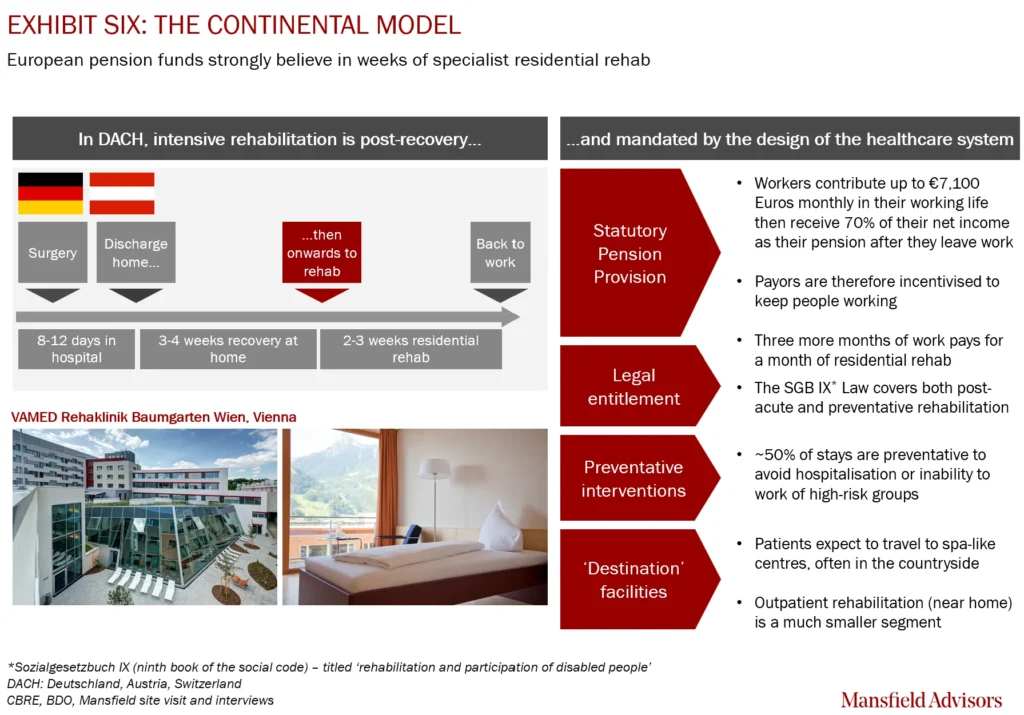
In most cases, a standard package of rehabilitation is provided by an individual’s insurance. The social insurance healthcare systems, although varying in scope and form between countries, are built upon reimbursement mechanisms which support rehabilitation services and thus encourage both patients and healthcare professionals to take up these services when they are needed.
But how did this come to be part of the expected healthcare ‘package’ in Germany? In the early 1900s, Germany built tuberculosis hospitals as spacious spa-like facilities in the countryside. As tuberculosis prevalence declined, these were repurposed as convalescence facilities for patients who were unable to work due to injury or illness. This provided the foundation for rehabilitation culture, which was further bolstered as the financial case aligned as the concept of rehabilitation became attractive to social insurance (SHI/SPI) healthcare structures.
German health insurance funding is linked to pension funding – and crucially – the healthier a person is, the longer they will go without claiming their pension. So, insurers are incentivised to provide the fullest post-operative rehabilitation to working-age patients in order to keep them in work as long as possible. Moreover, insurers require that a person must be considered for rehabilitation before they can claim their pension due to illness or injury. This is how rehabilitation has become part of the fabric of German healthcare culture, and for this reason, there are many more rehabilitation beds per capita in Germany versus the UK.
Crucially, these facilities are large enough to be efficient, and are comfortable for stays up to three weeks, with swimming pools, restaurants, and gyms. They have plenty of space often in picturesque countryside, yet still attract patients from urban areas.
At the luxury end, Clinique Valmont is a well-known example on Lake Geneva. The recommended two full weeks after orthopaedic surgery, with a package of physiotherapy, spa sessions, nursing care and rehabilitation is priced at ~£30,000.
Health vs wellness
Part of the explanation arises from the difference between what we would call health and wellness. These two concepts can and are defined differently by different authors in academic, business and policymakers. Please accept our definition for now, which is health is the absence of illness to the extent that it is not a problem for anyone else, while someone who is well has the physical capability to achieve their full potential in life.
A simple example – if you have a broken leg, it’s a problem for everyone else and even the poorest countries in the world will fix you in a state hospital. But if you have a few twinges in your body which make you feel old, then it’s not an immediate problem for anyone else. It’s a also a highly subjective experience and you would normally have no reason to know how it could have been prevented or delayed. Yet thanks to those ‘twinges and a resulting lack of enthusiasm, you are that much more likely to leave work and start collecting your pension.
Show me the incentives and I’ll show you the results
There is always a payor when the ‘health’ problem is obviously someone else’s. In the U.K. the state typically pays under the big blue brand of the NHS.
For many ‘wellness’ problems, when the only result is a mediocre outcome for an individual and society, e.g. a white-collar professional leaves work months before they might have done. In that case, countries have very different degrees of coverage for different population segments. The U.K.’s coverage is spotty, and most are not covered, with some exceptions such as interventions to reduce the benefits bill for working-age adults, or fortunate office workers whose large employer may have them covered under a group risk scheme.
The German-speaking countries, either through accident or design, created universal coverage payors with the incentives, capacity and long-ingrained habit of paying for such wellness interventions. The social funds want workers to both return and stay in work as long as possible after a major health episode, to both avoid paying the pension and to receive payments over a longer period. Obviously, they have the financial capacity when most households do not. Their habit of paying began from a supply-side accident of history, since there were plenty of those large, well-appointed tuberculosis sanatoriums which were keen to be repurposed once infectious diseases gave way to the chronic conditions induced by prosperous longevity.
Individuals and households are poorly incentivised to spend on their own wellness, especially if the returns are only achieved after a certain large minimum spend. We discount the future, for perfectly understandable reasons, however much academics may sniff at our innate bias towards the short-term. Otherwise far more of us would spend – for example – on personal trainers, regular dental hygienist visits and long-term family doctors; without even considering many other more debatable or marginal investments that we could make in our own bodies and resulting working lives and ‘healthspan.’
The UK is different, but change is easy to imagine
This is a fundamental truth which has profound implications for state policy. Subsidising (i.e. lowering the sticker price) of something can return positively for society, and through taxes to the state. The specifics are not easy to deduce and agree on, which is why the most sophisticated states create a system where multiple payors are incentivised to commission different offerings, experiment with prices and co-ordinate coverage.
Any state, including the United Kingdom, should in theory be incentivised to keep its taxpayers well for as long as possible. In practice, for reasons that would require a book in themselves, the current system means that only basic health matters. If you can make a cup of tea and walk up the stairs, that is sufficient. It is not a concern whether you continue working – possibly progressively less – into your 70s. Please note that this is not a criticism necessarily of the U.K. since it is much closer to the norm in OECD countries than the German approach.
Why German rehabilitation could be better termed professional reablement
Rehabilitation is often narrowly defined as a clinicalapproach to restoring function through prescribed physical therapy, exercise and temporary use of special equipment. Everyone receives it. If expectations and aspirations are low, then elementary functioning is sufficient.
Reablement isaftercare and focused on the return of basic skills to live independently at home. In a best-case scenario for the U.K., there will be up to six weeks support at home to help a complex elderly patient remain out of hospital. It is more likely after NHS intermediate care (also known as sub-acute)for patients with co-morbidities and challenging home environments.This is a placement in a care home or community hospital for up to six weeks, to help an elderly person to return to living at home. NHS community hospitals tend to provide more intensive and shorter stays.
Recovery isa holistic process – including mental and social factors – for regaining full activity. This is arguably most reliably achieved in a two-step process, as in Germany. Basic functioning is first restored through rehabilitation, and then optimum psychological wellbeing is achieved, along with a full return to confidence, through a substantial three week stay with vigorous physical exercise in an energetic atmosphere. After a lifetime of hard work, petty frustrations and a steadily declining physique and possibly a health event; the default path is leaving full-time work sometime after a major surgery, if not at once.
For lack of a better word, English-speakers call the German effort to avoid this outcome ‘rehabilitation’ as well. We would suggest it’s more akin to a form of ‘professional reablement.’ The median age for joint surgery is only 67 which is still too young for most to risk being a burden on public health services. The English goal for reablement is to ensure people can make a cup of tea and make it to Sainsbury’s. The Germans want their citizens to go back to work, because they appear to think it’s necessary for happiness and fulfilment.
Does the German approach create value?
A recent healthcare value study by the University of Groningen [Stevens et al, 2023] compared the German approach to the Dutch for 124 hip-replacement patients under the age of 65. They found significant post-operative clinical benefits from the German approach four weeks after surgery and months later. German patients reported psychological benefits, were more satisfied and had recuperated faster than the Dutch. The Dutch approach was highly varied, since there is no mandate requirement for insurance to cover German-style rehab, but is analogous to the British experience. (See Exhibit Seven.)
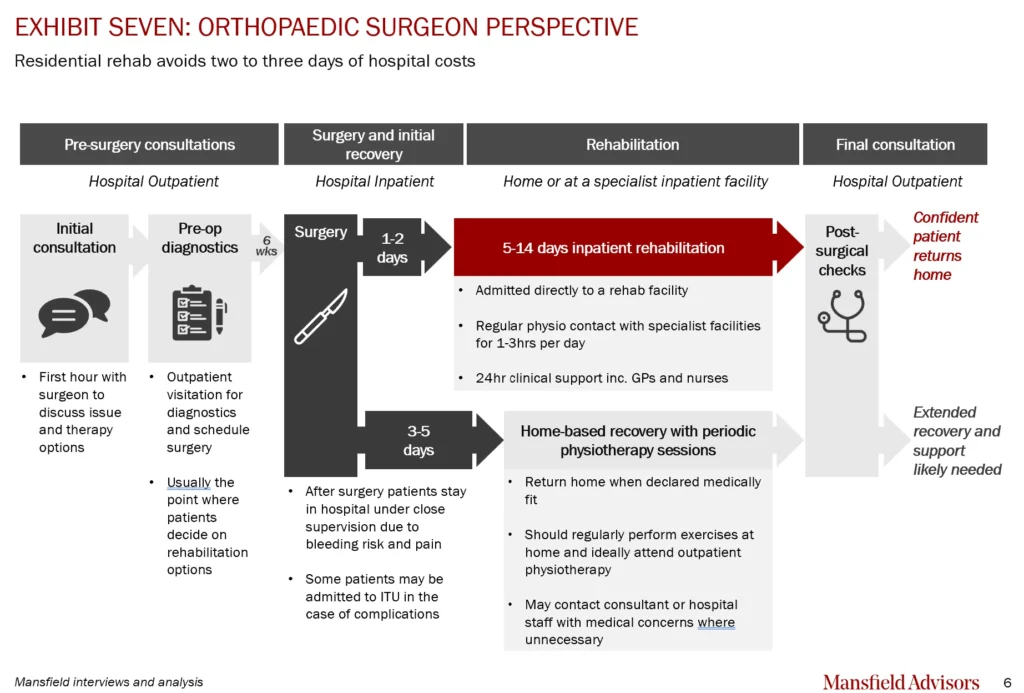
The German cost was 45% higher than the Dutch, though only 20% higher for working adults allowing for income lost. The Germans returned to work two weeks faster, which was almost enough to justify the cost of the three-week facility stay in itself. [Note that the German delivery cost was also lower than the equivalent would be in the UK, with our higher construction & land costs, and initial lack of scale.]
Frustratingly the study did not look at whether the Germans stayed in the workforce longer afterwards, though there would of course be other factors involved between different countries. The average German is not reported to retire later than comparable countries, though the mix by sector and professional could be more supportive. We have been told the German insurers assume at least three more months employment results from better rehab, but this is anecdotal.
The study concluded that there was certainly a likely economic case for working adults to receive the German-style rehab, if not retirees.
People will take a free active holiday when they wouldn’t pay to go away themselves.
While there is room to argue that those who can, are becoming more comfortable with the idea of self-paying for healthcare, this does not guarantee success in this segment.
Self-paying for rehab would be rather novel for the target UK patient, in both the service they receive and the way they access it by paying for it out-of-pocket instead of another discretionary purchase e.g. holiday. For rehab to work at scale, the British population would require a mindset shift to become more comfortable with both paying and actively participating in rehab activities.
Part of the appeal of rehab is that it is a destination and an experience for the patient. The most comfortable rehabilitation facilities are in the countryside – with plenty of space, fresh air, and nature around. However, so much of the private-pay wealth in the UK is concentrated in London, which limits new-build sites.
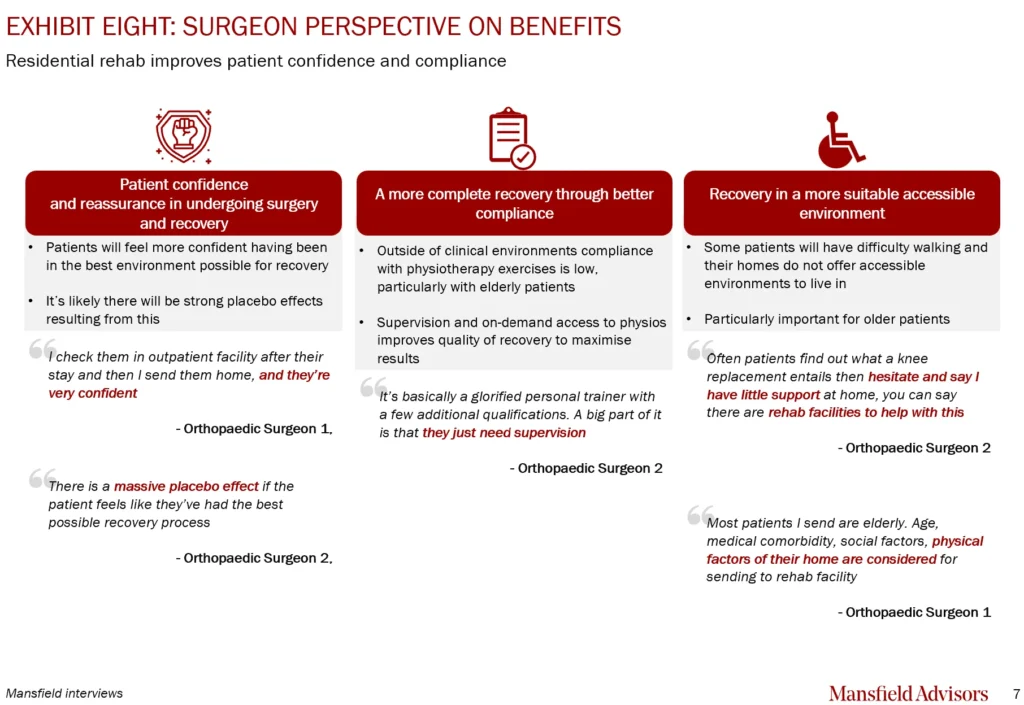
For the German approach to become the British standard, far more stakeholders would have to be fully convinced in the value to society of three-week comprehensive packages free to the recipient. Surgeons are already happy to see more rehab, but they would need to become evangelists for a comprehensive approach over and above their current attitudes. (See Exhibit Eight.)
This mindset change might be difficult to envisage occurring in one major policy shift, but a possible interim step would be full tax deductibility of corporate healthcare expenditure on employees. It’s not impossible to imagine a Labour Government championing the change if it were accompanied by mandate on large companies to provide world-class occupational health.
Notwithstanding such major changes, new investment is about to enter and will offer new opportunities for British patients to recover more comfortably and effectively. Major structural constraints remain, but the rehab sector may finally be leaving its infancy.
The opportunity for new entrants does exist, but it will be necessary to provide a distinctive value proposition, further stimulate the private market and deliver superlative execution of strategic marketing and service delivery.


