


Introduction
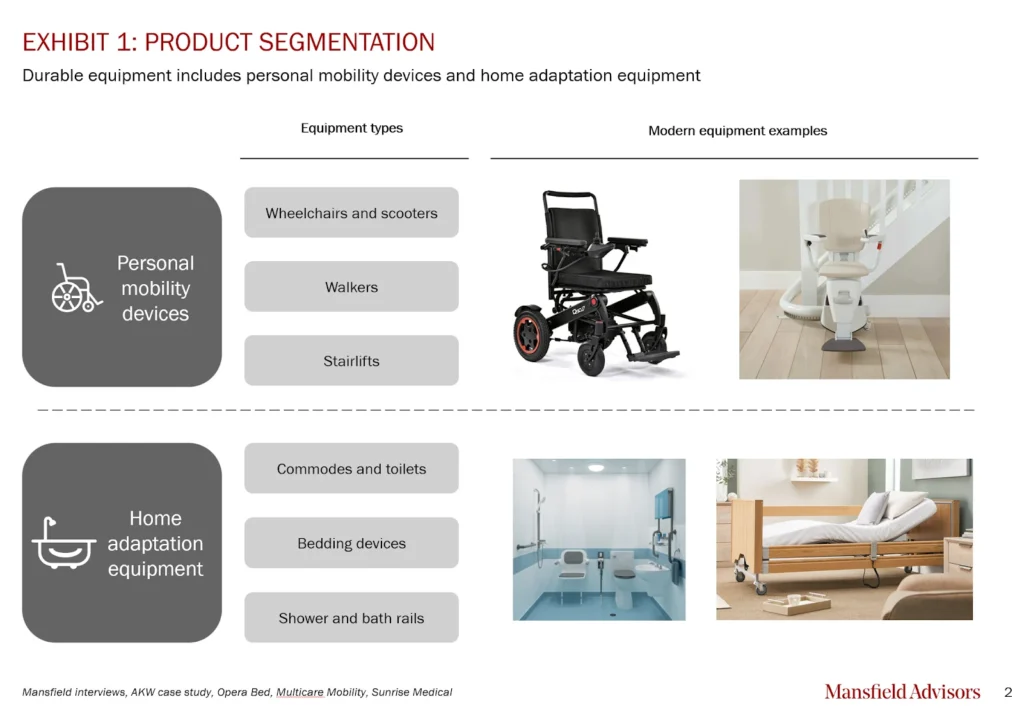
The “hardware” of health and social care is the unglamourous, but critical equipment used for a medical purpose that withstands multiple uses, such as hospital beds, wheelchairs, and bathroom railings. Medicare in the US categorises this as ‘durable medical equipment’, or DME, and includes mobility, home adaptation and therapeutic equipment.
This article focusses on the two segments: personal mobility and home adaptation equipment, both attractive markets underpinned by aging demographics, as well as shifts to home care and increasing personalisation of products. On top of the underlying market trends, there are also opportunities for growth from expanding product ranges, adding service elements and international expansion. The other half of durable equipment – therapeutic and monitoring devices – is subject to different regulations, market structures, payment mechanisms and sold by different providers so we would cover that separately.
The total DME market is generally estimated to be ~$200bn worldwide, though estimations vary of the split between the segments. Therapeutics and monitoring devices is actually believed to be the largest segment, followed by personal mobility and then only home adaptation. Six market reports agree that the total market is forecast to grow at 5-6% CAGR to 2030. The largest geographical market is North America, though Asia is growing the fastest, driven primarily by China with a rapidly aging population and growing expectations of care.
Key players and transaction history
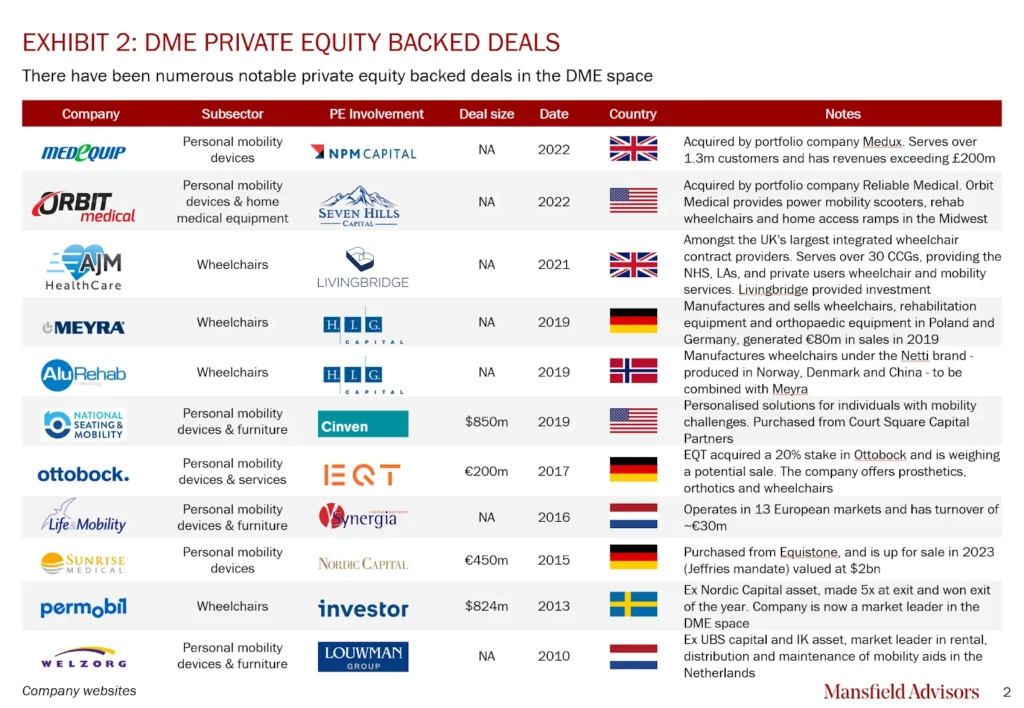
The DME sector has seen at least nine notable transactions since 2015. Sunrise Medical is currently rumoured to be for sale with the investment bank Jefferies at an enterprise valuation of ~$2B. Sunrise Medical is a manufacturer and distributor of mobility assistance devices, with a portfolio of wheelchair brands that has grown through acquisition in both product range and geography. Sunrise has also expanded into related products, including bath lifts and scooters, and vertically integrated by both building and acquiring manufacturing facilities and distribution companies. They apparently intend to own and optimise the entire product pathway.
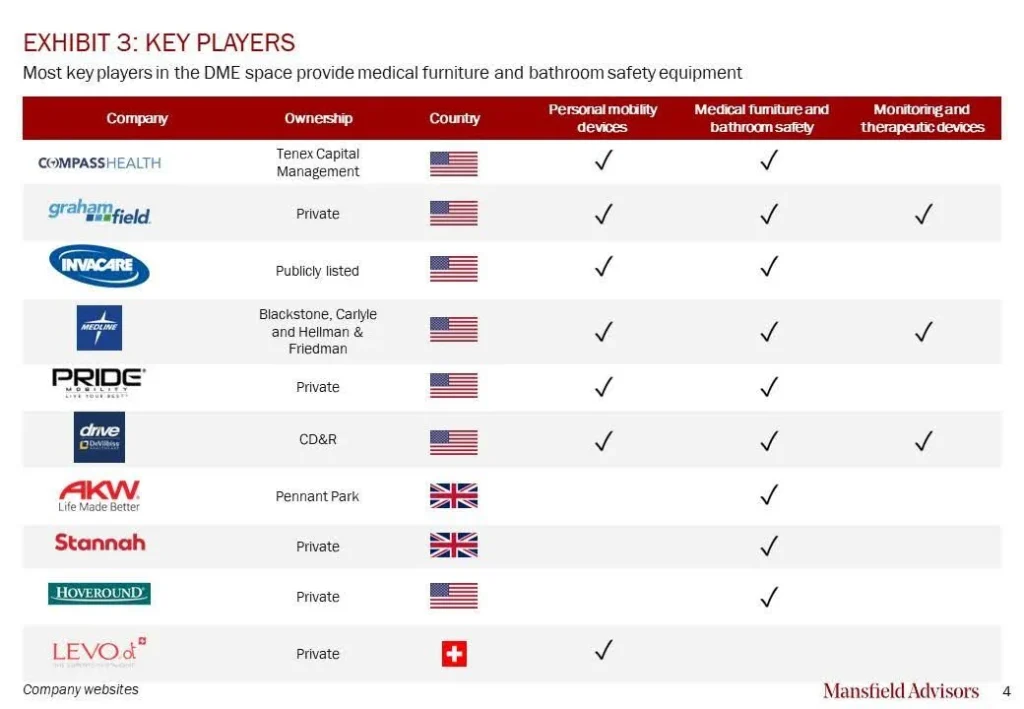
Permobil, initially a Nordic Capital asset and later an acquisition of the Investor AB family office, is another key player in the sector. It was amongst the first to launch electric wheelchairs, which gave people more independence. It was acquired by Investor AB in 2013 for ~$783 million as a technology-based company. Permobil has since acquired US wheelchair manufacturers TiLite, a personalised wheelchair company in 2014 and ROHO, a developer of wheelchair pressure cushions, in 2015.
AKW Medi-Care, owned by Pennant Park is a key player in home adaptation equipment in the UK and increasingly Europe. It specialises in accessible bathroom and kitchen equipment, for which it has the entire product range, and sells into local authorities and housing associations. AKW, a subsidiary of DLP, has a team of engineers who design their products which are then sourced or manufactured in China, which enables it to sell products for every customer requirement at a competitive price.
There are also companies that are breaking away from ‘traditional’ DME into management and services, such as Parachute Health in the US which introduced software solutions for e-prescriptions including DME items, or Medstrom in the UK which provides ‘total bed management’ to the NHS, with 25% of NHS acute beds and mattresses under their management.
Family offices have been active in the DME space; with longer investment horizons than PE they are able to capitalise on long term demographics trends and evolve with the market in the longer term. These acquisitions include Permobil (as above), and Welzorg, a Dutch ‘one-stop-shop’ owned by the Louwman Group for DME including mobility aids, home and car adaptation equipment.
The sector has also seen private equity backed consolidation, such as the merger of wheelchair manufacturers Meyra and AluRehab by H.I.G. Capital in 2019. We expect strategic acquisitions and mergers of small innovative players to continue as companies seek to expand their product range and geographic coverage.
Country comparison of provision
The provision and payment for DME differs by the category of equipment, as well as by country. DME can be required for health or social care purposes, for example a wheelchair needed for post-op recovery has a different use case than someone with age-related long-term mobility issues. This means often the authorities on health and social care have separate funding budgets and processes. Generally, DME sales are a B2B model, rather than retail oriented, with the NHS, local authorities or sometimes building contractors being the key purchase decision-makers. There are cases where the responsibility is less clear cut, which has led to joint running and funding of some services. In the UK, the NHS is responsible for healthcare related DME and local authorities for social care. In the US Medicare is the only public funder of DME; Medicare is the federal program providing medical coverage for those over 65 and people with disabilities.
In both the US and UK contribution to the cost of DME requires a patient to be assessed medically by a registered practitioner. In the UK, GPs and other primary care providers can prescribe DME to patients that need them; for smaller items such as bedpans and pressure relief pillows these prescriptions can be redeemed at an accredited retailer.
Local authorities are the main point of contact for home equipment and adaptation to meet safety and mobility needs; people request a ‘needs assessment’ and, if suitable, a ‘care and support plan’ with a ‘personal budget’ is made. This equipment could include grab rails, bed raisers, wheelchair ramps or walking frames with each item having a budget of up to £1,000. For larger scale home adaptations and equipment, a Disability Facilities Grant (DGF) can be applied for, which is means tested and can have a value up to £30,000.
GPs, hospital consultants and social care providers are all able to refer people for wheelchair need assessments at specialised centres. These specialised centres are jointly funded and run by the NHS and the local authority and provide wheelchairs on free long-term loan.
In the US, DME is provided by Medicare which covers all over 65s and disabled people and provides the majority of DME categories (excluding items such as stairlifts). One key difference to the UK is the mandatory co-pay of 20% of the Medicare-Approved Amount for the required equipment. This must be recommended and supplied by approved Medicare providers, and can be rented or bought depending on the type of equipment. Additionally, Medicare does not typically cover home adaptation items such as grab bars and ramps, however this can vary by state. As such, out-of-pocket payment is still a large part of the market in the US.
Demographics and demand drivers
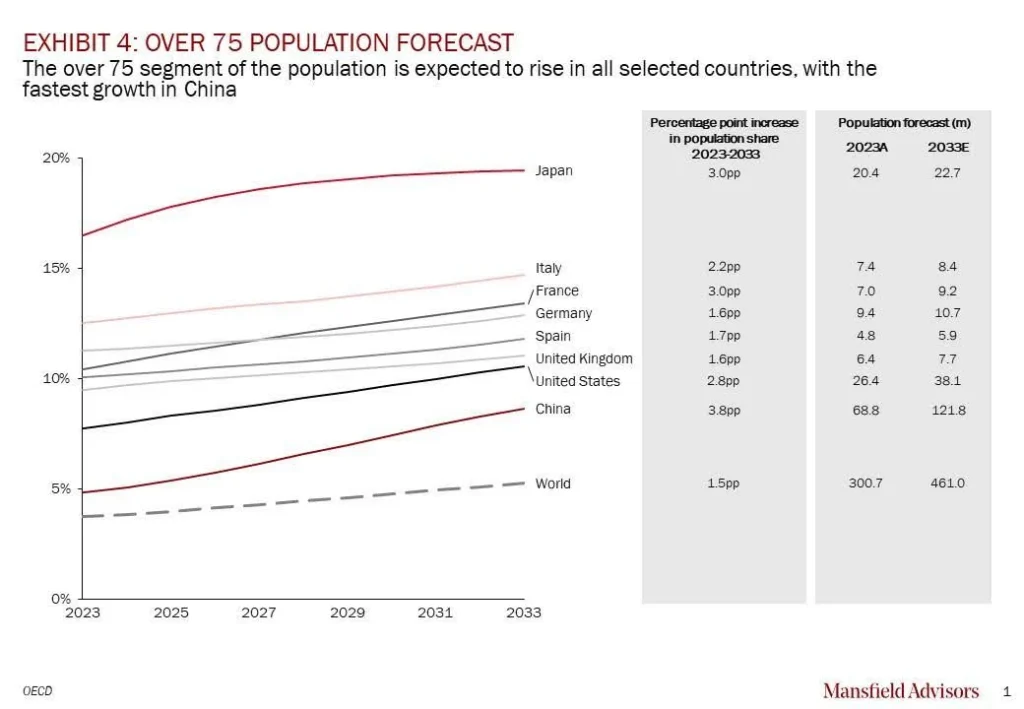
The DME sector is forecast to grow at 5-6% CAGR to 2030, largely driven by demographic changes globally, including increases in chronic disease prevalence. The Organisation of Economic Co-operation and Development (OECD) projects the global 75+ population will reach ~461m by 2033, half as much again as the time of writing in 2023. Asia will see the fastest growth, particularly China and Japan. Southern Europe is seeing similar growth, and though the United States is growing more moderately, it will continue to be the largest market.
The population over 75 largely determines the need for medical care, but it is the eldest of them who might potentially need residential care. Home care – delivered into their home by a visitor – can pre-empt this need but often some adaptation to the bathroom or perhaps kitchen is needed to support this. Long term home care is cheaper than residential care since the public payor is always then paying for accommodation element as well. Even for an individual reliant on public support, the accommodation would have been paid for by a separate central budget in a country like the U.K, so the local authority payor is incentivized further to support individuals to remain at home.
Nick Parsons, CEO of AKW Medi-Care, estimates the cost of installing an accessible bathroom to be between £5,000-£10,000. We estimate the average weekly fee for residential care is £740. If the person receives ~£280 of home care per week, then effectively the difference is a return on capital expenditure. If the person is able to stay at home for an extra year, the savings would be between £14,000 and £19,000 over that year. Moreover, if it is a social housing property, the adapted property can provide the same benefits to another person with accessibility needs, increasing the rate of return for any adaptation. Care Management Matters research argues that by 2035 there will be a shortfall of 58,000 care beds across the sector, so providing care into people’s homes is an essential way to make the available infrastructure match the demand.
The shift to caring for people at home expands beyond elderly care, with virtual wards being developed as a major part of the NHS plan to increase capacity. Virtual wards support patients, who would otherwise be in hospital, to get the acute care, monitoring and treatment they need in their own home. These will be provided by the NHS in partnership with trusted third-parties, such as Sciensus which has signed a substantial contract to provide virtual ward services, including healthcare professional home visits, and a 24-hour clinical advice service. Virtual wards are technologically-enabled, with wearables reporting continuously monitoring and sending vital signs to a dashboard for clinical teams. Some cases of virtual wards will also require DME such as bed rails and bathroom safety adjustments.
Conclusion
The DME market has strong and robust market drivers in demographic changes, with ageing populations, and the growing prevalence of chronic diseases. The trend towards personalised care solutions is enabling the industry to cater to a wide variety of individual needs, and the increase in homecare further broadens the range of products and services demanded. It may be easy to assume that DME are commodities, but there are always efficiencies to be gained and new niches to be filled through thoughtful product design, effective engineering and streamlined manufacturing.
New developments in the market is driven by new technological developments, including in motorised wheelchairs, but now more remote care, wearables and the ‘internet-of-things’. One example of this is smart hospital beds that use wireless sensor networks to avoid bedsores and have the potential in the future to send data straight to the doctor.
Management and servicing of DME is another opportunity as it gives long-term recurring revenue and relationships with customers that facilitate cross-selling. Medstrom providing a ‘total bed management’ service to the NHS creates an opportunity for adjacencies in bed management software or ‘smart beds’ technology.
There is no way but up for demand of personal mobility devices, home adaptation equipment and medical furniture as the population ages and expects more personalised care; and this durable market holds even more opportunity if digital equipment and services are developed alongside it. To be successful in this market it is essential to focus on the needs of the product users; purchasers focus on ease of installing/maintaining and price, but ultimately products that enhance their users’ lives are the ones that sell.
The winners in this segment are able to deliver a personalised product – designed for best outcomes and at a competitive price. It further requires a combination of both scale in breadth of product portfolio and geographic reach and then quality of execution to achieve outperformance in growth.
Related Insights
Lorem ipsum dolor sit amet, consectetur adipiscing elit, sed do eiusmod tempor incididunt ut labore et dolore magna aliqua.


