


It was reported in December that Outcomes First Group, the largest independent special education provider, is to be acquired by TPG’s The Rise Fund and Investcorp from Sterling Square Capital. This deal separates the Groups’ special education and children’s home divisions, Acorn Education and Options Autism, from the fostering division, NFA. Clearly, there is continued interest in the ~£2.2bn independent special education sector, but what drives value for investors in a children’s services market that some consider carries too much reputational risk?
Trends
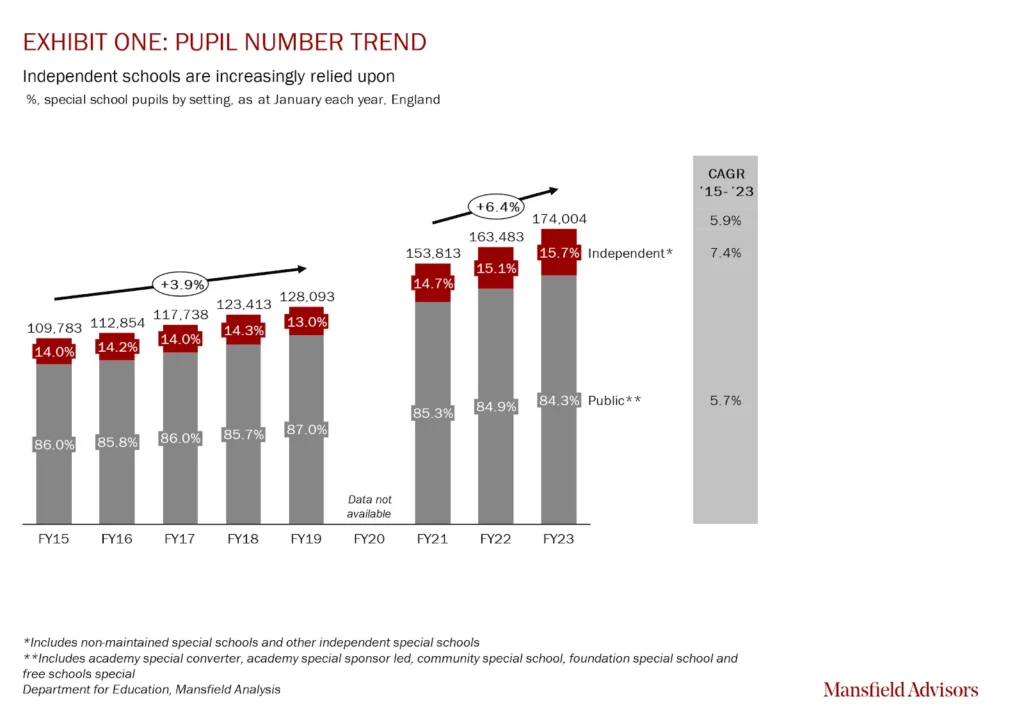
Total demand for special education continues to rise, with the independent sector increasingly relied upon. There are currently around 174,000 students receiving support within special schools and colleges in England, up from ~110,000 in FY15 at 5.9% annual growth in specialist learning environments over that period. Independent sector provision has grown at a faster rate than the public sector, at 7.4% CAGR versus 5.7%. And the rate of increase has quickened since the Covid pandemic with a 9.8% CAGR in the independent sector from FY21 to FY23.
Sector growth was spurred on following the introduction of the Childrens and Families act in 2014 where Statements of Special Educational Needs were replaced with Education, Health, and Care Plans (EHCP), offering a more comprehensive approach and extending local authority support to age 25. The independent sector’s gain in market share is due to the dynamism and specialisation it offers. Independent providers can be more agile, responding to changing trends and creating new capacity. This is combined with a rise in the complexity of individuals. The independent sector is more specialised and is typically used for higher needs students, fill needs which the public sector struggles to meet.
Funding for both the public and independent sectors is through local authorities and is secure. Pupils and students with significant Special Educational Needs and Disabilities (SEND) support, aged 0 to 25, are funded through the high needs budget within the Dedicated Schools Grant (DSG). Introduced in 2013/14 before the 2014 SEND reforms, the high needs budget is not ring-fenced giving local authorities discretion to spend within or beyond budget limits to meet their SEND statutory duties; there is typically an overspend. The DSG covers funding for both mainstream and non-mainstream education settings, with the High Needs Block being the major source of funding for students with EHCPs.
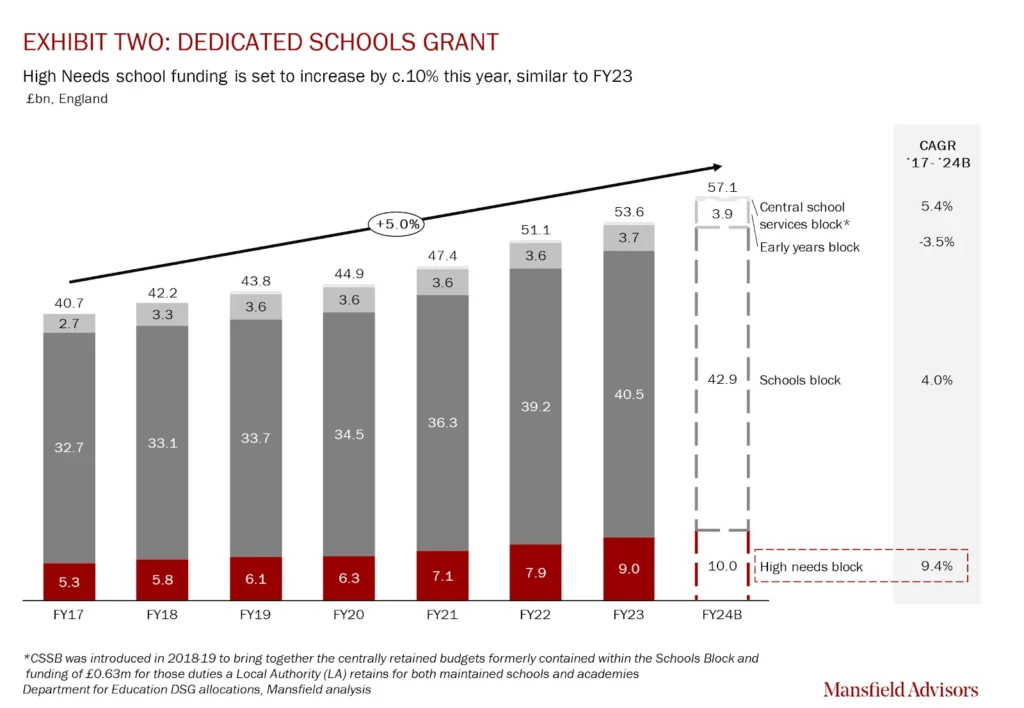
Funding has been growing at a faster rate than placement numbers. There has been a significant increase in the High Needs Block and high needs expenditure, with a notable 8.7% CAGR in expenditure from FY16 to FY22. This is well above the overall local authority expenditure growth of ~3% CAGR and reflects both the increase in demand, but also the protected nature of special education funding. While not ring-fenced, it is not exposed to the same cuts as other areas of spending, such as culture which has seen negligible growth over the same period. Independent providers have seen the fastest growth (11.3% CAGR FY16 to FY22), and expenditure is budgeted to continue rising at similar rates. It is worth noting that expenditure on the independent sector has consistently been over budget recently.
Per student spending on the independent sector is on average approaching three times higher than the public sector spend, reflecting the higher needs of the students. The independent sector represents 15.7% of all pupils and students attending special schools and colleges in England, accounting for an estimated 26.5% of the total high needs expenditure. This higher ‘unit spend’ on high-needs education in independent sector facilities compared to the public sector is due to the level of needs of the students. Independent sector schools typically cater to students with the most complex needs and provide more residential accommodation, leading to higher staffing ratios and overnight staffing support.

Demand and funding trends do not show any signs of slowing, however overall local authority budgets are clearly under strain. This does raise concerns over how long growth of this level can be sustained. With the expectation of a change of government this year, it is unclear how Labour will respond. We expect to see a continuation of current trends, but perhaps a greater scrutiny of costs and delivering value. In that case, good providers that can demonstrate superior outcomes will be best placed.
While the independent children’s care sector has been subject to high scrutiny recently, this is not likely to have a significant impact on providers in the special education sector. The Children’s Commissioner for England, Local Government Association, Competition and Markets Authority along with an independent review, discussed dysfunctional markets, excessive profits, and the risk of disorderly departure due to high provider debt. Although the independent review recommended a windfall tax on large for-profit providers, the Government rejected it, citing concerns about deterring investment. Instead, the Government proposed a financial oversight regime for major providers to enhance transparency and prevent sudden market exits. This could benefit financially stable providers by signalling to commissioners their long-term stability.
Increasing step-downs is also a trending topic. The SEND Review highlighted that the Government plans to incorporate a new mandate into the EHCP review process. This includes considering and documenting whether transitioning to targeted support and discontinuing an EHCP is more suitable for addressing the needs of a child or young person. Step-down could benefit the availability of funding for the system. However, there are complications associated with stepping down a child with specialist needs, such as taking them out of an environment they are already settled in. According to a NASS survey of schools, some level of ‘step-down’ could be possible for a number of pupils with SEND but a relatively low proportion of students who could step down actually do. 21 of 43 NASS school survey respondents said that only 1-10% of their learners tended to be stepped down. With the independent sector catering to higher needs students, it is unlikely that these will be ideal candidates for stepping down.
Market Activity
Specialist education has attracted private equity interest, leading to the formation of many large-scale independent providers, some of which have gone through multiple rounds of private equity. Investment strategies often involve roll ups of smaller providers and integrating services such as fostering, residential care and adult care, but it is not yet clear where the greatest success can be seen.
Adopting an integrated approach to services is thought to offer opportunities for independent sector providers to develop innovative, efficient and effective services. It was thought larger providers offering combined services across fostering, residential homes and special education would benefit from a focus on holistic care. Despite achieving some success persistent challenges emerged, particularly in establishing uniform care models for transitioning from children to adult services. There is difficulty coordinating between commissioners of children’s and adult social care, along with notable funding disparities. We are now seeing an undoing of this integration in recent transactions.
Following the acquisition of The Priory Group by Waterland Private Equity the children’s services division was spun out as a standalone business, Aspris, and subsequently merged with Sandcastle Care, another of Waterland’s portfolio assets. Now Stirling Square Capital has sold Outcomes First Group without its fostering business, NFA, at a reported $1bn valuation, 10.6x the £75m LTM EBITDA.
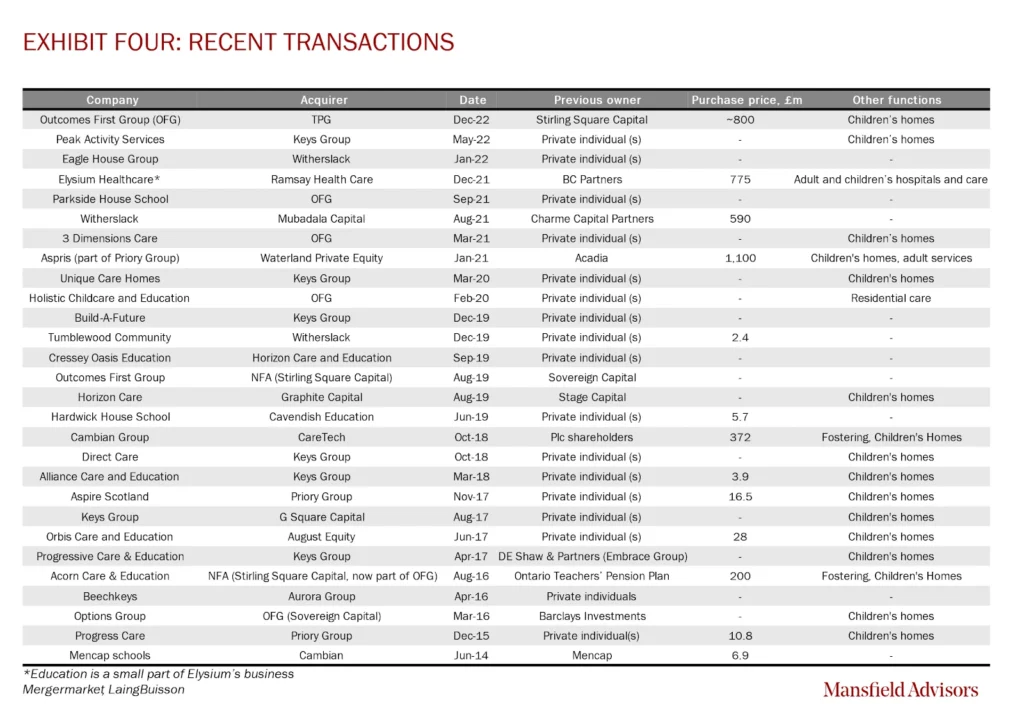
Historically, a majority of investment activity was bolt-on acquisitions from scale providers, such as Keys Group which has made six acquisitions since 2017. Following this consolidation we are now seeing these scale providers transacting such as the aforementioned Outcomes First Group, and Witherslack which was acquired by Mubadala in 2021 for ~£590m from Charme Capital Partners.
It was widely reported throughout 2022 that Graphite Capital intended to sell Compass Community off an EBITDA of ~£20m. Graphite is a serial investor in the children’s sector, also owning Horizon Care and Education, a specialist education and residential business, and Storal, a nurseries group. Recent transactions may trigger Graphite and others to reconsider selling.
Seeing through the risks
It is no secret that investment in specialist education is avoided by some, viewed as a sector with potential for reputational risk. Clearly recent activity proves that some see past this. Selecting the right asset can reduce much of this risk and implementing the right governance and protocols can mitigate further.
Assets that offer a high standard of education and quality of care to pupils carry significantly lower reputational risk. As such, investors should seek out assets with high Ofsted ratings; 83% of independent sector provision is rated Good or Outstanding, providing ample suitable targets. While this is lower than state provision, which has 92% of provision rated Good or Outstanding, it reflects the challenges of the high needs children the independent sector focusses on. This only reinforces the need to invest in a high-quality platform.
We have previously written about regulator concerns around children’s social care. In short, there was alarm over the criticism of the independent sector’s role in children’s services, however the government recognises the need for investment in the sector and proposed greater financial oversight rather than financial penalisation. Independent special schools, regardless of whether they include residential services, were not the focus of the investigations or the proposed changes and so we do not see a risk to providers here.
There are moves towards integrated systems across health and care, for example with Regional Adoption Alliances for foster care. There is a possibility that a push to regional commissioning in education could change the commissioning dynamic and increase pressure on independent providers. However, this risk is low; the infrastructure is not in place and the responsibility for commissioning of education still lies with local authorities. Ultimately independent providers are commissioned to meet a need that the public system is unable to internally. So, the commissioning status quo is likely secure, and any marginal changes would favour larger providers.
Another possibility in the future is a greater focus on improved outcomes by commissioners. The SEND Green Paper suggests local authorities should track performance more thoroughly through a dashboard of key metrics. This should be seen as an opportunity for good independent providers to differentiate themselves, attract more placements and justify fee rates.
Talking about the challenges in social care sadly would not be complete without mentioning staffing. In their annual review of Education, Children’s Services and Skills of 2021/22 Ofsted recognised the recruitment of qualified staff such as carers and teaching assistants to be difficult and that this was a major issue facing the wider sector. These challenges continue to face providers, though the best have proven it is possible to manage staffing well.
Opportunity
Despite the positive demand and funding trends, and the rate of new capacity being added, there is still a growing number of students awaiting placement. Schools are believed to be becoming increasingly full, though robust occupancy data is not available it is clear that the increase in demand is outstripping the increase in supply providing a clear opportunity for investors to meet this gap.
Newly developed capacity is being utilised and there is a mechanism for funding the places. In response to the increased outsourcing to the independent sector, the rate of capacity development by private providers has risen. Between 2013 and 2015 there were 2,814 new independent school places while between 2019 and 2021 there were 4,886 places added. This continued investment from private providers to meet the growing demand is being utilised once developed. The high needs funding mechanism gives local authorities the ability to spend over budget to meet SEND support needs and fund more placements.
Furthermore, there is also a consolidation play to be made. While we are now seeing the large groups transacting, special education remains less consolidated than foster and residential care with plenty of small-scale providers that can be acquired in a ‘buy and build’ strategy.
Finally, the specialist education sector, though not immune to the broader economic challenges society is facing, is more protected than most. While many have a positive outlook for this year, the last few years have proven nothing is certain. Investing in the specialist education sector not only offers some shielding from wider economic downturns, but also the potential for good return through the robust demand increases for those with an appetite to look beyond the perceived risks.
Related Insights
Lorem ipsum dolor sit amet, consectetur adipiscing elit, sed do eiusmod tempor incididunt ut labore et dolore magna aliqua.


