


Occupational health (OH) has become a hot topic in recent years, driven by a tight labour market, a strained NHS and higher long-term sickness rates following the pandemic. Employee health and wellbeing is now even higher on the corporate agenda which has spurred market growth and investor activity. Ali Bahram, Engagement Manager, and Adam Scott, Senior Partner, at Mansfield Advisors, explain key market trends and how investors are viewing the space.
The occupational health (OH) market in the UK is loosely defined due to a lack of strict legislation
There is no specific requirement in the UK for employers to procure or provide OH services. As a result, approximately 50% of employees lack access to these services, primarily due to the challenge of demonstrating a tangible return on investment. A key debate is whether the UK should emulate comparable European countries, such as France and Germany, where legal mandates require employers to provide OH services. Intuitively, employers valuing OH more highly should lead to a healthier and more productive workforce, assuming other factors remain constant. However, this is an oversimplification of a complex issue influenced by factors like working culture and healthcare provision.
Increasing OH provision in the UK, potentially through legal mandates, will be a focus of one of the consultations launched by Chancellor Jeremy Hunt as part of the 2023 Spring Budget, among other favourable measures for the sector. Positive political sentiment, along with strong fundamental growth drivers, has spurred an increase in transaction activity in recent years, including investments from both strategic players and private equity firms. We believe a Labour government would ultimately be positive for the sector owing to greater emphasis on workplace wellbeing and an increase in healthcare spending.
The undefined boundaries of OH services lead to significant overlap with adjacent sectors, such as primary care, healthcare insurance, income protection, and safety and compliance. This overlap explains why corporates like Spire Healthcare (private hospitals), Marlowe (compliance), and Bupa (health insurance) offer OH services.
The key bodies involved in OH in the UK include the Health & Safety Executive (HSE), the Faculty of Occupational Medicine of the Royal College of Physicians (FOM), the Society of Occupational Medicine (SOM), and the Safe Effective Quality Occupational Health Service (SEQOHS). Despite these organisations’ involvement, there is no clear oversight, and each has its own definition of OH. Acknowledging the diversity in these definitions, we have adopted an encompassing view of OH as the interaction between health and work.
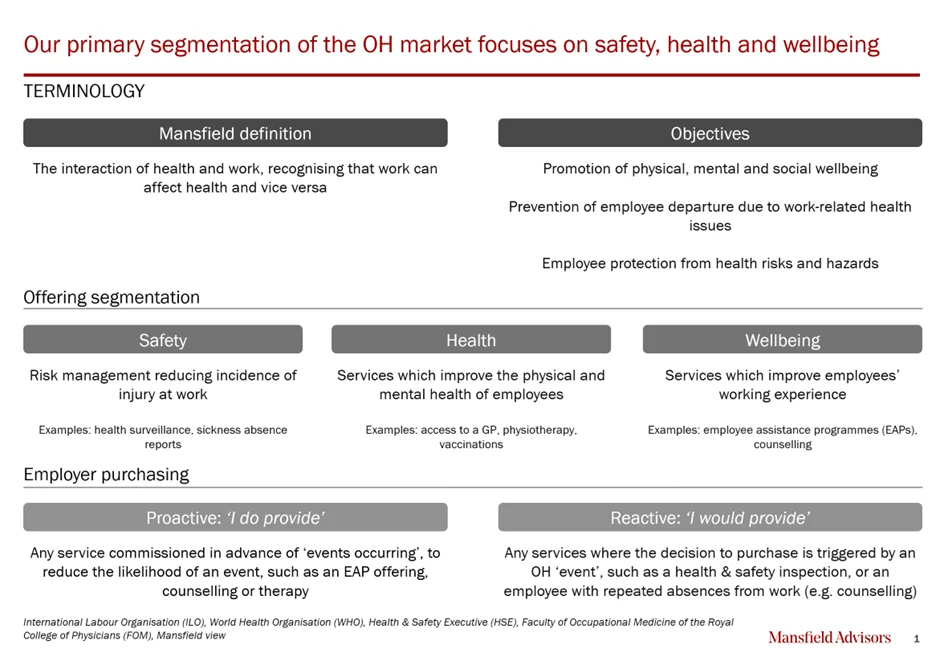
In Figure One, we segmented the market based on the type of offering and how employers typically procure services. While not all OH services fit mutually exclusively into our three categories – safety, health, and wellbeing – this classification provides a useful framework for understanding the objectives of different services. A notable trend is the growth in the wellbeing segment, which addresses the rise in work-related mental health issues, now one of the leading causes of long-term sickness absence.
Regarding OH procurement, employers can be categorised as either proactive or reactive. Large employers, with 250 or more employees, have high OH penetration and tend to be proactive, incorporating OH provision for various reasons. These include acknowledging the return on investment and fostering a reputation as a forward-thinking employer committed to workforce wellbeing, which helps attract and retain top talent. In contrast, OH penetration in small and medium-sized enterprises (SMEs) is only at 10-20% (of employees) as these employers are typically reactive. Even if SMEs recognise the potential return on investment, the complexity of purchasing OH services leave many uncertain about where to start. This challenge was highlighted by the Department for Work and Pensions’ (DWP) Advice Lines initiative launched in 2009. Through this initiative, employers could access free advice to navigate the unclear OH landscape and were often directed to OH providers.
Figure 1
A ~£900m market underpinned by strong growth fundamentals and now with ~10 providers of scale
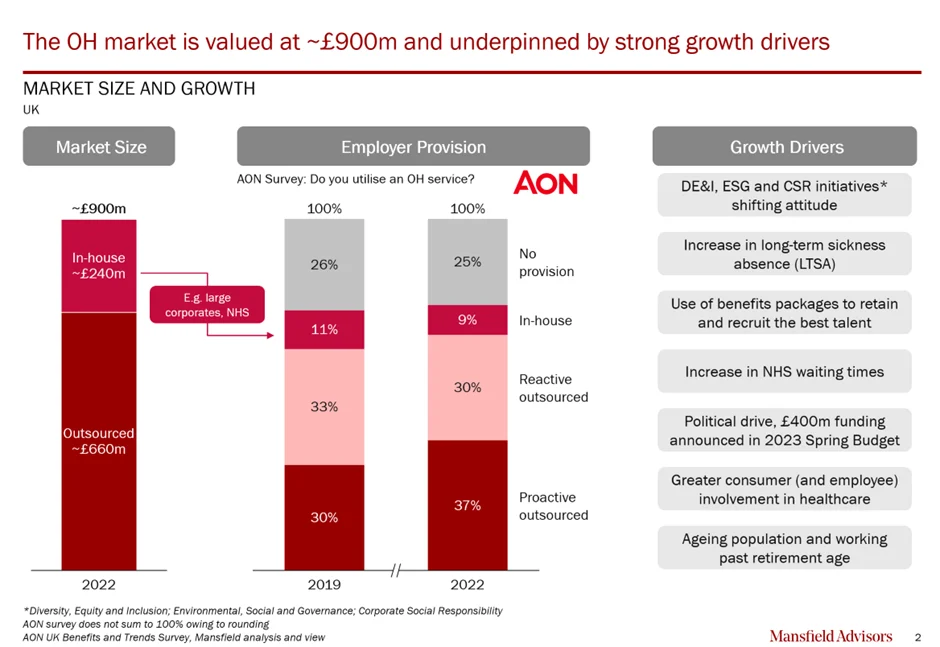
From our analysis, we have valued the 2022 OH market at approximately £900m, as shown in Figure Two. Of this, outsourced services account for ~£660m, representing ~75% of the total market. According to the AON annual Benefits and Trends Survey, a trend towards increasing OH penetration and a shift from in-house provision to outsourcing is evident. The decline in in-house provision is attributed to various factors, including cost efficiency, expertise and flexibility.
Underpinning the market are strong growth drivers, such as the rise in corporate responsibility, the use of benefits packages for recruitment and retention, and record-level NHS waiting times. The OH market shows notable similarities with the private medical insurance (PMI) market, which currently has the highest number of policyholders since 2008 and growth is expected to continue. OH sector profitability (EBITDA margin) has grown by ~5pp to ~15% since the pandemic largely due to the rapid increase in online and telephone consultations, enabling significant time and cost savings.
Providers are also exploring how artificial intelligence (AI) can further enhance services, such as improving employee assistance programmes and increasing clinician efficiency. Overall, we anticipate that providers will continue to leverage scale and new technologies to increase profitability and we project that market growth will be in the mid to high single digits over the next five years.
Figure 2
The largest OH provider is publicly-listed Marlowe (LSE:MRL) whose strategy is to be a one-stop-shop provider in the regulated safety, compliance software, and services market. Its major shareholders include Octopus Investments, Capital Research Global Investors, and Slater Investments. Since its founding in 2015, Marlowe has expanded aggressively through M&A, initially starting in water treatment and fire safety. Its OH acquisitions include Optima, Healthwork, TP Health, and many smaller platforms. Marlowe has managed to realise synergies beyond cost savings as acquisitions broaden its OH service offering and serve customers across different markets that may require specialist expertise. In addition, Marlowe leverages its position to cross-sell OH services to its existing customer base, thereby enhancing customer value and deepening client relationships. Marlowe’s revenue from OH services is now approximately £120m, contributing to a total revenue of £466m in the fiscal year 2023. The group’s EBITDA margins have seen year-on-year growth, now at ~18%.
The second-largest provider is Bupa Occupational Health, with revenues of around £85m. As a leading PMI provider, Bupa leverages its ability to cross-sell OH to existing insurance customers. While there might be some inter-company accounting affecting margins, Bupa’s historical organic revenue growth has been robust at mid-single-digits.
Table 1

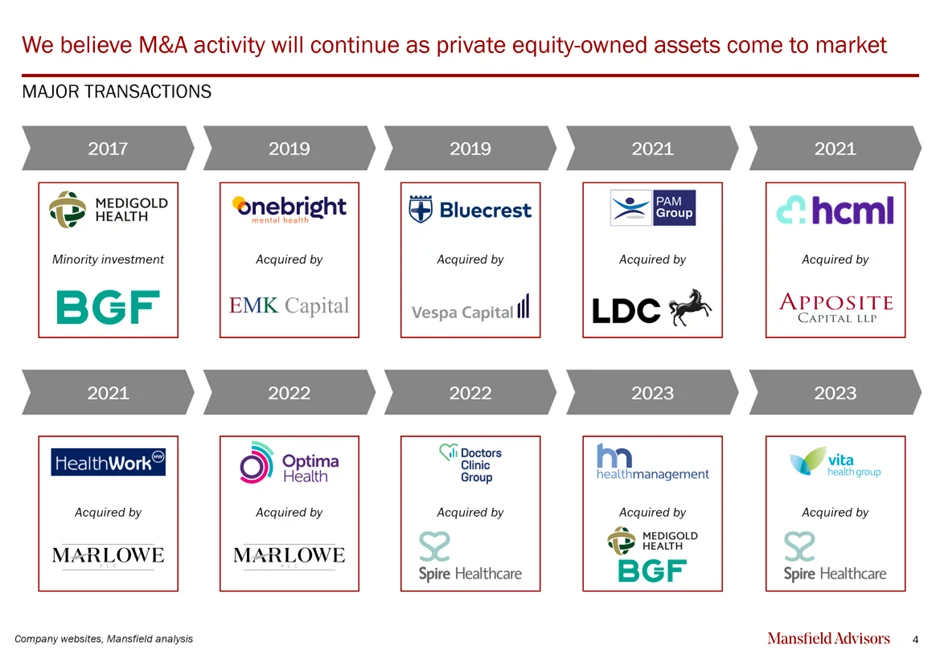
In recent years, the OH sector has seen significant interest from private equity, contributing to its consolidation. In 2017, BGF made a minority investment in Medigold and supported with the acquisition of Health Management last year. The combined platform is now the third-largest player with revenues of ~£65m. LDC’s investment in PAM Group in 2021 has led to notable acquisitions, including MedProtect, Connect Health’s occupational physiotherapy business, and Corporate Health Ireland. With all the acquisitions, we estimate PAM Group’s revenue to be at ~£50m.
Vespa Capital acquired Bluecrest Wellness in 2019, a provider specialising in screening tests. Since the acquisition, the focus on organic growth has led to a double-digit revenue CAGR now totalling ~£30m. Apposite Capital’s acquisition of HCML in 2021 mirrors LDC’s acquisitive strategy. HCML, primarily focusing on case management, also offers occupational health services, especially following its acquisition of Healthcare RM. In 2019, EMK Capital invested in Onebright, a mental health-focused player, which recently acquired Psicon, a rapidly growing neurodevelopmental assessment provider. Other providers with OH as part of their broader offering include Ascenti (backed by BD-Capital), HealthHero and GoodShape (both backed by Marcol).
Outside of private equity, the sector has attracted interest from private hospital groups such as HCA and Spire Healthcare. HCA entered private primary care and OH in the UK in 2011 with the acquisition of Roodlane Medical. Spire Healthcare, announcing its diversification strategy in 2022, acquired Doctors Clinic Group and Vita Health (previously owned by Archimed). With consumers increasingly taking healthcare into their own hands due to diminishing trust in the NHS, private hospital providers are seeking more control over patient flow. Beyond Spire Healthcare and HCA, Nuffield is pursuing a long-term wellness strategy with its gyms and Circle has launched its private hospital membership subscription app (MyWay). The trend towards a broader and integrated healthcare offering is evident, hence the growing interest in the OH sector.
Figure 3
Sickness absence is at a 10-year high
In 2022, the UK witnessed a significant increase in workplace absences, with approximately 186 million working days lost. This amounts to an average of nearly six days of absence per employee, the highest per-worker absence rate since 2004, and the largest overall figure since such records began. This trend marks a concerning shift from the steady decline in sickness rates observed since the 1990s, a decline that had stabilised before the pandemic. Employees in the public sector averaged over two weeks of sick leave, a rate significantly higher than that of private sector employees. Larger organisations also reported higher absence rates compared to SMEs.
Figure 4
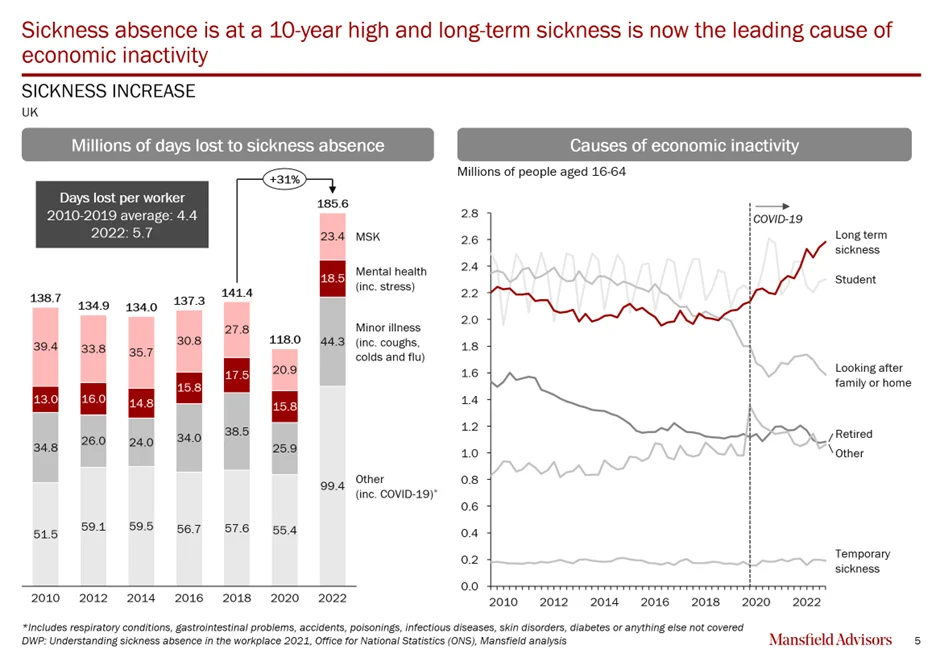
The primary explanation for the increased workplace absence in the UK is COVID-19. In 2022, nearly 10.5 million confirmed COVID-19 cases were recorded, and approximately 2 million individuals are still experiencing persistent symptoms of long COVID. In contrast, days off due to musculoskeletal (MSK) issues, such as back and neck pain, decreased by 5 million from 2019 to 2022. This decline is partly attributed to proactive employer interventions and adaptations in workplace ergonomics. Meanwhile, mental health-related issues, including stress, continue to rise. A survey by the Chartered Institute of Personal and Development (CIPD) revealed that 76% of organisations reported incidences of stress-related absences, often linked to heavy workloads.
Additionally, the UK has seen a significant increase in individuals who are economically inactive due to long-term sickness, reaching an unprecedented level. Initially, this trend was thought to be a result of the so-called ‘great retirement’ during the pandemic, where older workers left the workforce by choice. However, it is now clear that long-term illness is also a contributing factor.
Following the introduction of lockdown restrictions, a rise in economic inactivity was a common trend across all G7 countries. However, unlike other nations, where this trend has largely reversed, the UK continues to experience an upward trajectory in economic inactivity. The most significant growth in inactivity is observed among individuals over 50, with approximately 1.4 million people, or ~55% of those economically inactive due to long-term sickness, aged between 50 and 64.
Furthermore, among those marked as economically inactive due to long-term sickness, nearly two-fifths (38%) reported experiencing five or more health conditions, an increase from 34% in 2019. This data indicates a prevalence of complex and interrelated health issues within this demographic. Notably, over 1.3 million (around 50%) of these individuals identified mental health conditions such as depression and anxiety, with the majority indicating these as secondary health conditions. The primary health concern remains musculoskeletal issues.
Considering the various causes of absence, how should OH providers position themselves?
As previously mentioned, the intricate nature of procuring OH services is driving a trend towards one-stop-shop providers that comprehensively cater to the full spectrum of businesses’ OH needs. This is true for both SMEs and large organisations. Employers who previously used multiple OH providers are now consolidating their procurement. The expansion of service offerings, beyond just scale advantages, is a key reason behind the market consolidation. A prime example is Medigold’s 2017 acquisition of Hampton Knight, a specialist in alcohol and drug testing.
The underpenetrated SME segment represents significant growth potential. Historically, this market was not the primary focus, as OH services originated in industries like coal mining and manufacturing, with smaller offices receiving less attention. Considering that SMEs are generally more price-sensitive, OH providers are adopting a retainer and fee-per-service model. The demand for OH services within SMEs, as evidenced by the DWP’s Advice Lines, suggests that OH providers need to carefully consider their approach to marketing and the steps involved in the purchasing process.
Recruiting and retaining clinical staff remains a challenge across all healthcare services firms, with demand increasing faster than the supply of clinicians. Understanding the staffing situation in the NHS is crucial, as many clinicians ironically switch to private for better working conditions and higher pay. The NHS’ Long Term Workforce Plan, published last year, aims to increase the number of occupational therapists from approximately 18,000 to about 30,000 by 2037. This increase is driven by a planned 30% rise in annual training places by 2031. While the NHS has faced criticism regarding the feasibility of its targets, it has nonetheless acknowledged these shortfalls.
Conclusion
As we look ahead, demand for occupational health (OH) services will continue to increase signalling a strong period for providers in this sector. The market is also expected to see continued consolidation as OH providers broaden their service offerings. Furthermore, the involvement of larger healthcare players indicates a shift towards more integrated health services, blending occupational health with broader healthcare provision. Ultimately, the market’s positive trajectory is set to offer employees more comprehensive and tailored OH provisions, leading to improved workplace conditions and health outcomes.


