


Why is now a good time to invest in CDMOs, and where should you invest?
Outsourcing of clinical research, development and manufacturing by both large and small-scale pharmaceutical companies has continued to outpace overall pharmaceutical industry growth since our last review in 2021. While traditional underlying drivers remain strong, including access to specialist expertise and technology (exacerbated by treatments becoming more complex), cost advantages and a greater focus on innovation and marketing amongst big Pharma, significant recent developments have taken place that strengthen the case for investment in outsourcing. These developments featured extensively in presentations and discussions that our team attended at CPHI Frankfurt 2022, and include new pricing pressure in the US, a progressively urgent need for biologics manufacturing capacity, and increasing sector-wide focus on sustainability. While these trends are strengthening tailwinds across sub-segments (CROs, CDMOs and CPOs), they are also reshaping competitive dynamics and hence presenting new opportunities for players to differentiate and succeed. Investors are likely to play a significant role in how the sector evolves over the next five years as the implications of these developments are realised, given capital investment and careful strategic planning will be required to grasp these opportunities. Indeed, Private Equity interest has accelerated sharply in recent years, with 10 European transactions in 2022 including Clinigen (Triton), Biofarma (Ardian) and Corden Pharma (Astorg) compared to 6 in 2019 (Table One). A number of investments like Airnov (CPO), KD Pharma and Ardena (CDMOs) will also be reaching maturity over the next two years.. In this article, we review the key opportunities for smart investors to enter and influence this space.

US pricing control legislation has strengthened outsourcing trends by emphasising the need for speed to market and cost reduction
Developments in the US market, as a consequence of the Inflation Reduction Act passed in 2022, are reinforcing the already-substantial trend towards outsourcing. The Act outlines a new process by which Medicare pricing rates (which made up ~30% of drug spending in 2020) can now be more aggressively negotiated on high-revenue branded drugs, with the first set of negotiated prices to come into effect in 2026. Pricing with commercial payors is also likely to be impacted as markets generally use the Medicare rate as a benchmark. In practice, new small molecule drugs will be subject to pricing competition after 9 years from FDA approval, and biologics 13 years, compared to existing periods of pricing exclusivity (based mainly on patent protection) of ~14 and ~21 years respectively– effectively a ~35% and ~40% decrease in ‘high price’ market conditions.
Consequently, pharmaceutical companies expect lower total lifetime revenues from successfully launched future products, with two key implications. Firstly, there is a renewed focus on speed-to-market for new molecules given the increased value of each year of potentially ‘high-price conditions’ that passes during development and commercialisation. Secondly, there is increased pressure to reduce variable costs both before and after Medicare price negotiation to maximise margins and maintain returns on R&D. We believe both of these implications will contribute to future outsourcing growth, which is already strong given over 50% of biopharma companies planned to increase outsourcing spend when budgeting for 2022 (Figure One). CDMOs and CROs are able to leverage specialist expertise to deliver faster times-to-manufacturing, from clinical trial processes up to commercialisation, as well as more cost-efficient manufacturing at full production scale. Additionally, high capacity CDMOs (the number of which is increasing) allow better economies of scale, keeping costs lower than attempts to develop new manufacturing capacity in-house.
From the perspective of a services provider market tailwinds will be strengthened. However, being able to accelerate development and offer rapid scale-up will be essential, in addition to traditional ‘must have’ factors of quality and confidentiality, if firms wish to capitalise on this. CDMOs will be expected by potential customers to leverage scale economies and deliver cost-effective development and manufacturing services over efficient timelines. Investors should view this as an opportunity to develop a specialised, dependable, highly-responsive platform playing into these new competitive forces.
The shortfall in biologics manufacturing capacity offers a clear opportunity in a high-growth segment
In our previous APIs article, we noted the biologicals sector, currently around 40% of CDMO API revenues, is growing faster than small molecules (11% vs. 9% CAGR, respectively). Indeed, the global biologicals CDMO market is now at ~$16bn, expected to reach ~$25bn by 2026. However, servicing this rapidly growing demand requires smart, proactive investment.
A large part of this outsourcing demand growth will be driven by the need of pharma companies for biologics manufacturing capacity. Internal modelling from Samsung Biologics, presented at CPHI, indicates biologics demand is due to outstrip capacity by 2026 (Figure Two). More pressingly, global demand hit 75% of supply available in 2021, and this year is forecast to cross the 80% demand-supply ratio which industry experts view as a tipping point. Pharma companies therefore need to invest now to mitigate the risk of future biologics capacity shortages. However, building capacity in-house can cost upwards of ~$500m per plant upfront, takes up to four years, and requires recruitment of specialised staff. Many pharma companies lack the expertise, supply chain robustness and high speed of execution that increasingly complex biological development requires. Consequently, big pharma are increasingly favouring acquiring or partnering with CDMOs to address the capacity shortfall, driving rapid market growth.
However, the nature of this outsourcing demand in biologics is also evolving. Pharma firms are outsourcing at progressively earlier stages of product development, which makes it increasingly important for them to ‘lock in’ a supplier at the research and early development stage to continue into later-stage manufacturing. This minimises the number of tech transfers needed, which are both expensive and take up to two years to execute. Therefore, clients now prefer CDMOs not only with the right capabilities and technology for biologics manufacturing, but also capacity to scale up. Additionally, this scale-up must be able to occur at a more rapid rate, with the number of accelerated approval submissions doubling over the last few years, and typical biologics development timelines reducing by 35-70% according to McKinsey estimates. Consequently, CDMOs are investing in new plants to guarantee this, for example Sterling Pharma (backed by GHO Capital) recently completed the acquisition of a manufacturing facility in Ireland (for both small molecule and antibody-drug conjugate production). McKinsey analysis indicates CDMO players have already increased biologics capacity from ~1.5ML in 2020 to ~1.9ML in 2022, demonstrating the increased capital risk CDMOs are now willing to take. This affords them better negotiating positions with big pharma, aligning with their needs to ramp up capacity quickly and provide it long term when needed. It also emphasises the advantages for larger CDMO players discussed previously.
TABLE ONE: EUROPEAN PHARMA INVESTOR ACTIVITY
| Asset Type | Name | HQ Country | Majority Owner | Month Transacted | Hold Time (as of Jan ’23) |
| CDMO | Sterling Pharma Solutions Limited | UK | GHO Capital | Feb 2019 | 3 years 11 months |
| CDMO | Sintetica | Switzerland | Ardian | May 2019 | 3 years 8 months |
| CPO | Airnov | France | Arsenal Capital Partners | Jul 2019 | 3 years 6 months |
| CRO | Quotient Sciences Limited | UK | Permira | Jul 2019 | 3 years 6 months |
| Integrated | Pharmanovia | UK | Triton | Aug 2019 | 3 years 5 months |
| CDMO | DFE Pharma | Germany | CVC | Sep 2019 | 3 years 4 months |
| CDMO | KD Pharma Group | Switzerland | Capiton | Oct 2019 | 3 years 3 months |
| CDMO | Ardena Holding NV | Belgium | GHO Capital | Jan 2020 | 3 years 0 months |
| CDMO | Pharmazell | Germany | Bridgepoint | Feb 2020 | 2 years 11 months |
| CDMO | Genetic | Italy | CVC | Jul 2020 | 2 years 6 months |
| CDMO | Recipharm | Sweden | EQT | Feb 2021 | 1 year 11 months |
| Integrated | Advanz | UK | Nordic Capital | Jun 2021 | 1 year 7 months |
| CDMO | Pharmathen | Greece | Partners Group | Jul 2021 | 1 year 6 months |
| CDMO | Adragos Pharma | Germany | FSN Capital | Sep 2021 | 1 year 4 months |
| CDMO | Suanfarma | Spain | ArchiMed | Nov 2021 | 1 year 2 months |
| CDMO | HTL Biotech | France | Montagu | Nov 2021 | 1 year 2 months |
| CDMO | Seqens | France | SK Capital Partners | Dec 2021 | 1 year 1 months |
| CDMO | Biofarma Group | Italy | Ardian | Jan 2022 | 1 year 0 months |
| Integrated | Theramax | UK | Carlyle; PAI | Mar 2022 | 10 months |
| CDMO | Mipharm | Italy | Alto Partners | Mar 2022 | 10 months |
| CDMO | Upperton | UK | Inflexion | Apr 2022 | 9 months |
| CRO; CSO | Clinigen | UK | Triton | Apr 2022 | 9 months |
| CDMO | Corden Pharma | Germany | Astorg | May 2022 | 8 months |
| Logistics | Envirotainer | Sweden | EQT | Jun 2022 | 7 months |
| Integrated | DOC Generici | Italy | TPG | Jun 2022 | 7 months |
| Integrated | Havea | France | BC Partners | Jun 2022 | 7 months |
| CRO | Avania | Netherlands | Astorg | Jun 2022 | 7 months |
| CDMO; CPO | Steripack | Ireland | Inflexion | Jul 2022 | 6 months |
| Medcomms | OPEN Health | UK | Astorg | Jul 2022 | 6 months |
| CDMO | Kedrion Biopharma | Italy | Permira | Sep 2022 | 4 months |
| Integrated | Norgine | Netherlands | Goldman Sachs | Dec 2022 | 1 month |
Company press releases, Mansfield analysis

While these new trending demands from the market are significant, the upside of manufacturing biologics as a CDMO remains strong – biologics manufacture can reach gross margins of 30-50% vs 15-30% for small molecules, and the cost per gram is upwards of $100 vs $0.10. Thus revenue and profit per gram of material produced are substantially larger. In summary, if players are correct in their approach and meet the increasingly stringent customer demands there is scope to capitalise significantly on this highly-profitable high-growth segment of the CDMO market. Investors can play a pivotal role in helping the best players increase their capacity and roll-out efficient processes to address these needs for rapid high-capacity scale-up.
Increasing focus on sustainability offers an opportunity for European CDMOs to differentiate and benefit from capital investment
In addition to the strong outsourcing market tailwinds and presence of a clear high-demand biologics segment, the Pharma Services segment is becoming more attractive to investors due to their being an increasing number of areas in which players can differentiate. Sustainability is one such area, which is becoming increasingly relevant and important to a variety of stakeholders both within and outside the industry. Nine of the ten largest global pharmaceutical companies (ranked by 2021 revenues) either have or are committed to developing scientific targets to reduce their carbon emissions in the next five to ten years (Figure Three).
Pharma companies build their emissions targets around three areas:
Scope 1 – Direct emissions from own activities
Scope 2 – Emissions from generating the energy used in own activities
Scope 3 – Emissions from activities both upstream and downstream in the firm’s supply chain
Naturally, Scope 3 makes up the majority of emissions for big pharma, and hence most targets demand a substantial reduction in these emissions (also noted in Figure Three). This means that manufacturers effectively take on responsibility for their entire supply chain and hence seek sustainable practice in their suppliers of both services (CDMO, CPO, CRO) and materials. In practice, the extent to which Pharma players are focussing on this does vary: many commit to a defined percentage reduction in Scope 3 emissions (e.g. Johnson & Johnson), or a requirement for all suppliers/service providers to themselves have also committed to emission reductions (e.g. Pfizer). Of the top ten, AstraZeneca has the strongest and most comprehensive plan in place, committing to reach net-zero by 2045 including a substantial 50% reduction in Scope 3 – aspiring service providers will need to seriously consider this before seeking a partnership.
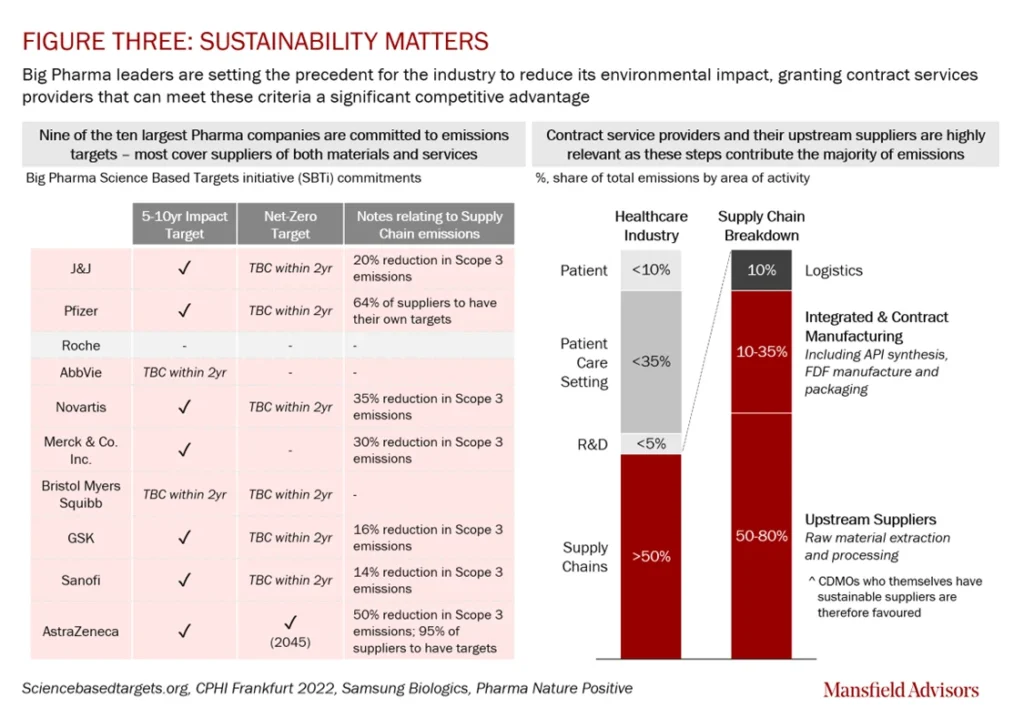
The momentum of the sustainability trend and ubiquity of emissions targets with big pharma customers has several implications on the Pharma Services industry. A firm which has the following features can expect to enjoy a competitive advantage:
- Uses efficient manufacturing processes and HVAC systems (heating, ventilation and A/C represents most of a sites energy demands) i.e. reducing Scope 1 emissions of their own
- Has a clean energy supply i.e. reducing Scope 2 emissions of their own
- Sources materials from responsible and sustainable suppliers i.e. reducing Scope 3 emissions of their own
- Is located in close geographical proximity to the pharma customer i.e. reducing Scope 3 emissions from logistics
Pharma players selecting service providers on these criteria is driving changes across the vertical. For upstream CDMOs and CROs, this includes investment in green technologies and waste-reduction processes, and additionally a knock-on effect of them being more demanding of their own reagent suppliers, applying the pressures further upstream. Supplier markets are reacting in-turn: Roquette, a leader in sustainably-sourced raw materials, is for example improving further by installing solar panels at manufacturing sites and expanding its usage of natural extracts. The downstream CPO segment is also evolving, with many players including Aptar Pharma, Airnov and Pharmaserve NW (now part of Noveayr) innovating new drug delivery devices, storage vessels/vials and recyclable packaging to help customers reduce downstream emissions related to product and material waste. An entirely new consultative service has also been born, both operational (e.g. EECO2) and strategic (e.g. Recipe Design) firms now exist to help CDMO clients improve processes and better address customer demands relating to sustainability.
There is also the grander-scale trend of re-shoring of manufacturing – more precisely the shifting from Asia and into Europe – being driven by these new competitive forces. Using European partners guarantees lower emissions from transportation, results in cleaner energy usage (China and India still feature significant coal-powered generation on their power grids), and generally provides greater supply chain transparency. Combined with greater demand for supply chain reliability (also discussed in our previous article) purchasers are increasingly more comfortable using a European CDMO partner.
Given these trends, service providers should have sustainable practice high on their list of priorities if they wish to win business with their largest potential customers. The sustainability trend also presents an opportunity for investors, as capital investment and operational process refreshment will be required for many players to improve on these new key purchasing criteria. Returns on relevant energy-saving investments have also improved over the last year on account of unprecedented energy costs (analogous to the effect on healthcare services providers discussed previously), strengthening the argument that now is the time to act.
Conclusion: Finding a niche in this attractive market
The above trends set a strong rationale for investors looking into the Pharma Services market. It is one with strong, reliable growth drivers, clear high demand subsegments calling for investment-driven growth, and additional capex-dependent opportunities to differentiate. The benefits of scale and rationale for consolidation are also clear. Despite this however, market leaders continue to demonstrate that if not adopting a scale play, a careful strategy and niche is required to succeed. Investment does not come without execution risk, particularly given the increasing complexity of drug development and manufacturing, but now is as exciting a time for smart equity investment in this space as there has ever been. At Mansfield Advisors, we can advise on commercial strategy and help you to navigate this potentially high-return sector.


