


CDMOs remain central to the global pharma landscape, but their roles are evolving as new technologies emerge, according to Abhishek Patel, senior associate, and Victor Chua, senior partner, at Mansfield Advisors.
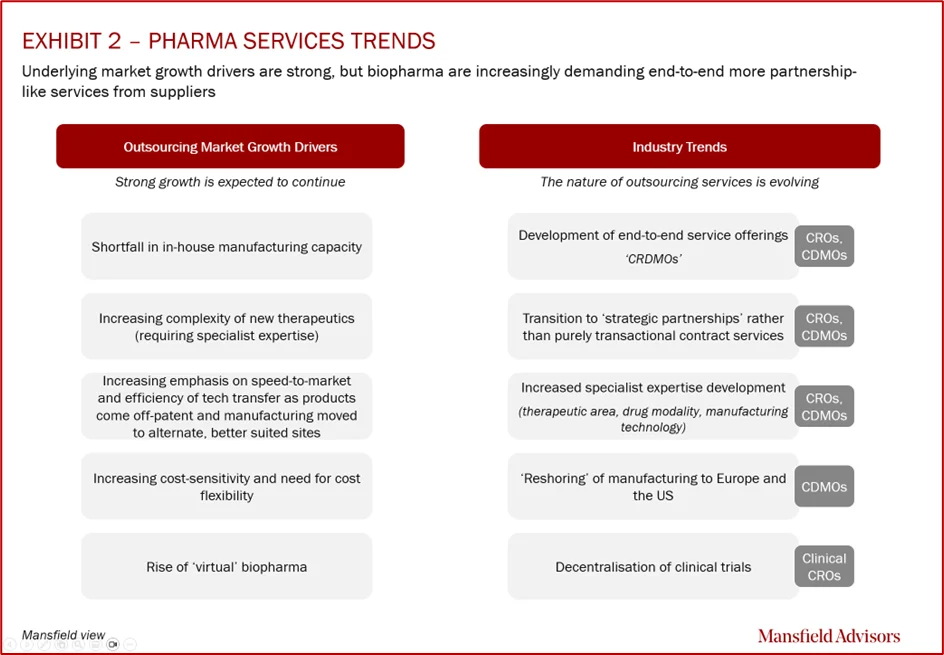
As covered in our previous article ((25) The Commercial Case for Investing in CDMOs | LinkedIn), outsourcing drivers remain strong in the global pharmaceutical CDMO sector, with the market projected to grow at 7.5% CAGR over the next five years (Exhibits 1 & 2), outpacing the overall pharma market. Pharmaceutical companies continue to report a shortfall of in-house manufacturing capacity, requiring the specialist expertise of CDMOs to navigate the increasing complexity of new therapeutics – particularly biologics, which are forecast to grow at twice the rate of small molecules.
Business models and outsourcing agreements are changing, however; innovative biopharma companies are increasingly engaging in strategic partnerships with CDMOs as opposed to transactional, fee-for-service relationships. Moreover, CDMOs are broadening their capabilities, investing in new sites and covering a greater scope of the value chain as they seek to move towards providing a complete end-to-end service for clients.
For investors, this development offers an attractive opportunity to provide the capital required for both the growth and further consolidation of CDMOs. It brings the promise of greater revenue visibility for successful platforms that forge strong, long-term partnerships with their biopharma clients.
Recent transactions
Despite macroeconomic headwinds, CDMOs led M&A activity within healthcare in 2023, with over 15 buy-out deals. The largest transactions were Syneos Health’s take private for US$7.1bn and divestment of Baxter’s BioPharma solutions business to Advent International and Warburg Pincus for US$4.25bn, and subsequent rebranding to Simtra BioPharma Solutions. Amongst PE investors, GHO Capital retained its significant share in Sterling Pharma Solutions, a UK-based CDMO with differentiating technology capabilities in high potency APIs, antibody-drug conjugates and hazardous chemistry, with Partners Group acquiring a minority stake in the business. This follows the merger of Novasep, a France-based CDMO also with API and ADC specialism, with Pharmazell, a German small molecule API CDMO in 2022, which were subsequently integrated with Farambios and rebranded to Axplora. Additionally, Astorg acquired CordenPharma for US$2.6bn in May 2022 and has since expanded its FDF capabilities with acquisitions of three manufacturing facilities from Vifor Pharma, a Swiss-headquartered specialty pharma company.
CDMOs continue to represent attractive assets within healthcare given strong market fundamentals, but investors need to be wary of evolving business models and outsourcing agreements with biopharma clients.

Strategic partnerships
One of the largest changes in the innovator, complex pharmaceutical space over the last decade has been a shift away from a fee-for-service, transactional relationships between CDMOs and their biopharma clients towards strategic partnerships. Expectations amongst biopharma clients are increasing, as reported by an expert panel at CPHI Barcelona 2023, with representatives from Roche, MSD and Thermofisher. They not only demand a proactive approach to solving development and manufacturing challenges, but also a commitment to quality, timelines, delivery and capacity.
Big pharma companies are now outsourcing entire portfolios to CDMOs, rather than individual products, as well as agreeing manufacturing capacity reservations for molecules still in development (Exhibit 3). This is most apparent with the emerging class of GLP-1 drugs which target obesity and diabetes, with many CDMOs investing in capacity not just for recently approved treatments such as Novo Nordisk’s Wegovy and Eli Lilly’s Zepbound, but also a broader range of pipeline drugs that could further grow this market to US$100bn by 2030. Biotechs have also considered seamlessly integrating any in-house development and manufacturing with CDMOs, as they themselves lack the required capacity to scale innovations.
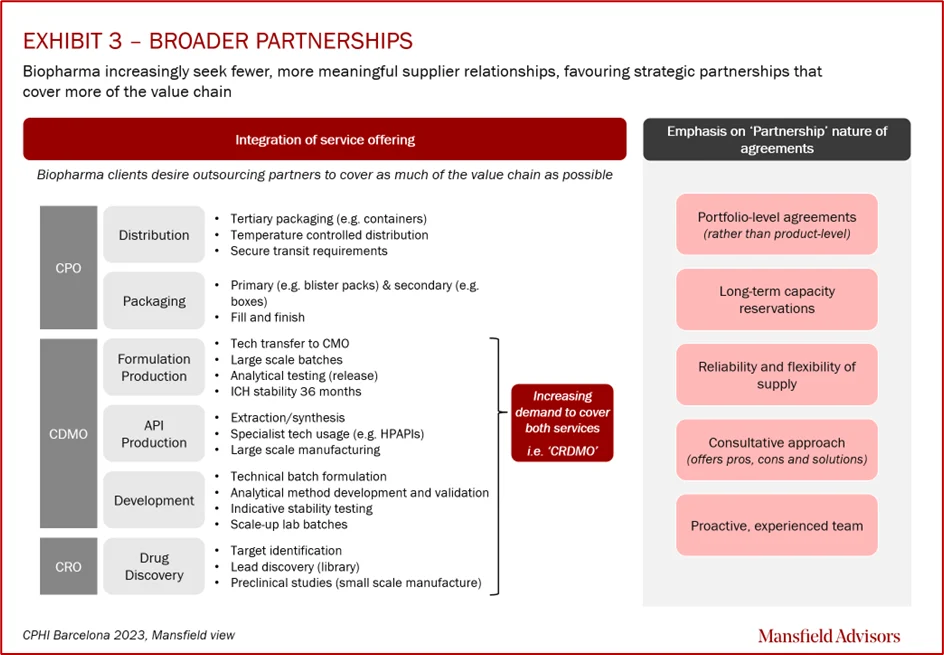
Partnership agreements require greater flexibility from CDMOs to adapt their capacity as demand changes – for example, if there is attrition in one molecule, manufacturing must be able to shift to others. Increasingly, there is also a desire amongst biopharma to rationalise strategic partners (particularly for more traditional small molecules and monoclonal antibodies), to improve flexibility and efficiency of development and manufacturing.
To this end, CDMOs require the capacity to succeed and a willingness to share infrastructure and platform technologies. This creates opportunities for investors to consolidate attractive platforms and offer a greater range of outsourced services, something that is reflected by another major emerging trend: a move towards end-to-end Contract Research and Development Manufacturing Organizations (CRDMOs).
Moving towards CRDMOs
Historically, the pharma outsourcing value chain focused on small molecules and was highly fragmented with distinct services provided by CROs, CDOs, CMOs and CPOs. This offered reduced time to market and greater cost efficiency, particularly for small to mid-sized pharma clients. The focus has shifted over the last 10 years to include a broader range of molecule types, with greater emphasis on integrating development and manufacturing services, and providing capabilities for novel technologies such as biologics and cell and gene therapies.
More recently, CRDMOs seek to provide a one-stop-shop service to clients supporting drug discovery and early clinical development all the way to commercial manufacturing (Exhibit 3). This is evidenced by a number of recent announcements by leading Tier 1 CDMO players. Lonza, for example, recently opened a new laboratory in Cambridge, Massachusetts to support pre-clinical stage biotechs, whilst Catalent announced the addition of two new analytical development laboratories in Kansas City, their flagship facility, to increase biologics CGMP analytical capabilities.
At the other end of the value chain, CDMOs are looking into packaging and supply chain services in support of new technologies such as cell and gene therapies, as illustrated by ThermoFisher and Catalent.
This approach is not suitable for all customers, however, with notably some small to mid-sized biotechs preferring to partner with smaller CDMOs that retain expertise in specific technologies. Nevertheless, the directional of travel for larger CDMOs is towards covering as much of the pharma value chain as possible.
Capacity constraints and cost inflation
Manufacturing capacity constraints in the West have persisted since Covid-19, and these constraints are even more acute in biologics and other emerging technologies, where Europe has a distinct lack of expertise, manufacturing and distribution capacity in cell and gene therapies, for example.
The desire to ‘re-shore’ manufacturing to strengthen regional supply chains post Covid-19 has exacerbated capacity constraints. Expansion has been further hampered by unprecedented cost inflation of 12-15% in 2022/23, which has driven the need for more innovation in efficiency of the manufacturing processes. Those CDMOs with continuous manufacturing capabilities have become increasingly important in bringing down costs for higher volume drugs, for example.
Ultimately, capacity investment is needed to serve increased demand in the West, and this is evidenced by multiple site expansions and greenfield builds, not only amongst leading Tier 1 CDMOs such as Lonza, Catalent and Samsung Biologics, but also a number of small and mid-sized CDMOs including Sterling Pharma Solutions, Aenova, Corden Pharma, Lotte Biologics, Fujifilm Diosynth Biotechnologies, Bachem and Agilent Technologies.
Conclusion
CDMOs continue to represent an attractive segment for investors given the strong market fundamentals, high levels of fragmentation outside the Tier 1 players, and capacity shortfalls, particularly for more complex, differentiated technologies.
The era of fee-for-service, transactional relationships with innovative biopharma companies is rapidly being superseded by increasingly long-term, strategic partnerships, with an emphasis on broad capabilities and an end-to-end service offering. There will, however, always be some demand for transactional relationships for off-patent drugs and more traditional technologies.
Whilst there is still a place for niche players with differentiated technology platforms, particularly within emerging areas such as cell and gene therapies, we see potential for strong value creation though continued consolidation, and expansion, of CDMO platforms. This meets biopharma’s increasing desire to improve efficiency and flexibility by rationalising their outsourcing partners. Longer, larger contracts also come with the promise of greater revenue stability for CDMOs.
Investors, nevertheless, need to select the right platform to best grow capacity, capability and geographic footprint, and that requires careful diligence.
