


The success of GLP-1 weight loss drugs has reshaped the pharmaceutical landscape and created one of the fastest-growing segments in global pharma. While pipelines at companies such as Novo Nordisk and Eli Lilly dominate headlines, accelerating demand and supply chain constraints are shifting attention toward the wider ecosystem required to scale production.
Many of these companies are privately held and receive far less attention than the big pharma names, yet they hold critical capacity positions in the scale‑up process now underway. Understanding where the bottlenecks and enablers lie in the wider GLP-1 ecosystem is essential for investors looking to position themselves for the next wave of growth in weight-loss drugs.
The next phase of GLP-1 expansion will be determined as much by manufacturing capacity and reimbursement dynamics as by clinical innovation.
Capacity constraints have already driven significant activity across the GLP-1 value chain. Multiple CDMOs are active in drug production, including Corden Pharma (Astorg), Axplora (Bridgepoint) and AmbioPharma (Carlyle); sterile fill-finish specialists such as Simtra (Adventa International/Warburg Pincus); and device manufacturers such as Nemera (Astorg/Montagu). Beyond drug development and manufacturing, there are adjacent opportunities in packaging and distribution channels including online pharmacies (eg Numan, Hims and Hers) and digital health platforms.
Whilst the market is currently led by Novo Nordisk’s semaglutide (Ozempic/Wegovy) and Eli Lilly’s tirzepatide (Mounjaro/Zepbound), stronger competition is expected as new entrants — including Boehringer Ingelheim, Amgen, Pfizer and Roche — offer novel mechanisms (dual agonists, triple agonists and amylins), formulations (oral vs injectable) and dosing regimens (daily vs weekly vs monthly).
Dr Lakshiv Dhingra, Dr Seren Marsh, Abhishek Patel and Dr Victor Chua of Mansfield Advisors consider how the GLP-1 landscape will evolve over the next 10 years in light of: increasing competition and the entry of generics; how reimbursement dynamics will shape penetration in the US and the EU5 (France, Germany, Italy, Spain and the UK); and emerging treatment paradigms that may reshape demand in what is already a US$70bn-plus global market.
A blockbuster sector led by two big players
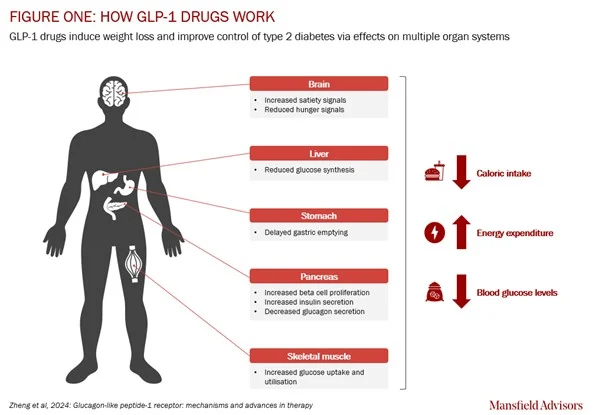
GLP-1s activate GLP-1 receptors in multiple organs to enact metabolic effects that result in improved blood glucose control and weight loss [FIGURE ONE].
Novo Nordisk’s blockbuster molecule, semaglutide, was launched for Type 2 diabetes (T2D) in 2018 as Ozempic; however, it piqued significant public and commercial interest in 2021 when the STEP-1 trial demonstrated up to 14% placebo-adjusted weight loss, leading to its approval as a weight loss drug, Wegovy. Between 2021 and 2024, global sales of Ozempic surged from US$5.3bn to US$18.9bn, while Wegovy amassed global sales of US$9.2bn.
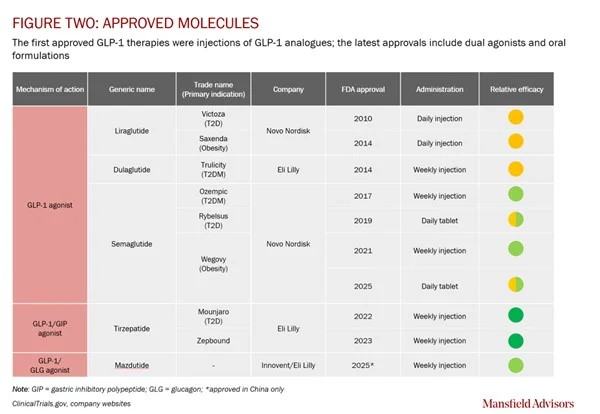
Eli Lilly’s GLP-1 offering, tirzepatide, launched shortly after (as Mounjaro for T2D in 2022 and Zepbound for obesity in 2023), demonstrated greater HbA1c reduction and up to a 20% placebo-adjusted weight loss. This superior efficacy helped it achieve global sales of ~US$16.4bn in 2024 (Mounjaro ~US$11.5bn and Zepbound ~US$4.9bn), rivalling semaglutide and completely overshadowing the sales of historical GLP-1s, such as exenatide, liraglutide and dulaglutide [FIGURE TWO].
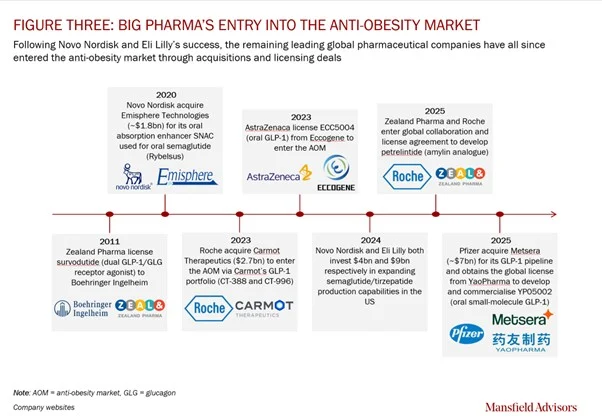
While Novo Nordisk and Eli Lilly both have promising GLP-1 pipelines and anticipate multiple drug launches over the next five years, several other big pharma companies are also investing heavily in GLP-1 drugs in a bid to grab a slice of the pie, primarily through the acquisition of biotech developers [FIGURE THREE]. This will open the door to new entrants and fiercer competition over the next decade.
The competitive dynamics will also be affected by the emergence of generic drugs – semaglutide faces loss of exclusivity (LOE) as early as 2026 in some countries.
Future success will be driven by those who can win favour with payors, clinicians and patients.
Competition and expansion to improve public reimbursement
There is already strong reimbursement coverage of GLP-1s for T2D across US federal, state and commercial payors. The EU5 public healthcare systems also reimburse GLP-1s, but often with prescribing restrictions – such as specialist approval or use only as 3rd line treatment at the earliest, which limits penetration.
Prescribing restrictions are likely to relax over time, and coverage and penetration improve, as increased competition and the entry of generics drive price erosion.
Unlike T2D, there is currently very limited coverage of GLP-1s for obesity within the US and EU5. The UK reimburses GLP-1s for obesity but with much stricter requirements than label indications: BMI ≥ 35 plus at least one weight-related comorbidity. Consequently, the majority of the US and European GLP-1 obesity markets remain self-pay — a dynamic likely to persist over the next decade.
This has led to a surge in Direct-to-Consumer (D2C) platforms such as Pharmacy2U, Voy and Numan, offering online assessment and prescriptions. These platforms provide considerable Return on Investment (ROI) given the size, growth and anticipated persistence of the self-pay segment. They also carry potential reputational risk, however, given concerns about inappropriate GLP-1 prescribing following limited online assessments and fears of counterfeit products.
Obesity coverage by US payors should increase as prices fall, but in many European countries, particularly Germany, France and Spain, the issue lies with obesity being regarded as a ‘lifestyle’ disease, and so something that should not be treated with drugs.
To overcome this assessment, pharmaceutical companies are instead targeting obesity-related co-morbidities, such as cardiovascular disease, chronic kidney disease and obstructive sleep apnoea, for which reimbursement is more likely. For instance, semaglutide received FDA and EMA approval for cardiovascular risk reduction in patients with obesity in 2024, and Novo Nordisk are also targeting the use of semaglutide in patients with obesity-related heart failure and metabolic associated steatohepatitis (MASH, formerly known as fatty liver disease). Similarly, many of the advanced pipeline molecules are concurrently in trials for obesity-related comorbidities in addition to standalone obesity and T2D.
Demonstrating efficacy in obesity-related comorbidities will be paramount in order to achieve reimbursement in Europe, yet it will take time for trials focused on these co-morbidities to translate into label expansion and revenues.
Higher efficacy
Aside from pricing competition and label expansion, greater efficacy in HbA1c reduction and/or weight loss, reduced side-effects and increased patient convenience (eg an oral tablet rather than a subcutaneous injection) will also contribute to the success of new GLP-1s and associated weight loss medication.
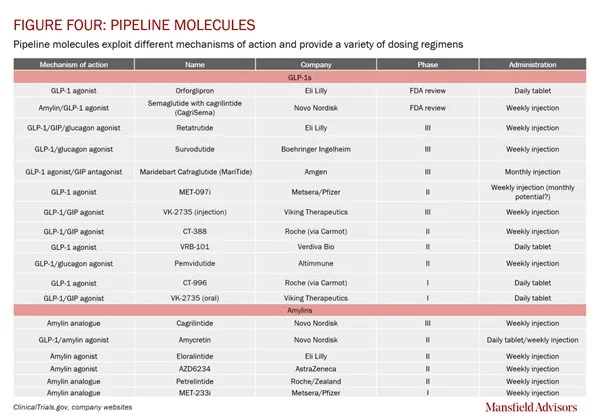
From a weight loss efficacy perspective, the bar has been set by tirzepatide. The GLP-1 most likely to surpass this is retatrutide, Eli Lilly’s triple-agonist that targets GLP-1, GIP and glucagon receptors [FIGURE FOUR]. In phase 3 trials, maximal dose retatrutide demonstrated 29% placebo-adjusted weight loss at 68 weeks (albeit with higher discontinuation rates than semaglutide and tirzepatide). Retatrutide is widely viewed as a potential next efficacy benchmark ahead of its expected 2027/28 launch.
In markets where there is state/PMI reimbursement of GLP-1 treatment for obesity (eg the US), retatrutide is likely to be reserved as a second-line GLP-1 for those who have failed to lose sufficient weight with a cheaper alternative (such as semaglutide or tirzepatide). Meanwhile, in markets where GLP-1 obesity treatment is likely to remain entirely self-pay, patients will be attracted by the greater weight loss potential (in spite of the higher price and inferior tolerability).
In some self-pay markets such as Brazil, short-duration use of high-efficacy GLP-1s has emerged as a cost-control strategy among patients.
Lower treatment burden
While retatrutide shows significant promise, Eli Lilly is likely to disrupt the market – more imminently and more substantially – following the launch of orforglipron in early 2026. This novel small molecule oral GLP-1 drug will feed the substantial appetite for needle-free alternatives (as demonstrated by the early success of the oral Wegovy pill, which was prescribed >18,000 times in the first week after the January 2026 launch in the US).
By 2035, oral formulations will expand the overall market by targeting new, hitherto unaddressed patient populations rather than taking significant share from existing injectables.
Novo Nordisk may have first-mover advantage in the oral space, with oral Wegovy (obesity) and Rybelsus (T2D, launched 2019), but orforglipron is expected to outperform these on-market semaglutide options for a number of reasons: superior HbA1c reduction and weight loss; greater ease and scalability of manufacturing; and the absence of dietary restrictions associated with oral semaglutide.
Eli Lilly and Novo Nordisk have both agreed to offer their lowest dose weight loss pills at a price of US$149 per month for Medicare, Medicaid and self-pay patients in the US, which is up to half the price of their current injectable counterparts. Roche (via its acquisition of Carmot) has also been developing a small molecule oral drug, CT-996, but its progress has been stunted by poor tolerability.
Oral penetration will be higher in T2D, as diabetes care is principally delivered by primary care physicians who will face lower prescribing barriers with oral GLP-1s. In contrast, self-pay obesity patients will prioritise the higher efficacy of injectables over the convenience of oral pills. Oral GLP-1s may also provide more nuanced treatment regimens, such as combining the rapid weight loss of injectables maintaining a desired body weight with orals.
In any case, the shift towards oral drugs provides a significant demand tailwind for CDMOs, given the much higher API requirements (due to lower bioavailability).
It is important to note that both orforglipron and oral semaglutide require daily administration (compared to weekly administration for the injectable drugs), and this raises the question of ideal dosing frequency for patient convenience. Amgen is developing a GLP-1/GIP dual agonist called MariTide (currently in phase 3 trials expected to complete in 2027), which is administered as a once-monthly injection. This sounds revolutionary, but it has received a mixed reception among clinicians, with many citing concerns that once-monthly dosing may paradoxically worsen patient compliance (patients may simply forget to take the medication, as once-monthly administration may not be frequent enough to build adherence behaviours) and slow dose titration.
Pfizer/Metsera is testing MET-097i at both once-weekly and one-monthly regimens in phase 2 trials.
This molecule, as well as the broader pipeline, placed Metsera at the centre of a fierce bidding war between Pfizer and Novo Nordisk in late 2025, with an eventual deal value of around ~US$10bn.
There is limited data available about MET-097i at present; however, Pfizer’s robust marketing machinery and strong presence in primary care (owing to the blockbuster status of Lipitor/atorvastatin) would position the molecule well for commercial success.
Given the increasing diversity in treatment paradigm, investors need to carefully think about patient segmentation and archetypes. With an increased choice of drugs, success will require targeted clinician engagement, D2C marketing and clear differentiation.
Greater tolerability
Tolerability is another factor to consider, given the intended long-term use of GLP-1s. Whilst evidence is limited, it appears that amylins, a new emerging class of anti-obesity medications, show promise here. Amylin drugs mimic the endogenous hormone amylin to slow gastric emptying, reduce appetite and suppress post-meal glucagon release. Compared to GLP-1s, amylins may induce fewer gastrointestinal side effects and preferentially target fat loss over muscle loss, but the available clinical data is currently mixed.
Most big pharma companies have at least one amylin in development, the most advanced of which is Novo Nordisk’s CagriSema, a dual amylin/GLP-1 agonist currently under FDA review. There are multiple amylins in phase II trials, including Amycretin (another dual amylin/GLP-1 agonist, Novo Nordisk) and Eloralintide (a single-target amylin analogue, Eli Lilly).
All three amylin products appear to have the potential to challenge tirzepatide on an efficacy/tolerability basis, so it will be interesting to see how Novo Nordisk and Eli Lilly position these products alongside their current GLP-1 offerings.
Price erosion and supply reliability
Despite the promise of the pipeline, incumbent molecules – injectable semaglutide and tirzepatide – will likely continue to lead a much-expanded GLP-1 global market in 2035. The Loss of Exclusivity (LOE) of semaglutide in China, Brazil, Canada and India in 2026 will result in the availability of cheaper generics in these countries (and possibly neighbouring countries via parallel import).
This impending patent cliff is a material headwind for Novo Nordisk, but price reductions will drive a substantial uplift in the volume of patients on injectable semaglutide, through preferential reimbursement (by state or PMI payors) and improved affordability for the self-pay segment.
This represents a tailwind for generics manufacturers, CDMOs and D2C platforms.
In the US, the advent of TrumpRx means that the prices of Wegovy and Ozempic will fall substantially even before LOE in the early 2030s (for reference, the cash-pay price of Wegovy has dropped ~33% in the last year alone), potentially softening the commercial impact of genericisation. However, big pharma will still have the ability to charge premium prices for innovator molecules, especially those with higher efficacy (eg retatrutide) and those aimed at niche patient populations rather than the mass market (eg survodutide, which is targeting MASH endpoints in clinical trials).
Supply reliability has been a frequent pain point in the GLP-1 space over the past three or four years, with unprecedented demand exceeding manufacturing capacity and resulting in years-long drug shortages across US and Europe. This has constrained the revenue potential of upstream and downstream players in the value chain.
While previous semaglutide/tirzepatide shortages have now been resolved, supply constraints remain a threat for future molecules – especially for oral molecules that have much higher API requirements. However, smart investments in capacity and technical expertise can mitigate against future supply issues, and there are clear signals that both Novo Nordisk and Eli Lilly are taking these steps. For example, in December 2024, Novo Nordisk bought three Catalent sites for US$11bn in order to boost its injectable drug capacity, and in December 2025, Eli Lilly announced new plans to build a US$6bn manufacturing facility in the US. Furthermore, reports suggest it has already produced a billion tablets of orforglipron ahead of the molecule’s launch.
GLP-1s: an attractive high-growth industry for all investors
Overall, there remains considerable opportunities for investment across the GLP-1 value chain, despite this market becoming increasingly crowded.
Biotechs are obvious investment candidates, although they can prove to be a binary outcome, and pharmaceutical companies are obvious for public market investors. For investors seeking lower clinical risk exposure, API manufacturers, self-injection pen manufacturers, weight loss practices, and pharmacies, are interesting alternatives.
Multiple CDMOs are already active across the GLP-1 value chain, including those involved in drug manufacturing, such as Corden Pharma (Astorg), Axplora (Bridgepoint) and AmbioPharma (Carlyle); creation of the sterile fill-finished product, such as Simtra (Adventa International/Warburg Pincus); and manufacturing the drug delivery devices, such as Nemera (Astorg/Montagu). Beyond drug development and manufacturing, there are adjacent opportunities in packaging and distribution channels including online pharmacies (eg Numan, Hims and Hers) and digital health platforms.
Whilst the market is currently led by Novo Nordisk’s semaglutide (Ozempic/Wegovy) and Eli Lilly’s tirzepatide (Mounjaro/Zepbound), stronger competition is expected with new entrants (Boehringer Ingelheim, Amgen, Pfizer, Roche amongst others) offering novel mechanisms (dual agonists, triple agonists and amylins), formulations (oral vs injectable) and dosing regimens (daily vs weekly vs monthly).

