


Cell and Gene therapies (CGTs) are an exciting novel class of pharmaceuticals, and an area where pharma services including CDMOs are likely to play a significant role. Will Johnson, senior associate, and Victor Chua, senior partner, discuss why investors should be considering the CGT space, and the potential investment options available.
INTRODUCTION: From concept to a real opportunity for investors
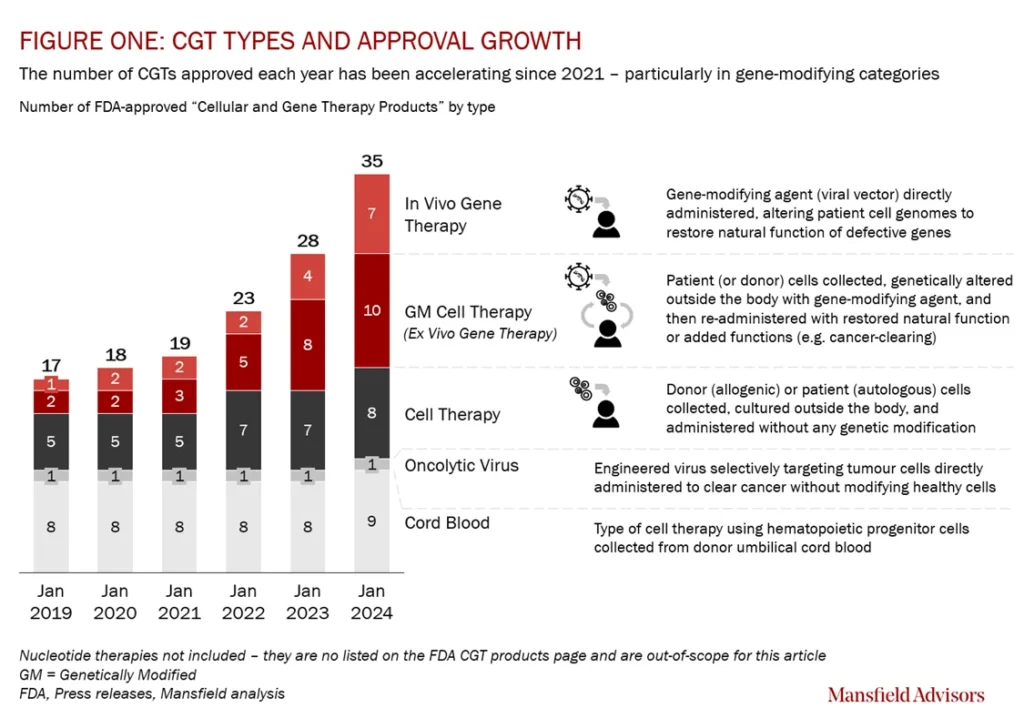
The wave of approvals for Cell and Gene Therapy (CGT) products since 2019 signifies the progression of this advanced treatment class from a breakthrough concept to reality. These novel therapies aim to revolutionise the medical landscape for chronic diseases including cancer by offering patients a single ‘curative’ dose of medication in place of current long-term, often life-long, treatment options. Ten years ago there were very few FDA-approved CGTs, most of which were umbilical cord blood products that have been used for stem cell transplants for decades, but the picture is now very different. In the last five years alone the number of CGT products has doubled, with rapid expansion since 2021 in innovative gene-modifying therapies in particular [FIGURE ONE].
Sector growth was spurred on following the introduction of the Childrens and Families act in 2014 where Statements of Special Educational Needs were replaced with Education, Health, and Care Plans (EHCP), offering a more comprehensive approach and extending local authority support to age 25. The independent sector’s gain in market share is due to the dynamism and specialisation it offers. Independent providers can be more agile, responding to changing trends and creating new capacity. This is combined with a rise in the complexity of individuals. The independent sector is more specialised and is typically used for higher needs students, fill needs which the public sector struggles to meet.
Until recently, this space has been viewed mainly as an opportunity for early-stage investors in pre-revenue start-ups and small-scale biotechs. But as the number of approved products reaching commercial scale grows and more enter clinical trials, opportunities for midmarket (and larger) investors materialise across the industry vertical – including in raw materials, manufacturing equipment and services, and logistics. The complexity of CGTs and fragmented nature of biotech developers makes outsourced services particularly relevant, meaning CDMOs and CROs (asset types typically favoured by PE investors) are likely to play a substantial role in the future of this market.
The underlying growth of the CGT space, and how investors can approach the sector, will be discussed in this article – note that the FDA’s “Cellular and Gene Therapy Products” definition has been used, meaning nucleotide therapies (e.g. RNAi, mRNA, ASO) are not covered in detail.
MARKET: A booming end-user market with few signs of slowing down
CGT is a broad term used to refer to several novel treatment subcategories, distinguished by their mechanism of action. The most widely publicised CGTs are CAR T-cell therapies, themselves within the Genetically Modified (GM) cell therapy subcategory. The pioneer brands Yescarta (Kite/Gilead) and Kymriah (Novartis) made headlines as the first therapies of this type approved by the FDA in 2017 – both work by genetically modifying (‘reprogramming’) a patient’s own white blood cells to enable them to target and clear blood cancer. Yescarta has pulled ahead in terms of uptake and is now the single highest-revenue CGT product, with estimated sales over $1.5bn in 2023 [FIGURE TWO]. Since 2017, eight further GM cell therapies have been approved. This includes many more CAR T-cell cancer therapies as well as GM cell therapies for non-cancer applications including sickle cell disease.

Shortly after the first CAR T-cell approvals, the first in vivo gene therapy product was approved. Unlike CAR T-cell therapies, in vivo treatments involve direct administration of the gene-modifying agent into the patient (i.e. without first collecting cells and modifying them in a lab). Luxturna (Spark/Roche) was the first approved product in this category, used to restore vision in retinal dystrophy patients. Zolgensma (Novartis) was next, used for treating spinal muscular atrophy and famous for its $2m per patient price tag – it reached over $1bn annual sales in 2021.
These breakthroughs in both GM cell therapy and in vivo gene therapy have resulted in expansion of the CGT market (excluding nucleotides and cord blood) from sub-$1bn in 2018, consisting primarily of legacy non-GM cell therapies like Provenge (Dendreon), to over $5.5bn in 2023. This growth has been driven primarily by increasing uptake of the ‘pioneer’ products approved between 2017 and 2021, with Yescarta and Zolgensma both growing at ~35% CAGR since 2019. Recent growth has also been driven by a second wave of product launches in only the last three years. Key new CAR T-cell products include Abecma and Breyanzi (both Bristol Myers Squibb) – collectively reaching almost $1bn sales in their second full year.
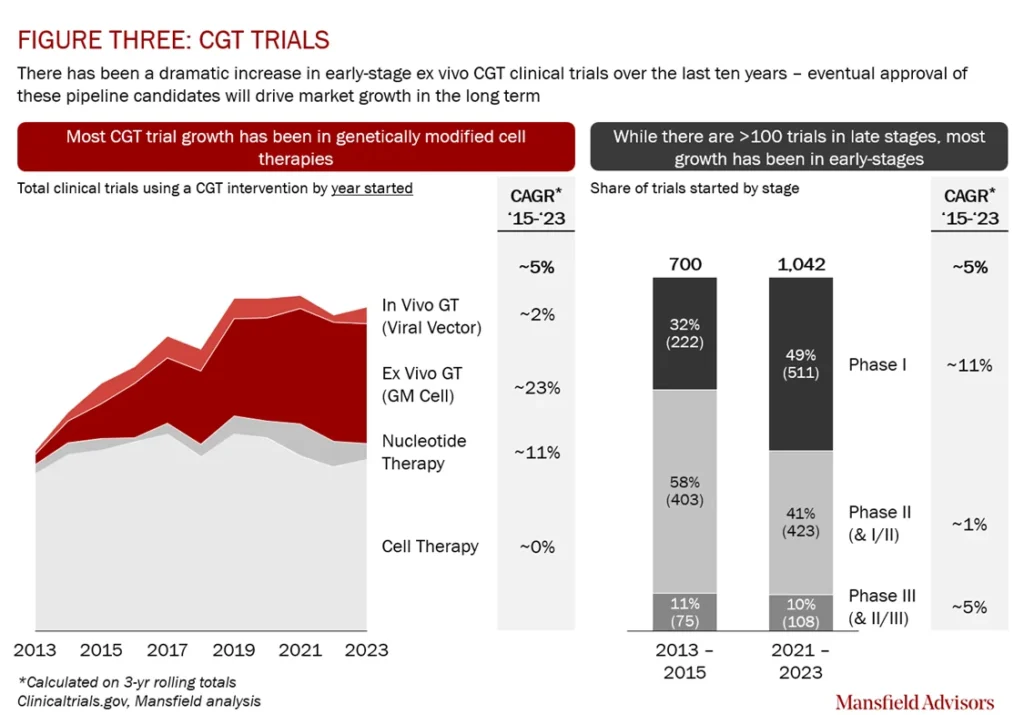
Rapid growth is expected to continue driven by uptake of recent launches – in the last 18 months alone, nine CGT products were approved and are likely to contribute significant near-to-mid-term growth. This includes in vivo gene therapies for both haemophilia A and B, and Elevidys (Sarepta Therapeutics) for treating Duchenne muscular dystrophy. Elevidys had estimated 2023 sales of $200m despite having only been approved for six months and missing a primary endpoint in recently published trial data. Two GM cell therapy products, Casgevy (Vertex) and Lyfgenia (Bluebird Bio), were approved for treatment of sickle cell disease in December 2023 – the former of which is notable for being the first therapy approved using CRISPR-Cas9 gene editing technology. Beyond these products, a substantial pipeline of CGT therapy candidates [FIGURE THREE] will underpin longer-term growth.
However, growth in the CGT market will not come without challenges. Unwillingness of health systems to pay for these hundred thousand to million-dollar treatments is one significant barrier to widespread uptake. This issue is being addressed currently through performance-based payment schemes and managed access agreements – where treatments are reimbursed so long as significant benefits over existing therapies are proven on an ongoing basis. For a more detailed discussion on this, our recent webinar with DeciBio addresses this ‘predicament’.
PHARMA SERVICES OPPORTUNITY: CDMOs will likely be instrumental in supporting market growth
Our recently-published article “The Evolving Role of CDMOs” outlines why we view pharma services by and large an attractive market for investors with strong underlying demand drivers. Outsourcing of biologics development and manufacturing is highlighted due to the lack of in-house capacity and the greater dependence on expertise – two characteristics which are even more pronounced for CGTs.
Whilst the expansion of in-house capacity for CGT development and manufacturing is noteworthy (e.g. Kite/Gilead’s California facility, and Novartis’s Stein facility), industry experts still overwhelmingly expect overall capacity to significantly lag demand in the mid-term. This represents an opportunity for CDMOs, which will be strengthened further by a market shift away from big pharma. Smaller biotech players with limited in-house manufacturing capacity (some of which are fully ‘virtual’ companies) are expected to take share as their products reach larger-scale trials and commercial launch – products which will be partially or fully reliant on outsourced manufacturing.
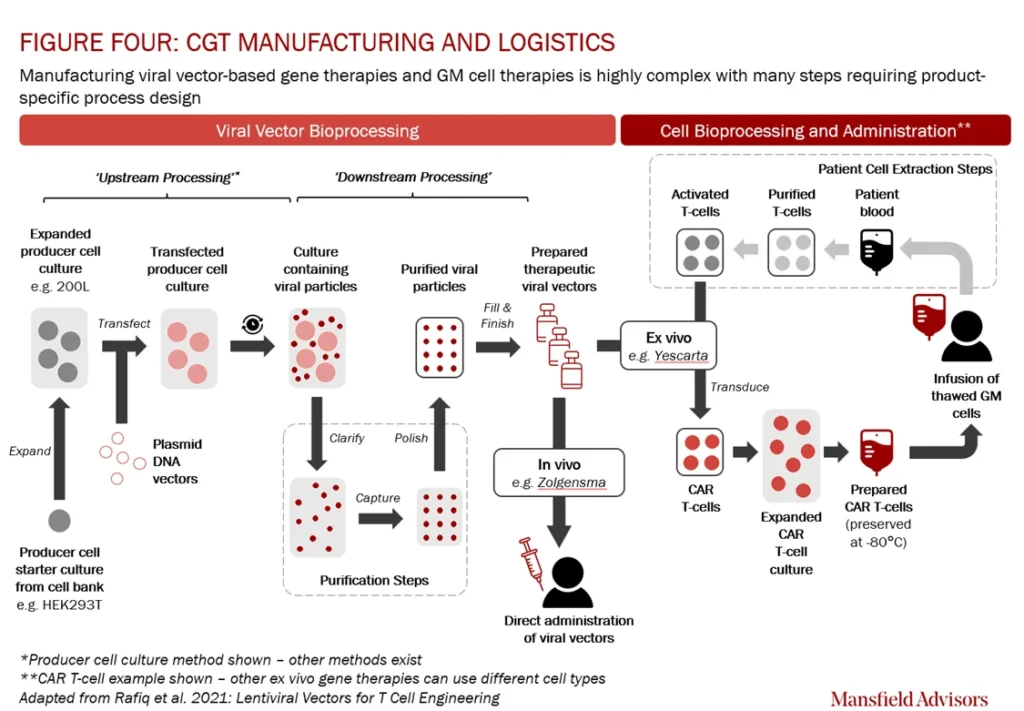
The rationale for outsourcing in CGT extends beyond a lack of in-house capacity. The technical nature of these products comes with it a greater dependence on niche expertise during development – expertise which a specialist external partner with its own differentiated technologies is more likely to have. Manufacturing processes, particularly for viral vectors which ultimately perform the gene editing itself, are also highly complex [FIGURE FOUR, LHS]. Optimising workflows depends on selecting from a range of different producer cell types, culturing methods, and purification protocols – making the right decisions across these aspects is data-driven, but even selecting the correct items to measure requires careful consideration. Organisations with access to large datasets and know-how across a wide range of product types and manufacturing methods therefore have a significant advantage – CDMOs are well positioned to fit this role. Additionally, outsourced manufacturing is particularly attractive in the CGT space from a risk-sharing perspective. Future sales of these novel therapies are hard to predict (especially with aforementioned reimbursement challenges), so substantial in-house capex is preferably avoided.
Using a network of contract manufacturing partners also makes sense for GM cell bioprocessing, where patient cells are modified before re-infusion [FIGURE FOUR, RHS]. In this phase of manufacturing patient cells must be transported from the clinical setting to the plant/lab, and then back again. Shortening this supply chain by using local CDMOs, rather than a large central in-house facility, minimises transport-related risks and reduces turnaround time. This benefits both the patient waiting for their crucial treatment and the pharmaceutical company wishing to deliver as competitive a treatment as possible.
This clear rationale for outsourcing has translated into practice. Vertex Pharmaceuticals has agreements with both RoslinCT (a GHO asset) and Charles River Laboratories for manufacturing of its breakthrough GM cell product Casgevy. Novartis has reportedly used Catalent (recently taken private by Novo Holdings) for multiple CGT products, as well as the French cell therapy CDMO CELLforCURE (now part of Seqens, an SK Capital and Meriux EP asset) to help serve the European market. Sarepta Therapeutics, behind the recently approved Elevidis, also has agreements with Catalent.
INVESTMENT STRATEGIES: A CDMO pure play is not the only option available to investors
For investors looking to this high-growth industry, there are options along the vertical with varied degrees of risk and upside potential. There has been deal activity across all these options in the last few years [TABLE ONE].
Most deals have been in the CDMO space, the traditional platform of choice for private equity in the broader pharma market for the past decade. EQT and Ardian acquiring and integrating Vibalogics into their leading CDMO platform Recipharm, expanding end-to-end CGT capabilities, is one key example. GHO has also been building out its own specialist CGT CDMO platform by acquiring RoslinCT then integrating Lykan Bioscience in 2022.
Outside of CDMOs, there has been significant activity in CGT tool and equipment developers – KKR has made multiple acquisitions in this space through its Gamma Biosciences platform. Archimed’s acquisition of Plasmid Factory is an example of a raw materials play. CGT CROs have been less popular with buyouts, potentially due to a lack of CGT-dedicated targets of scale, but the acquisition of BioAgilytix Labs (which has CGT services as part of a broader bioanalysis offering) by Cinven and Cobepa is one example.
Investors seeking lower-risk options should consider cold chain logistics due to the universal need for these services across CGT products (i.e. they are fully product-agnostic) – Envirotainer (EQT and Mubadala)and CRYOPDP (Hivest)are examples of deals in this area. Laboratory space and infrastructure is a similar low risk option – including modular solutions like Germfree Laboratories (EW Healthcare Partners). On the opposite end of the risk spectrum are the Biotech companies leading development of specific product(s), where there have been very few buyout deals.
Following an initial investment, vertical integration strategies can be considered. Combining plasmid (raw material) and viral vector CDMO capabilities is logical – given plasmids, like viral vectors, are also developed and manufactured on a product-specific basis. Combining CRO and CDMO (i.e. ‘CRDMO’) services can also make sense in CGT, as seen across pharma services more broadly (discussed in our recent article).
Building a platform with a broad offering is another option, for example a CDMO which can manufacture multiple virus types and has a wide range of upstream and downstream processing capabilities [FIGURE FOUR, LHS]. This adds value for customers by enabling the CDMO to develop bespoke, product-optimised manufacturing protocols, and for the investor by allowing the CDMO to service a broader range of customers and products – adopting a more hedged position.
TABLE ONE: CGT ASSET DEAL ACTIVITY

CONCLUSION: The CGT space represents an opportunity for many types of investors
The strong growth profile and product pipeline indicate that the CGT space is one of the major up-and-coming areas within pharmaceuticals. Indeed, this appears to be a consensus view across leading pharma services players. The major CDMOs Lonza, Recipharm, Catalent, and Siegfried have all been building or buying CGT capabilities in the last five years. Charles River Labs, a leading biologics CRO, has also launched a CDMO service almost exclusively for CGT applications including cell, viral vector, and plasmid manufacturing. Industry confidence in CGTs is therefore demonstrably high.
Additional breakthroughs are also yet to take place, namely solid-tumour CAR T-cell therapies, and gene therapies for conditions outside of rare orphan diseases – both of which would have substantially larger addressable patient populations compared to current CGTs. The market growth impact these breakthroughs could have, alongside resolving challenges around reimbursement, is still to be fully understood and represents significant upside potential. Investors with a pharma or life science focus should certainly consider the outlined options across the CGT vertical for one of their next investments.