


Introduction – quality matters
Quality should be at the forefront of any investor’s key priorities when assessing providers in health and adult social care. Acquire a poor-quality service, and significant management time and resource will be required to turn things around; conversely, a good-quality service will be more profitable and more valuable.
In England, all health and adult social care services are independently regulated by the Care Quality Commission (CQC), an arm’s length body of the Department of Health and Social Care which monitors and inspects sites and publishes quality reports with a simple 4-point rating scale (outstanding, good, requires improvement, inadequate). Other parts of the UK have equivalent independent regulatory bodies – Health Inspectorate Wales, the Care Inspectorate and Healthcare Improvement Scotland, and The Regulation and Quality Improvement Authority in Northern Ireland.
But whilst these reports provide a useful site-level proxy for quality, they mask the nuances behind ratings at a sub-sector and provider type level and are ultimately a ‘snapshot in time’ – the periods between inspections can be long and a lot can change. As a result, careful expert diligence is required to truly understand a provider’s real quality and their outlook.
This article analyses some key operational metrics for the CQC over the last 5 years, before taking a deep-dive into acute and mental health hospitals.
A brief background to the CQC
The CQC was established in 2009 to independently regulate all health and adult social care services in England, thereby consolidating its three predecessor organisations (the Healthcare Commission, the Commission for Social Care Inspection and the Mental Health Act Commission). Its primary aim is to ensure all services provide people with safe, effective, compassionate, high-quality care. More specifically, its key roles are to (1) register all health and adult social care providers; (2) monitor and inspect services to ensure they are safe, effective, caring, responsive and well-led, and subsequently publish quality ratings; (3) enforce changes through legal action when poor care is identified.
Ian Trenholm was appointed CEO in August 2018, taking over from Sir David Behan who had been in post since 2012. Whereas Behan had a strong social care background prior to joining the CQC, with executive positions at the Commission for Social Care Inspection and the Department of Health, Trenholm started his career as an Inspector in the Royal Hong Kong Police Service. He subsequently held executive positions at NHS Blood and Transplant, the Department of Environment Food and Rural Affairs (Defra), and the Royal Borough of Windsor and Maidenhead before joining the CQC. Under Ian’s leadership, the CQC has weathered the storm of COVID-19 which caused significant disruption to inspection activity, and has moved towards a risk-based ratings approach where struggling providers are prioritised to drive improvement. In tone, the CQC is seen as moving from a more collaborative regulator seeking to help providers improve performance to a more proactive and assertive regulator, seeking to prosecute more poor providers.
In 2021, the CQC set out four strategic priorities:
(1) people and communities – focus on experience and what is important to them when they access, use and move between services;
(2) smarter regulation – provide up-to-date and high quality information and ratings, simplify interactions and ensure responses are more proportionate;
(3) safety through learning – prioritise learning and improvement to ensure stronger safety cultures; and
(4) accelerating improvement – empower systems to improve quality of care where it is needed most.
But how does this reflect in the numbers, and have we seen a change in activity since Trenholm’s appointment as CEO in 2018? We analysed some of the key operational metrics to understand how the CQC’s recent activity stacks up against its funding and resources.
Stable resources, more complaints, fewer inspections
The CQC receives ~£200m income from fees charged to registered providers (Exhibit 1), which constitutes ~90% of its total revenue; the remainder is mostly DHSC-provided grant-in-aid funding. ~50% of its fee income is from independent sector providers, predominantly adult social care (~40%), but also hospitals, community and single specialty providers, and dentists (together ~10%). Income and employee numbers have remained largely flat over the last 5 years, which indicates relatively stable resource capacity, although funding may have been hit by recent inflationary pressures – the average salary for a CQC inspector is now estimated to be £38,328.

During the COVID-19 pandemic, expenditure shifted away from inspection towards monitoring, given extreme pressures which prevented on-site inspections. However, whilst expenditure on inspections has somewhat recovered to pre-pandemic levels, a closer look at overall inspection frequency reveals a longer-term decline that predates the pandemic (Exhibit 2). Mansfield sent an FOI request to the CQC to segment inspection activity by provider type; the results show adult social care and primary medical services have seen the greatest decline since 2016 of 12-15%, but hospitals have also seen a marked 7% drop in inspection activity. Given all health and adult social care services must be registered with the CQC, fees charged to providers is effectively a ‘tax’ on the independent sector to be appropriately regulated and for quality standards to be maintained, it follows that all independent sector providers might reasonably expect frequent monitoring and inspections (and more importantly re-inspections) to give a current and relevant quality rating.

However, whilst employee numbers at CQC have remained around 3,000 over the last six years, the number of inspections per employee has declined by ~2x since 2016. Taken together, this indicates inspection activity has been in sharp decline despite relatively stable resources, and is yet to return to peak levels. This trend cannot be explained by the COVID-19 pandemic given inspections have not returned to pre-pandemic levels and resourcing is similar, but by key changes in the CQC’s inspection strategy.
Historically, if a service was rated ‘good’ or ‘outstanding’, the CQC aimed to conduct a full inspection within 5 years. However, since 2021 CQC is taking a more ‘risk-based’, targeted approach to inspection, and only inspect sites where there is a clear risk to safety (i.e. prioritise struggling sites). For other all other sites, the CQC has conducted ~20,000 ‘direct monitoring activity’ (DMA) assessments over the last 3 years – these entail speaking to service users and analysing data directly from providers, without going on-site to conduct a full inspection.
The CQC is also rolling out its new “single assessment framework” for reports, which replaces key lines of enquiry (KLOEs) with new, standardised ‘quality statements’. However, there is an even greater risk of losing context at the expense of striving for consistency. Caroline Barker, Non-practising Solicitor at the law firm Ridouts points out: “whilst these new quality statements are better aligned to regulations compared to the KLOEs they replace, it remains to be seen whether the proposed ‘ongoing assessments’, rather than inspection, will be used as a means to avoid the CQC’s statutory obligations to produce a full written report that a provider can review and respond to. We’ve also seen more enforcement action by the CQC over the last 5 years, and it’s become harder to get changes to reports than it used to be – so we might find more judicial reviews with the new system.”
So, whilst dedicating resources to struggling sites aligns with the CQC’s key strategic pillar to accelerate improvement where it is needed most, its implementation also creates uncertainty over the quality of services rated ‘good’ or ‘outstanding’ in inspections that in some cases were 6-7 years ago. Moreover, complaints and whistleblowing enquiries (Exhibit 3) are on the rise and at their highest ever levels, so it is surprising this has not resulted in more inspections.

Private acute and mental health hospitals: a tale of contrasting ratings
Private acute hospitals and mental health hospitals are two provider types that have seen contrasting trends in CQC ratings over the last 5 years.
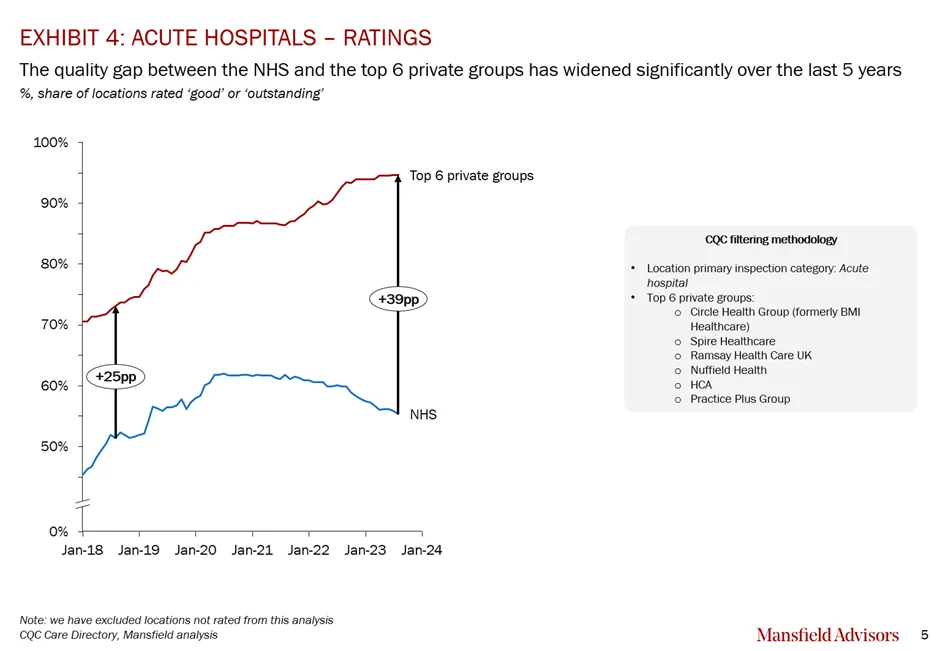
The top 6 private acute hospitals have seen their CQC ratings increase consistently, whereas their NHS counterparts have seen a steady decline since COVID-19 (Exhibit 4). Whilst the top 6 groups have always had superior quality ratings to the NHS, the gap has widened significantly. ~95% of locations from the top 6 groups are rated ‘good’ or ‘outstanding’, compared to just ~55% of NHS acute hospitals; a stark difference which not only articulates the extreme pressures faced by the public healthcare system, but also indicates how strong leadership and effective collaboration with the CQC in the independent sector can drive quality improvements.
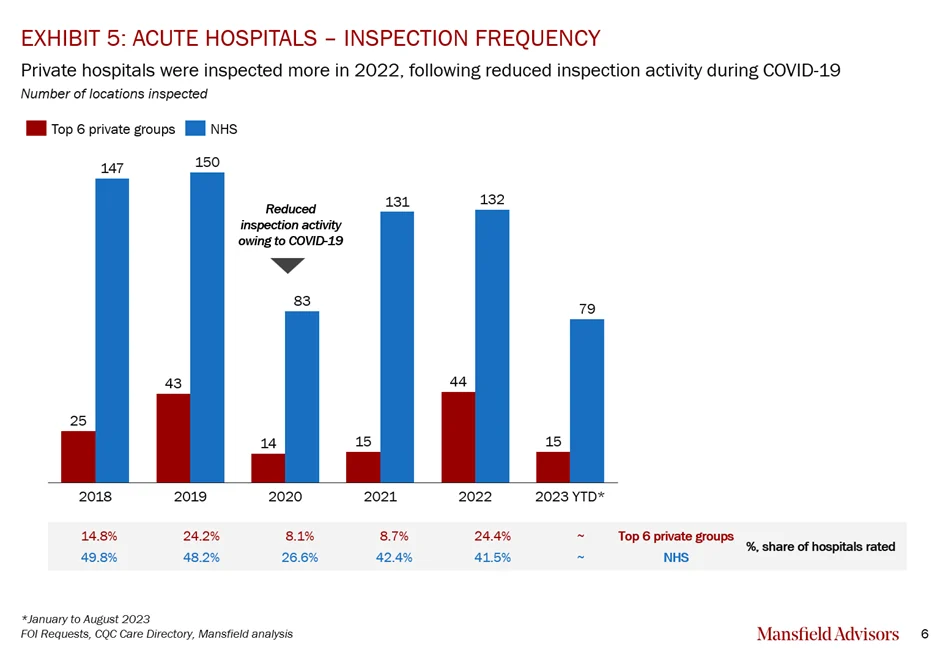
Private acute hospitals saw more inspections than pre-COVD in 2022 (Exhibit 5), with ~25% of rated locations inspected (similar to 2019 levels), following reduced activity during COVID-19. Of the 44 locations inspected, only three decreased in rating; 11 increased, 21 saw no change, and 9 were inspected for the first time.
In contrast, NHS acute hospital inspection frequency has not recovered to pre-pandemic levels yet and many rating for both NHS and private are out of date. As at August 2023, the average time since last inspection for NHS acute hospitals was 3.8 years for good or outstanding sites, compared to 1.9 years for requires improvement, and 1.2 years for inadequate; therefore, good or outstanding sites were being rated ~2x less frequently. However, for the top 6 private groups, the average time since the last inspection was 3.7 years for good, outstanding and requires improvement locations, so the rating appears to have no impact on inspection frequency.
The private mental health hospitals have seen a very different profile – five years ago independent providers had 14% more good and outstanding ratings that the NHS whilst today they have 9% fewer. They have seen a steady decline in CQC ratings by 10pp since COVID-19, whilst NHS mental health Trusts have largely been unchanged. (Exhibit 6). A number of leading private providers including St Andrew’s Healthcare, InMind and CareTech have had multiple services downgraded. A closer look at the key lines of enquiry (KLOEs) in inspection reports reveals safety and leadership concerns as the key drivers for lower ratings. The mental health sector as a whole has faced profound system pressures since COVID-19, with high staff churn and persistent shortages, and a lack of training often cited. Nevertheless, it is clear staffing capacity and investment is needed in a sector that faces increasing demand and that often deals with the most challenging of patients in the health system.

Conclusion
Without consistent monitoring and frequent inspections, can providers be credibly held to account over service quality? The CQC rightly provides critical and necessary regulatory oversight to ensure patients receive the best care possible. However, when investors are looking to buy assets, CQC reports and summary ratings mask the nuances at the sub-sector and provider type level. A private mental health hospital provider with a high proportion of ‘good’ or ‘outstanding’ sites should be considered particularly attractive when contextualised to the overall decline in ratings in this sub-sector. Conversely, a private acute hospital provider with declining ratings should be approached with caution given the high and increasing ratings of the top 6 groups.
In addition, diligence now also needs to encompass how providers participate in an integrated health and care economy. Chris Day, Director of Engagement at the CQC, points out “6 years ago, quality was about how well you manage inside your organisation – having good processes and workflows; what will define the next 6-7 years will be how well they take part in that wider system, particularly in the NHS”.
Investors always require assurance on quality, but ratings from inspection reports are only a starting point – to truly understand quality, there is no substitute for in-depth site visits, conversations with key site-level personnel and the expertise of a commercial due diligence specialist.
Related Insights
