


When advising our clients about strategy and opportunities in social care, staffing has become the single most important issue, especially since the pandemic. While providers may be differentiated on price, profitability, or service quality, the availability of sufficient, high quality carers is now a systemic problem which impacts everyone: investor, provider, payor and service user. We are where we are because of history, and the lack of political will by all parties to recognise and appropriately reward care workers as a profession, acknowledge their critical role in an integrated health and social care system.
This article provides some context for the current staffing ‘crisis’, reviews the approach taken in Germany and New Zealand, and proposes a solution which would start to transform the profession. Ultimately, we need to attract more people into social care and, importantly, retain them.
Context
Our focus is on paid care workers, such as those employed by domiciliary or residential care providers, although unpaid carers who look after loved ones at home also play a critical role. Perhaps the lack of professional recognition of paid care workers stems from a sense that if care can also be provided at home by family, then it must be unskilled work and it must be comparable to other low (minimum) wage occupations like hospitality and retail. Unfortunately, this means social care also competes with hospitality and retail for labour.
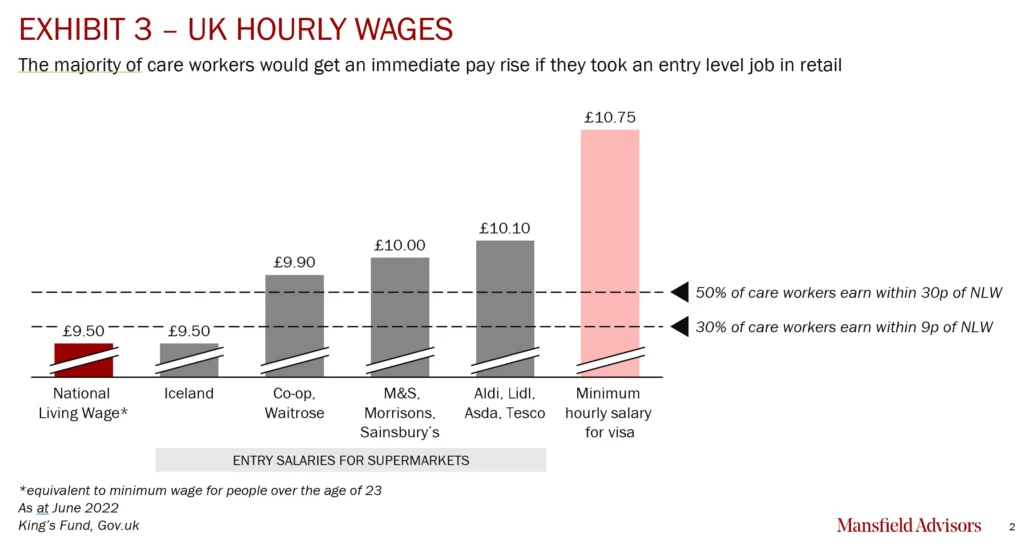
Pay: The Government would argue that social care competes with other sectors, but providers, like supermarkets and restaurants, set wages in an open labour market (which hints at part of the solution to the current crisis). The minimum wage sets the lower boundary, but providers could pay more to attract more. Yet King’s Fund research in 2022 showed that 30% of care workers earned within 9p, and 50% within 30p of the hourly National Living Wage (NLW). Rather than being a minimum, the NLW has become the de facto reference price for care workers.
As a result, care workers are dependent on benefits and even charity to make ends meet. 20% have dependent children and 40% have other family responsibilities which limit the hours they can work. Unsurprisingly, 18.5% of residential carers live in a household in poverty, and 16.9% of residential carers receive Universal Credit, according to the Health Foundation.
Financial hardship is more prevalent than the benefits system implies: the Care Workers Charity (CWC), gives emergency grants to care workers (£2.1m in 2020), and while 30% of applicants are receiving Universal Credit, 70% do not. We cannot simply conflate care workers with dependent children and Universal Credit, but our own rough estimate is that up to £5bn of Universal Credit is effectively supporting the care sector. Put another way, the benefits system represents a hidden 15-20% subsidy on top of the £27bn cost of adult social care.
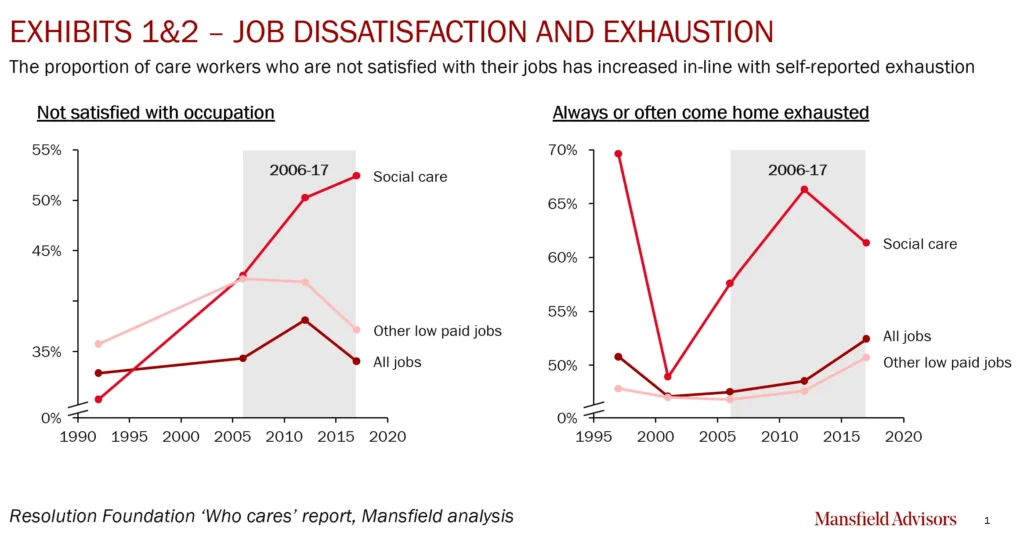
Status: Status is typically recognised through absolute levels of pay, and differentials within and between professions, but job satisfaction is a more complex blend of financial and personal rewards. The Resolution Foundation found that, historically, care workers were satisfied with their jobs, but this started to decline after 2006, particularly as reported levels of exhaustion grew.
Low pay fails to reflect the responsibility of the care worker’s role, and care work is far more physically and emotionally demanding than competing sectors. In fact, care worker pay now lags retail: in June 2022, 9 in 10 major supermarket chains paid entry level roles 40p per hour more than the NLW, and the differentials have been eroded over time. A retail assistant in 2012/13 earned 16p per hour less than a care worker. By 2020/21, retail assistants were paid 21p more per hour.
In contrast to wages in most professions, social care wages barely change with experience level, and differentials within the profession have eroded. In 2021/22, a care worker with 5 years’ experience was paid just 6p per hour more than one with less than a year’s experience. Prior to 2017, this gap was 35p. Hence, highly experienced care workers, who create value not only by providing care but also by training and mentoring new starters, earn little more than their trainees and often feel frustrated and dissatisfied.
Vacancies: Skills for Care1 reported that vacancies increased 52% between 2020/21 and 2021/22: there are 165,000 vacancies out of a workforce of 1.62m care workers. Furthermore, we expect demand for geriatric care to grow at 1.7-2.2% per year, compared with 0.3% growth in the labour force. Put simply, the care system needs to win workers from other sectors to fill vacancies now and into the future.

Migrant workers: The Government has responded by making it easier to hire care workers from overseas. Following a Migration Advisory Committee’s recommendation, all care workers were added to the Health and Care Worker visa scheme. In the year to April, more than 60,000 have applied, and these new migrant care workers are being paid more than the average entry level wage at top providers.
*
The reality is a care sector grappling with record vacancies and struggling to recruit. These challenges affect availability and quality of social care, and have implications for the NHS and its congested hospitals. While charities such as the CWC reduce reliance on pay advances or payday loans in times of need, that such help is needed is the consequence of low pay. The CWC has repeatedly closed its emergency grants fund due to demand exceeding the resources available. The system feels broken, and as more care workers leave, those remaining work ever harder, and even more burn out and leave.
What could we do?
Understanding the economic trade-offs is critical to breaking the cycle and developing a better deal for care workers. Market mechanisms have so far failed to rebalance the workforce in favour of social care, but it also makes little sense to deprive wealth-creating sectors of workers. Migrant workers are only a short-term fix and paying them more than workers recruited domestically creates a whole new set of imbalances and frustrations.
We do, however, have record numbers of people who are economically inactive, including 2.6 million people who are long-term sick. The Department for Work and Pensions, by way of the Spectator1, estimated that 20% of the population of working age is claiming out-of-work benefits. Attracting more people back into the workforce could make a significant difference to the labour market in social care and more broadly. Providing better pay, greater recognition, and improved career progression – including formal professionalisation – could attract more into social care and stimulate a rebalancing of the workforce. If social care is made more attractive, it need not deprive other sectors of workers if the supply of workers overall is increasing.
Higher pay, in particular increments which reward experience, would also improve retention. There could even be a positive return on investment in pay if it reduces hiring and training costs via reduced churn and increases revenue in the case of limited admittances due to inadequate staffing; higher wages and more staff could stimulate growth.
Nevertheless, the examples of New Zealand and Germany show that any approach needs to be pragmatic. In New Zealand, all care workers received a significant increase in pay, but a meaningful number opted to work fewer hours, because they did not want more money. In fact, given the flexible nature of the work, some care workers already earn what they perceive they need and then focus on their other responsibilities, such as child care. [TL1] [AS2]
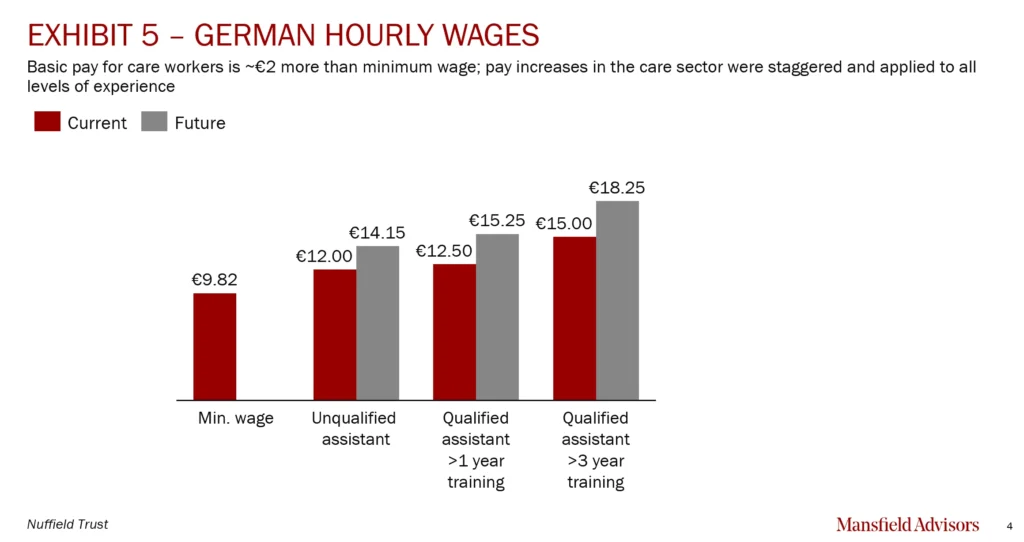
Germany, by contrast, implemented a more gradual increase in wages and has achieved better outcomes for the industry. The Care Wages Improvement Act 2018, updated in 2022, set wages for unqualified care assistants, and then additional wages for qualified assistants and assistants with 3 years of training. The minimum wage for a care worker is €2.18 higher than the national minimum wage and since Germany’s minimum wage itself is contingent on experience, there is a de facto salary scale for care workers, helping to build the idea of social care as a profession.
What should we do?
Ultimately, we need to develop a strategy which includes elements of all the above: encourage more to re-enter the workforce and make social care more attractive.
According to Skills for Care, experience levels are somewhat bimodal, there are many workers with less than 3 years’ experience and many with 10+ years in social care. In visits to care homes, it becomes clear that the relative value creation of experienced workers vs. new joiners eclipses the minimal pay gap. Key to developing the new joiners into more productive carers is a recognition of skill development.
The Resolution Foundation and the Liberal Democrats are calling for a care worker minimum wage that is £2 more than the national minimum wage. They estimate that this will increase gross spend by 8%, and net spend by 4% once increased tax contributions and reduced benefits are considered. While an across-the-board pay raise would make the role more attractive, it would fail to acknowledge the experience of seasoned employees and it would put a significant burden on employers. Labour costs already account for 60% or more of a care home’s turnover, and many homes run on relatively thin margins. Such a pay hike without additional value creation would be unfair to operators and much of the cost could eventually fall to taxpayers as nearly half of the sector is funded by local government. However, a progressive pay increase, one like that in Germany that scales with experience could be more than equitable.
In addition to increased pay, a more formal and centralised registration service for industry veterans, and titles that reflect relative experience would bring a level of status to the role. Registries for social care workers exist throughout the UK but they are country-specific and under-utilised, particularly by newcomers to the industry. Training and accreditation programs provided by professional societies can both upskill the workforce and help individuals demonstrate their value-add to employers. Routes to special senior titles, perhaps with 3+ years of experience, could also help retain talent within the sector.
It is not for us to determine exactly which levels of experience merit a pay increase, that is a conversation for workers, representatives like the CWC, operators, and regulators. However, we do know there is both a human and economic argument for lifting the wages and status of care workers to reflect the service and compassion they provide our loved ones.
The state of the adult social care sector and workforce in England. (2023, October). https://www.skillsforcare.org.uk/Adult-Social-Care-Workforce-Data/Workforce-intelligence/publications/national-information/The-state-of-the-adult-social-care-sector-and-workforce-in-England.aspx
Nelson, F. (2022, November 27). Yes, five million are on out-of-work benefits. here’s The proof. https://www.spectator.co.uk/article/yes-five-million-are-on-out-of-work-benefits-heres-the-proof/
