


Introduction
Insufficient diagnostic capacity has been a constraint on relative U.K. health system performance for decades, but there had been clear improvements towards an apparently politically acceptable level. However, since the COVID-19 pandemic, waiting times have again increased and it feels like we are going sideways at best.
Imaging has seen fundamental growth in both testing and monitoring to help doctors make data-driven treatment decisions. The increase in waiting lists has resulted in a major initiative to build community diagnostic centres (CDCs) and this has provided a new opportunity for corporate providers and their investors.
The right diagnosis, early in the pathway, creates tremendous value for patients and for society, but it can be difficult to fully communicate the value to both NHS and private payors and capture more of the tremendous value created. The sector has seen strong competition on private prices and NHS tariffs, which has now abated. But now price levels make it substantial private capex investment justifiable only for contractually guaranteed volumes. Volumes have been growing for many years, but that growth has been affected by the pandemic and its after-effects. Until it returns emphatically, lenders and investors want to see guaranteed contracts and little uncertainty as a quid pro quo, but the sector is dependent on NHS payors who have been strangely reluctant to commit long-term despite the apparent predictability of their needs.
NHS imaging equipment is running at high levels of utilisation and much of it is old or out-dated. MRI and CT scanning rates in 2019 (or nearest year) were substantially below other comparable countries, with the UK performing, per capita, around 50% of the MRI, CT and PET CT scans undertaken in the US, Germany, and France. The UK has far worse five-year cancer survival rates in key tumour types than these countries, and late diagnosis is seen as a contributing factor. Additionally, increasing practice of defensive medicine is driving utilisation and together with replacement of older consultants to younger consultants who rely on scans for diagnosis. Finally, there is a post-Covid backlog resulting from people who were scanned when diagnosed and treatment planned but need re-scanning because they’ve waited so long for an operation that the consultant needs to re-plan treatment. Therefore, diagnostics is supposed now be a major priority.
Diagnostic imaging consists of image generation and reading
Generation is the images being taken by radiographers and reporting requires a radiologist to produce a diagnosis. Generation has seen less outsourcing than reporting but growing waiting lists mean both now present opportunities for the private sector. Reporting can be outsourced remotely, even internationally, via teleradiology while generation will always be a local service.

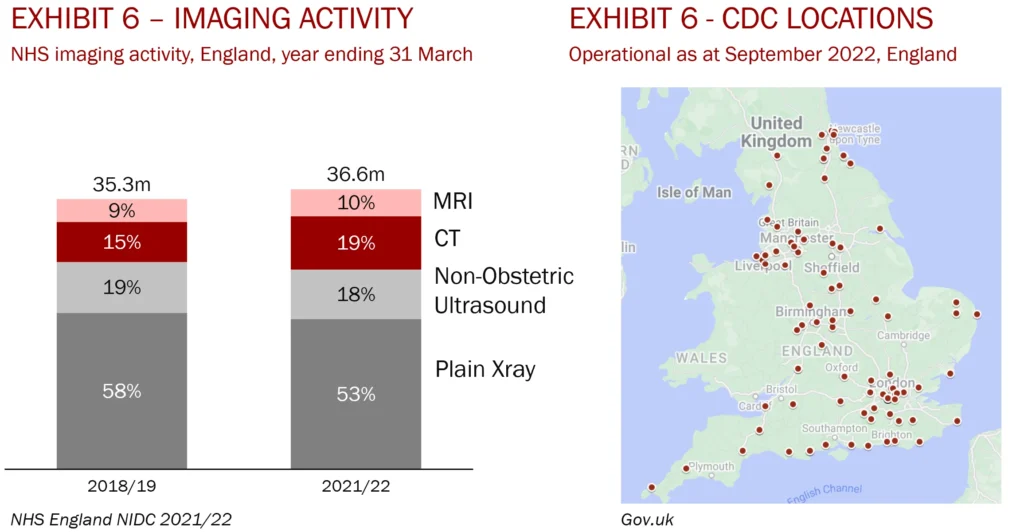
The most frequent image types and modalities differ in NHS facilities and private hospitals. CT and plain film see much higher utilisation in the NHS in unplanned care/A&E patients, and ultrasound in ante-natal care. MRI is used extensively in elective pathways and therefore sees much higher utilisation in private hospitals. MRI, echocardiography, and endoscopy is more often outsourced as part of planned services. However, plain film and CT both have significant elective volumes that could be conducted out of a hospital setting or outsourced, for instance, large PET CT contracts have been awarded to Alliance Medical, a private provider. In recent years both MRI and CT/PET CT have seen greater growth in scan numbers than other imaging modalities with movement from X-ray to these imaging methods.
Image generation markets have seen an increase in M&A activity in recent years
There are a range of ways that the NHS have used the private sector for imaging services: Mobile scanners, CCG community and GP direct access contracts, outsourced diagnostic centres, MRI and CT imaging contracts, and national contracts.
(Exhibit 3) Major players in the image generation market include Alliance Medical, InHealth, Healthshare, Medneo and Medical Imaging Partnership. Alliance Medical was previously owned by a consortium of 3i, Graphite Capital, Bridgepoint, Dubai International Capital and M&G before being sold to South African company Life Healthcare. Outside the U.K. and South Africa, Alliance Health are also present in Italy, Ireland, and northern Europe. Apposite Capital acquired a majority share of the Medical Imaging Partnership in 2016 and since it’s been six years, would presumably look to exit before too long. InHealth, chaired by Richard Bradford, remains resolutely private. Healthshare UK, has been backed by BGF in its muscular-skeletal health and diagnostics offerings for the NHS. Medneo, a German operator entered the market in 2018 and have highly active in seeking out NHS contracts.
Most of these providers have been actively acquiring. In 2017 alone, Medical Imaging Partnership acquired the Queen Anne St Imaging centre from Nuada Medical, InHealth acquired the Manchester CATS service from CARE UK, and Alliance Medical acquired Direct Medical Imaging. In 2019, Healthshare acquired Global Diagnostics and InHealth acquired United Open MRI. In 2022, InHealth acquired C7 Health which is the healthcare software platform that owns TAC Healthcare. More unusually, the owners of the diagnostics provider Lyca Healthcare acquired a full-service hospital, the Kent Institute of Medicine and Surgery (KIMS.) US imaging provider Radnet acquired radiologist-owned Heart and Lung Health in their first UK acquisition, which, as the name suggests, specialises in chest and cardiac.
What are community diagnostic centres?
CDCs are intended to be one-stop-shops for checks, scans and tests provided in a community setting, such as shopping centres and high-streets, away from hospitals, and are now being implemented. The 2019 NHS Long Term Plan emphasised the need for restructuring and more provision. Professor Sir Mike Richards’s October 2020 report outlined a plan for diagnostic waiting lists. Community diagnostic centres separate emergency/acute care from elective diagnostics. They also provide more accessible and convenient services for urgent cancer diagnoses, stroke, heart disease, and respiratory conditions. The initiative gained traction and now has £2.3bn budgeted to open up to 160 centres. The aim is to achieve 3.8 million diagnostic tests by March 2023 and up to 10 million diagnostic tests by March 2025. These aims are fairly general, as they have not projected tests by segment or described how much capacity is replacement or incremental.
Are community diagnostic centres the solution to tackle waiting lists?
The aging population, with its higher prevalence of heart disease and cancer, is an obvious driver of demand. Medical need has more often converted into demand when GPs have been supported to make direct referrals for advanced diagnostic imaging, and accessibility has increased for screening and early detection.
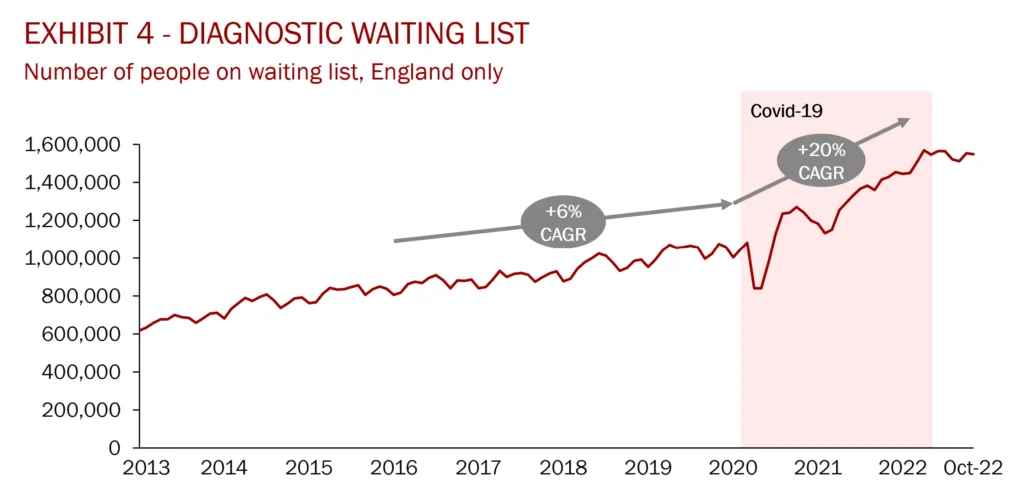
COVID-19 has curtailed supply as enhanced c leaning has cut into the available hours even once all the facilities became fully operational again. The number of patients waiting more than six weeks has grown exploded, from 31,395 in November 2019 to 427,968 in November 2022. The waiting list for Non-Obstetric Ultrasound has increased the most, from 388,056 in November 2020 to 554,816 two years later. This creates opportunity for providers such as Healthshare to provide these services. KP Doyle, its Chair, is optimistic that patients’ entitlement to choose a provider right from the beginning of the pathway will soon be re-emphasized in national policy, against having them being left to languish first on waiting lists before they are offered alternative such as a local independent provider. He is clear that policy direction like this is key to making choice work for patients, and the direction of policy is indeed in this direction, as shown by a move away from block funding to hospital Trusts from April 2023 onwards.
CDCs are supposed to make diagnostic imaging more accessible but more importantly will free up hospital capacity for urgent and acute patients. Hospitals need spare capacity for urgent needs, but high throughput efficiency is difficult to achieve when plans are continuously disrupted. Non-hospital diagnoses are likely to result in the all-clear and are likely straightforward, not an interesting case or high-tech modality. Dull, repetitive work must be paid for directly at an arms-length basis if it is to be quickly and efficiently delivered. Emergency trauma MRI is done as quickly as needed in any state hospital anywhere, but the non-urgent x-rays often pile up in the metaphorical corner. So the CDC is meant to take that work out, and patient accessibility is a nice-to-have and excellent public rationale.
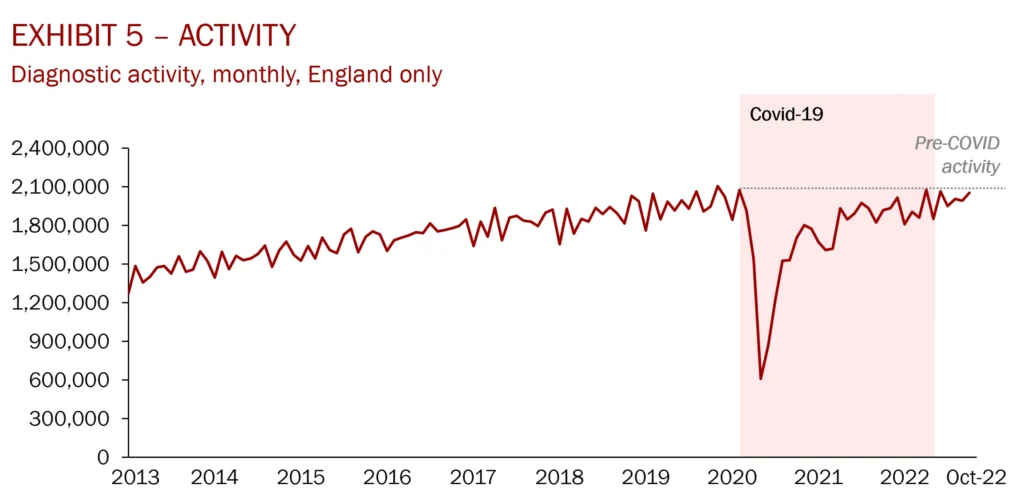
In October 2022, the Department of Health and Social Care stated that CDCs had delivered 2 million checks since July 2021. It is uncertain what proportion of these are additional tests vs those displaced from other diagnostic sites. Waiting lists have recently started to fall but not nearly enough to combat the growth experienced due to COVID-19 and actual diagnostic scan numbers are still not higher than years predating COVID (see Exhibit 5). English volumes have not increased since 2019 and so the CDCs do yet appear to have made a difference.
Dr Tim Ferris, the NHS National Director of Transformation quoted by the King’s Fund in 2022, said that the CDCs had only increased capacity by 2% and would add no more than 5% by 2027. This is a far lower estimate, from someone who would know, than the total number of CDCs vs the current sites would suggest. Even if only 2-5%, activity should be increasing already, even allowing for some double-counting and less incremental new capacity in reality, but we don’t see that in the numbers yet.
There has been a decline in elective activity since COVID-19, though it is returning to normal now, and a similar decline in activity level per system has remained long after the pandemic, offsetting any capacity increase. New machines may not be alleviating the true constraint, as a staff shortage is apparent too.
Opening 160 CDCs is challenging when there is 10.5% vacancy rate across the NHS for radiographers with one interviewee describing CDCs as ‘ghost towns’ because of the inability to find sufficient staff. The National Audit Office (NAO) says local NHS managers argue progress has been delayed due to ‘uncertainty accessing capital.’
There is also a large shortfall in radiologists, argued to be 29% in 2021 and is forecasted to grow to 39% in 2026. 97-98% of clinical directors surveyed are concerned about workforce morale, stress, burnout, backlogs and delays for patients. Teleradiology has already created more accessible supply of radiologist time and expertise. Enhancements in efficiency in improved processes, systems and IT continues to steadily expand it. However radiologists have long since been able to pick up as much extra work as they would like, and there is little utilised time left amongst UK registered radiologists.
We are struck by how busy our British teleradiology contributors are! There is a hard limit to how much more supply could be brought into the sector with just immediate short-term budget increases. This is in contrast with most surgical specialities, where even at current market rates surgeons and staff could do more sessions if the budget were found to pay them and the hospital.
Do community diagnostic centres provide an opportunity for private provider partnerships?
Waiting lists are unlikely to significantly decrease anytime soon and outsourcing will be necessary to keep up with demand. Professor Sir Mike Richards stated that “Use of independent sector facilities where possible should be maximised during the recovery phase”. His report also suggested that full implementation of his recommendations would result in a reduction in “outsourcing of image acquisition and generation”, however we are unconvinced by this. We expect ever greater reliance on private and corporate provision.
Greater NHS use of the private sector has already been seen with Alliance Medical, InHealth and various smaller providers included in the £10bn NHS framework contract for increasing capacity. We have heard from another private provider that local NHS hospitals are hesitant to sign contracts, but volumes are steady and increasing in under-served areas of X-ray and ultrasound. There is a lot of demand from NHS hospitals, but currently they are reluctant to guarantee volumes.
The liquidation of Rutherford Health, announced in June 2022, was highly unfortunate. Rutherford Health formed one of the flagship CDC partnerships at the Somerset Foundation Trust but the company failed in its first year. Their focus was on oncology centres and so this does not reflect on the viability of CDCs.
The NHS capital guidance for 2022 to 2025 states large new-build projects for CDCs will only be considered on ‘an exceptional basis’ and will only be supported if it can be demonstrated that a new-build is the only viable approach to increasing diagnostic capacity and addressing health inequalities. NHS Estates may indeed have the space outside of hospitals, but there are few multi-clinic sites to which could be added imaging as a new module, where diagnostics could benefit from GP referrals and the environment provide a pleasant place for staff to work. We reviewed a sample of CDCs and found that many of the centres are simply existing centres rebranded, including within some hospitals, supporting the cynics’ view that much promised new capacity does not look truly incremental. This contradicts the 2021 Spending Review where the Chancellor announced the opening of 160 ‘new’ CDCs.
In August 2022, 47 of the 92 community diagnostic centres existed on hospital sites. There is obviously an opportunity here for corporate imaging specialists to build where a need has been identified for a CDC but not yet built outside hospital. InHealth has built 11 community diagnostic centres which they state are located “in a community setting and can be NHS-branded’.
Conclusion
Studying British healthcare opportunities, it’s enervating how often one has to read the word ‘underinvestment’ when what is meant is there no personal or public incentive to spend more on a diagnostic, preventative or screening service even though on average it is probably worth far more than it costs to society, the individual or the state. But since diagnostic imaging is indeed unusually dependent on substantial capital expenditure, into both machines and human capital, the term investment is for once entirely valid here as an accountant would use the word, not as politician would do so, i.e. when using investment to mean any and all ‘good’ spending with a positive return perceptible to voters.
It’s incontrovertible that the British have underinvested in their imaging capacity, since we have only have only half the relative capacity in machines of other OECD countries. Working the equipment and senior staff harder, along with removing any bias towards referral, does take away some of that difference. But it doesn’t immediately follow that private capital should rush to fill the gap with other countries. Demand is constrained by the bifurcation of spending into either a state bureaucracy or individual spending, but of that at most a tenth of the population would have that cost reimbursed by an insurer.
There is no other private or public organisation in the middle, providing long-term group coverage, and incentivised towards early detection and effective diagnosis. Any state, and the UK is no different, is motivated by embarrassing international comparisons in healthcare as in education, but this is a blunt instrument which works slowly and fitfully. It most often results in exhortations to greater performance, without any new control taken or system incentive created. Bouts of spending on machines or buildings occur, because they can be seen, rather than a creation of a predictable and profitable market, which is far more difficult to design, deliver and sustain.
We don’t have time or space here to hypothesis how a well-designed system would fix this, or discuss how close other countries get. Back to the here and now, the answer is that British corporate providers can make an economic profit (after the cost of capital) in outsourcing but only when the local demand/supply and NHS environment is very well understood, and relationships can be maintained. There is little sense in speculative ventures, because the private market outside London is too small to make economic sense alone in most cases. The alternative, of ‘insourcing’ contracts, for capex and/or management and/or maintenance is perhaps a surer bet, and we think this sector is larger than most outsiders appreciate. This type of offering appears dominated by larger, more established players who are not following the headlines but sticking to their knitting of understanding imaging services better than any generalist, state-owned hospital would be able to. Either way, private investors have to bring real commercial and clinical skills and a lot more than just capital to the table to add and capture value sustainably.
Related Insights
Lorem ipsum dolor sit amet, consectetur adipiscing elit, sed do eiusmod tempor incididunt ut labore et dolore magna aliqua.


