


Amidst the tragic headlines about children who have slipped through the care system, the vision for children’s services has been remarkably clear and consistent: vulnerable children are best looked after in a home environment. If they cannot be looked after in their own home, then it should be a setting as close as possible to a home environment. This has favoured the growth of fostering as the preferred option for children who are looked after (CLA) and as local authorities (LA) have struggled to supply sufficient capacity, the market for independent fostering agencies (IFA) has grown.
Many IFAs are private equity (PE) owned, including National Fostering Agency by Stirling Square Capital, Polaris by CapVest and Compass by Graphite Capital, but there have not been any significant transactions since the acquisition of BSN Social Care by MML Capital in 2021. Nevertheless, interest in the sector will grow, with a number of assets, including both Polaris and Compass, expected to come to market during 2023. The key question for investors is what will drive value in the future, especially as growth in fostering appears to be slowing, recruiting enough carers seems ever more challenging and the Government is implementing a new children’s services strategy.
Recent trends
Focusing on England, the number of CLA has been growing by 2.1% (CAGR 2012-22). Despite this, growth in fostering – irrespective of provider type – has been lagging, with growth of just 1.4% (CAGR 2012-22) [Figure 1]. While IFAs[1]
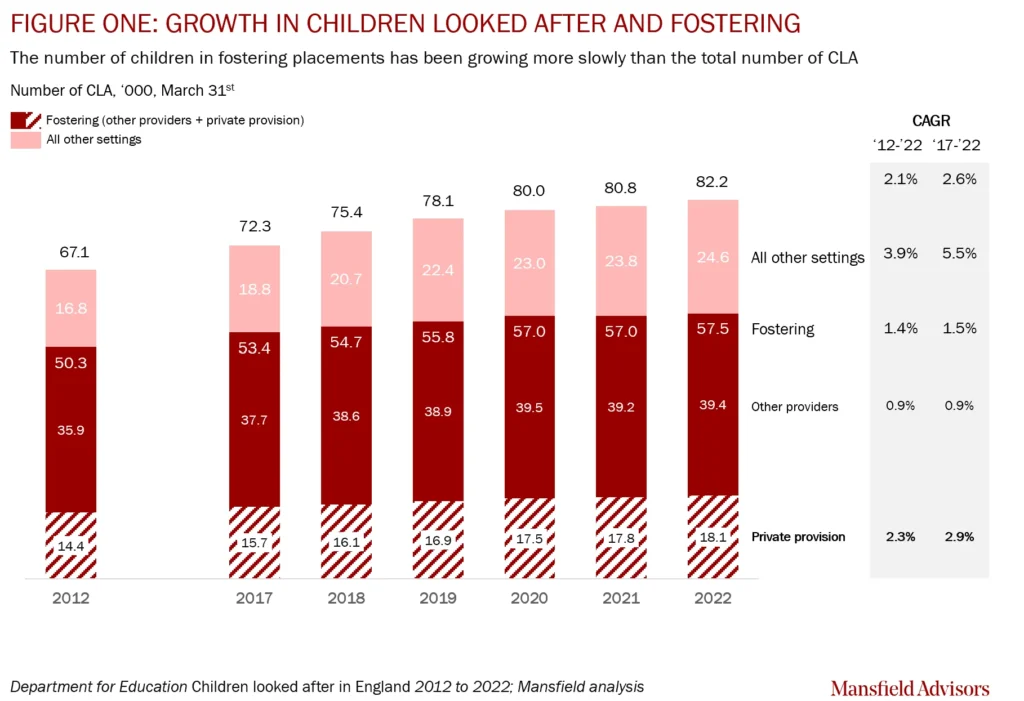
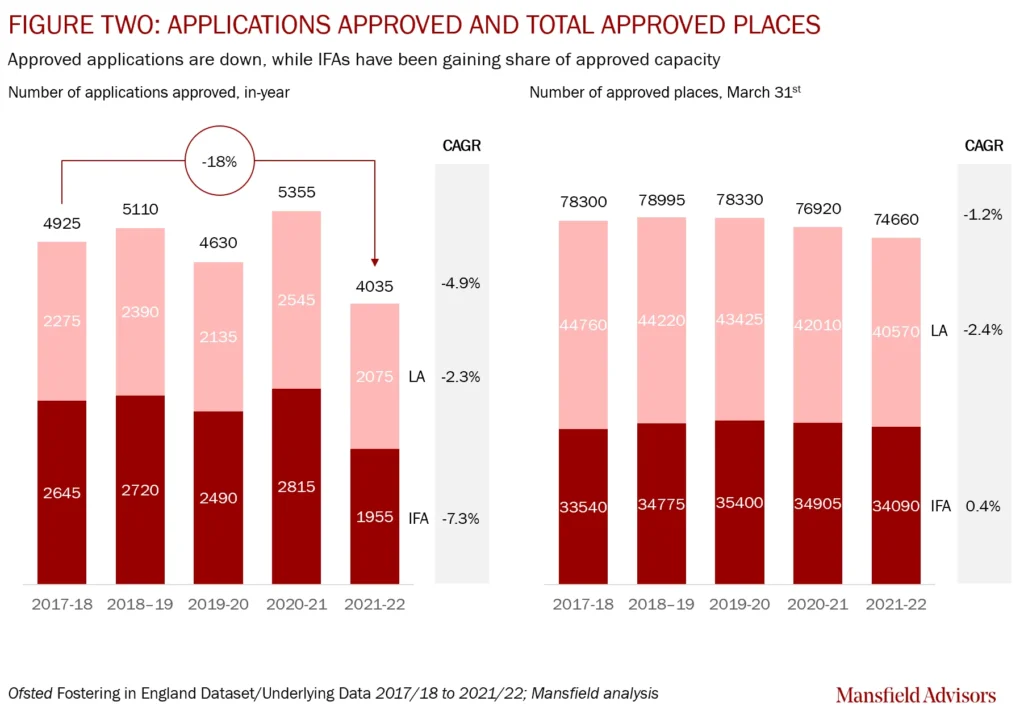
[1] Defined as ‘private provision’ have been taking share, up from 28.6% in 2012 to 31.5% in 2022, behind the scenes, both LAs and IFAs are struggling to recruit sufficient carers, with approved applications in 2021/22 down 18% on 2017/18. As carers leave the system, capacity has been declining, down 3,640 places overall, with IFAs managing a small increase offset by LA declines [Figure 2]. Overall, then, it looks like fostering could well be supply-constrained, and any provider which can deliver a successful recruitment strategy should be able to outpace the market.
Although fostering is the preferred option, the proportion of CLA in fostering placements varies markedly, from 44% in Hillingdon to 86% in Merton (31 March 2022), so there are still some LAs which appear to have further to go [Figure 3].
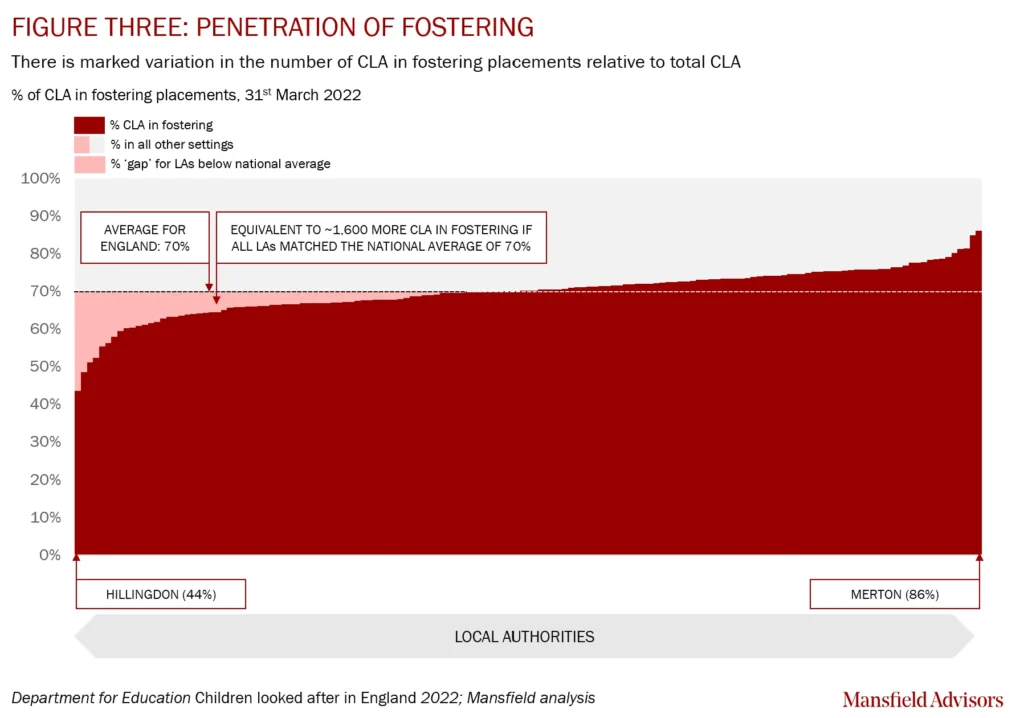
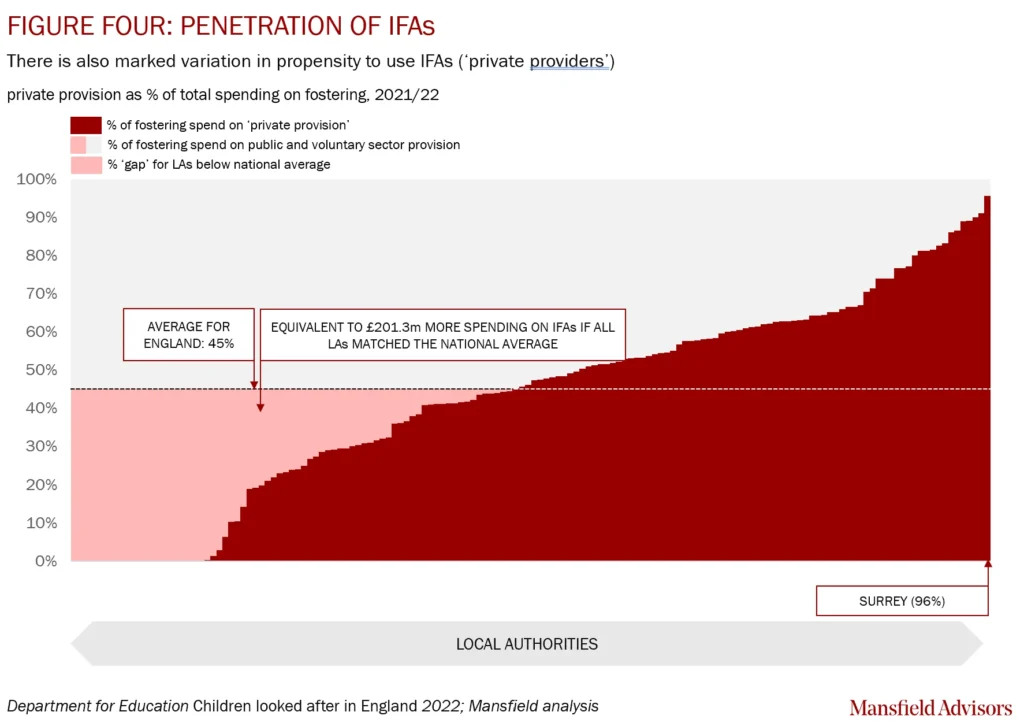
If lagging LAs matched the national average of 70% of CLA in fostering, that implies ~1,600 more children in foster placements, but all LAs achieving the maximum of 86% would imply more than 13,000 more. Nationally, 45% of the £1.9bn spent on fostering was with private providers, but varies from 0% in 19 LAs to 96% in Surrey [Figure 4].
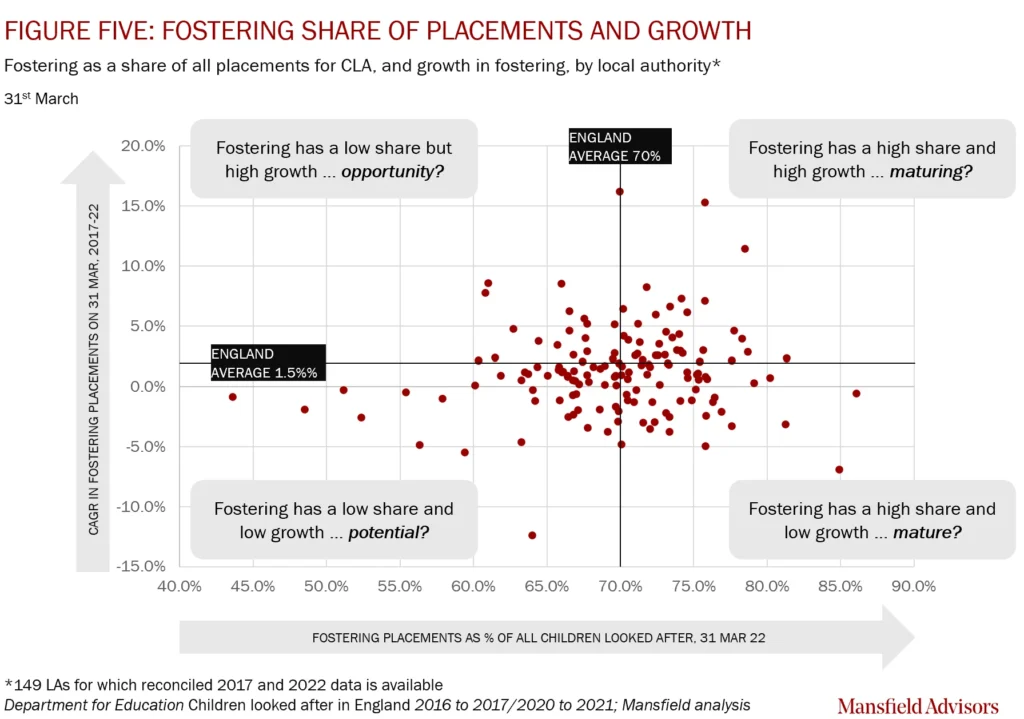
There are 46 LAs where fostering is underpenetrated and growth has been slow (i.e. below average) [Figure 5], and while we have not completed a deep dive into why, it seems plausible that, again, recruitment of carers may be challenging, but perhaps there is also a cultural aversion to using IFAs to stimulate local markets. Understanding which of these underpenetrated LAs – whether that’s low penetration of fostering or low penetration of IFAs – might present an opportunity is therefore valuable to providers seeking growth.
Government strategy
The Government published its new strategy, ‘Stable Homes Built on Love,’ in February 2023. It is billed as a “once in a generation” opportunity for reform and has its origins in a series of reviews dating back to 2020 [Figure 6]. What is likely to stand out and even alarm investors is that these reviews were critical of the role played by the independent sector in children’s services, especially PE-backed providers.

The Children’s Commissioner, Local Government Association (LGA), the Competition and Markets Authority (CMA) and Independent Review[1] talked about dysfunctional markets, excessive profits and the risk of ‘disorderly departure’ by providers carrying excessive debt. The Independent Review even recommended a windfall tax on large for-profit providers, although the Government ultimately did not proceed, arguing it would deter investment and make a difficult situation worse. However, the Government has proposed a financial oversight regime for the largest providers to increase transparency and reduce the risk of sudden market exit. This could actually favour large providers with robust financials, by signalling to commissioners they are stable long-term partners.
Along with another review by the Childrens Safeguarding Review Panel[2], the Independent Review also highlighted suboptimal organisation, complex regulation and care standards, and poor information sharing as additional reasons why children’s services are failing. Inadequate forward planning and market coordination was identified as another issue, and our own research found LA statutory plans are often out of date, making it difficult for providers to work out what is needed, even when there are acute shortages of appropriate places.
All these findings were acknowledged by the Government and its strategy proposes reforms and pilots across 6 ‘pillars’:
- Family help so that children can thrive with their families: improved Family Help services, investing in workforce and multi-disciplinary working to ensure early intervention and support to sustain family life
- Decisive multi-agency child protection system: pilot new Child Protection Lead Practitioners and multi-agency response, plus new standards and guidance, and speeding up court decisions to enable earlier intervention
- Unlocking the potential of family networks: test ‘family group decision making’ so more children could be placed with family and friends, plus training for ‘kinship carers’; improved payments for family carers
- Putting love, relationships and a stable home at the heart of being a child in care: boost foster care, including investment in recruitment and retention, review of standards, pilot Regional Care Cooperatives (RCC), financial oversight
- A valued, supported and highly-skilled social worker for every child that needs one: focus on recruiting and retaining social workers, reduce agency use and consult on price caps, prioritise high quality career development
- A system that continuously learns and improves, and makes better use of evidence and data: Children’s Social Care Framework and Dashboard to share best practice and data, a new funding formula and inspections aligned with the framework
Much of the strategy therefore focuses on making markets work better, collaborative working and strengthening family and home as the most appropriate settings for CLA. None of this is necessarily bad for IFAs.
RCCs are the most radical proposal, envisaging ~20 LA collaboratives which would plan and commission children’s services. Their size should mean greater market power, and could force down fees, but it is also likely to favour larger IFAs with the scale to meet an RCC’s needs. Hence, RCCs may be a stimulus for further M&A and squeeze out smaller IFAs. Ultimately, expansion in supply should contain fees, but in the short term, ongoing shortages of places should underpin price. The consultation on RCCs, pilots, legislation and roll-out also mean nationwide implementation is unlikely for several years.
[1] The Independent Review of Children’s Social Care, May 2022
[2] Child Protection in England, May 2022
New directions for growth
Against this backdrop of reform and change, we have characterised growth opportunities in terms of adjacencies, using the education, health and care approach to planning support for children [Figure 7].

The core IFA offer is part of the ‘care’ domain and providers which want to stay focused could, of course, look for opportunities in underpenetrated LAs. However, while the practical ceiling to fostering is unknown, lifting all LAs to national average penetration (70%) means only 2.8% more in fostering, which is hardly transformative. Lifting all LAs to the penetration in Merton (86%) implies a more significant increase (~23%), but requires change in almost every LA.
Therefore, ambitious IFAs need new ways to drive growth. The simplest approach is to move into other care services, but the most innovative IFAs could consider adjacencies in education and even health. Hence, a much bolder approach would bundle other services with fostering capabilities to meet a broader range of support needs:
- Care: programmes to support kinship carers which draw on IFAs’ experience in training and supporting foster carers. Transitional care and 16+ assisted living which could be integrated into fostering or kinship placements. ‘Traditional’ residential services.
- Education: stand-alone special education, home education, tutoring and digital/ed-tech services, and/or focused on supporting fostered children. Training, consultancy and assessment services.
- Health: therapeutic fostering, or stand-alone CAMHS and therapy services. Other health services, such as health checks.
There are challenges to this bold approach:
- packaging adjacencies with fostering is likely to be new to many LAs, presenting them with a blended service they may not have commissioned before.
- LAs may resist paying for therapeutic services, and the NHS resists paying for social care, so it may be difficult to find payors for multi-disciplinary education, health and care packages.
IFAs considering this kind of strategy therefore need to understand commissioner sentiment and, even where favourable, they could face building a market from scratch. Yet ‘multi-disciplinary’ is very clearly the direction of travel in the Government’s strategy and outcomes for CLA are already compromised by a lack of access to other services. Therefore, IFAs which approach LAs with joined-up solutions might find they are welcomed with open arms, particularly those which can point to evidence of improved outcomes and wider social benefits.
Conclusion
We are optimistic about the future for IFAs, and growth remaining in their core market, even if it is slower. There will be in-fill opportunities in underpenetrated LAs, in LAs which can be encouraged to use IFAs and in M&A as the largest IFAs are seen as more effective counterparties to RCCs. However, this is also a sector which has barely started to explore its potential. Fostering on its own, and combined with education and health, can transform the lives of many more CLA. So, what next for IFAs? It is likely to be a brave new world where investors in innovation and relationships really outperform.