


How often do you think about the money to be made from your food? Perhaps not as often as you should. Grazing and animal feed production require three-quarters of all agricultural land and are the most important economic factor for meat and fish production (See Exhibit One). Better feed is a large part of animal health. Not just an obvious essential; better food helps you – the reader – be healthier and more productive, and so optimal feed and supplemental additives do the same for production animals. Simply put, farmers achieve greater feed conversion ratios for any given land, water and energy use.

The global animal feed market is $500B, including additives at $41B, and both the larger market and additives are growing faster than the population at 4%1. The mix is changing towards more valuable livestock-based product. Two segments, aquafeed and probiotics, are growing fastest and receiving the most investment (See Exhibit Two).
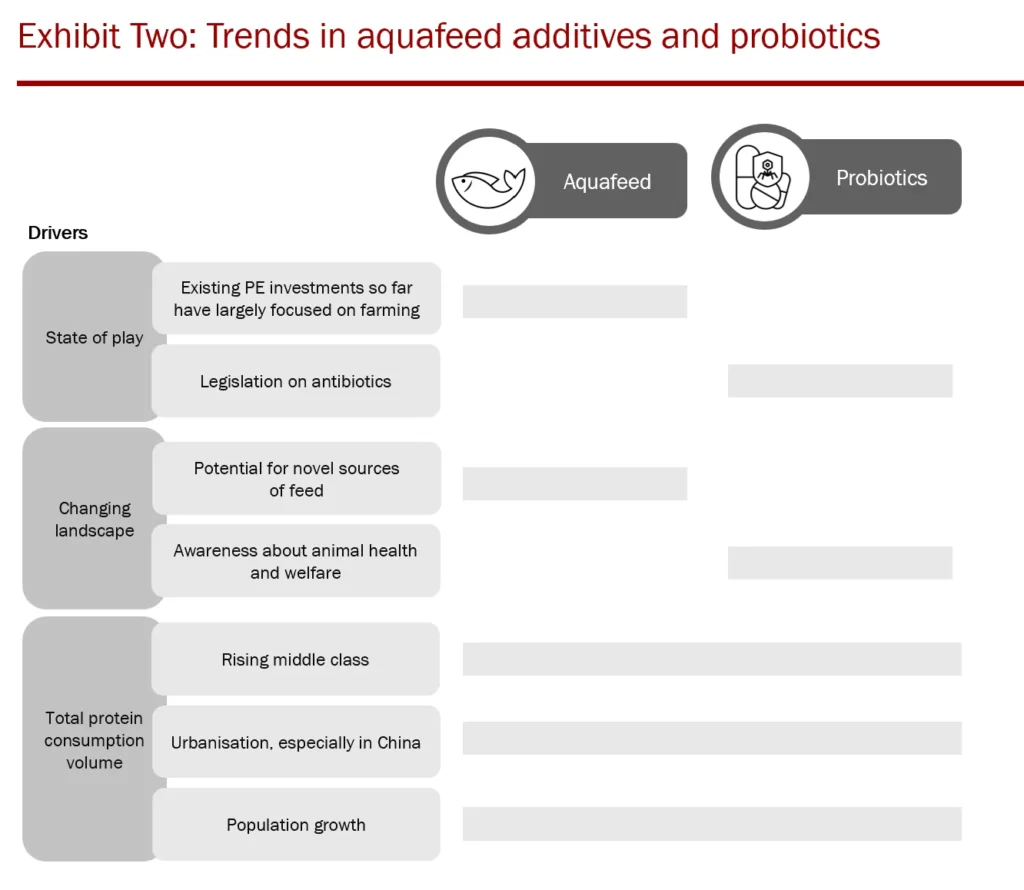
Trends in Aquafeed Additives and Probiotics: Growth Opportunities Ahead
Volumes of farmed fish surpassed those of wild fish in 2013, and aquaculture has continued to expand since, whilst wild fish catches have flat-lined. Moreover, aquaculture is the fastest-growing food production sector2 , so the need for sustainable and efficient practices has become paramount. As such, the aquafeed market, currently estimated at $61.8billion, is expected to surge at a 7.3% CAGR during the forecast period 2023 to 20283.
The other segment where we believe growth is imminent is in probiotics. Probiotics are live beneficial bacteria and/or yeast that are a natural alternative to antibiotic-based growth promoters, recognized for their capacity to safeguard animal (and human) health, enhance growth, and boost immunity and productivity. The market value for probiotics used in animal feed was around $4.6 billion in 2019, a ~8% share of the additive market by product. This market is expected to grow 7.4% annually until 2025, reaching a total value of $7 billion4.
Investment in feed to date
Most of the activity to date has been by large corporates acquiring assets, but private equity (“PE”) has slowly been entering the market, including major groups such as Kohlberg Kravis Roberts & Co. (KKR), which acquired Yuehai Feed Group in 2021, and IK Investment Partners, which acquired Innovad, a global supplier of animal health and nutrition solutions, in 2021. Permira sold aquatic health group PHARMAQ to Zoetis for US$765 million in 2015, and in 2018 re-entered the space, acquiring 50% of the shares of Grobest, an Asian aquafeed producer.
With regard to the corporate activity, major companies such as Archer-Daniels-Midland (ADM), DSM-Firmenich (DSM), Evonik Industries, Bluestar Adisseo Company, Cargill Incorporated, BioMar and BASF have been actively involved in developing innovative feed additives and expanding their market presence (see Table One).

In terms of PE, specifically in aquaculture, firms are investing globally in all parts of the sector. They have thus far been focused on buying up medium-sized companies and then consolidating them, horizontally and vertically (see Table Two).

Aquafeeds will support existing investments into aquaculture, and are on the brink of a technological upgrade
Upon analysis of deals in the last 3 years, it was surprising to find that the majority (22/41) were in the realm of fish farming (see Table Two). We believe this has now created the demand for feed, the logical next step for investment. This was illustrated when Changing Markets spoke to Skretting, a Nutreco company and the world’s largest producer of feeds for farmed fish. They wondered, ‘In order to produce 30 million tons of fish and shrimp we probably need 45 million tons of aqua feed- where are we going to get all this?’
A key barrier to growth in aquafeed is that fish feed traditionally contains a significant proportion of fishmeal and fish oil (FMFO) sourced from wild fish, stocks of which are currently exploited at their maximum. Consequently, Rabobank remarked that ‘fish meal prices have been high and are set to remain so’. The proportion of FMFO within fish feed has already decreased since the 1990s (see Figure Three), however, there is pressure to further reduce dependence on marine ingredients and explore sustainable alternatives. This need for viable, cost effective and sustainable alternatives to FMFO was brought up at the Global Shrimp Forum by Ronnie Tan, a regional aquaculture consultant within the US grains council, who said, ‘for industry the number one problem is that feed prices are very high – since early 2021 shrimp feed prices have risen 25 percent’ and ‘the emergence of El Niño (a climate pattern causing unusual warming of surface waters) is going to reduce the availability of fishmeal and fish oil from the eastern Pacific’.

Two such alternative innovations to FMFO are insect protein and algal oil. The approval of insect protein usage for aquaculture purposes by the European Union in 2017 opened up new avenues for sustainable feed production. Insect protein is seen as an efficient and sustainable alternative protein, with a favourable environmental profile, and the ability to upcycle low-value waste into a high-value ingredient. Although the insect industry faces challenges related to scale and cost, collaborations between feed companies and insect start-ups show promising signs of progress. In 2019, Skretting signed a deal with Protix that could see up to 5.5 million salmon servings per year brought to market with insect meal incorporated into the feed. The largest global land-based aquaculture company, Atlantic Sapphire partnered with Skretting to include Veramaris algal oil (a joint venture of DSM and Evonik) from Q4 2021, reducing the fish oil content in its salmon feed by approximately 25% and accelerating the process of eliminating the use of marine-derived feed ingredients by 2025.
Adisseo and the largest alternative protein producer, Calysta, signed an agreement to establish a joint venture, Calysseo, to develop FeedKind®, a feed composed of naturally occurring microorganisms. Calysseo constructed the world’s first commercial FeedKind® production facility in China, which opened in 2022 and could deliver 20,000 tonnes of FeedKind® protein per year, exclusively for Asian markets. We believe there is scope for a similar venture in Europe, another significant market for aquafeed, especially in countries with strong aquaculture sectors such as Norway, Spain, and the United Kingdom.
Additionally, companies have been going after vertical consolidation: animal nutrition company Alltech and Finnish fish farming circular economy company Finnforel acquired an aquafeed production facility from Raisio, enabling them to develop ‘gigafactories’ specialised in sustainable aquaculture, where they control the entire production chain.
Following these trends, a private equity firm could capitalize on the lucrative growth opportunities in the aquafeed market by implementing a strategy built on sustainable practices, strategic partnerships or incorporation of alternative protein facilities and a scale up of infrastructure enabling operational efficiency.
To highlight the potential for success in the sector, in 2013, Altor and Bain Capital acquired EWOS — a leading aquafeed business — from Cermaq for NOK 6.5 billion (~ 830 million euros), citing the potential to grow by focusing on R&D, developing higher quality feed and global expansion, as well as the increasing demand of consumers for healthier forms of protein. By 2015, it was sold to Cargill for EUR 1.35 billion, with Altor and Bain Capital commenting that they had achieved significant operational improvements across all facets of the business.
Finally, an investment in this sector would help towards Sustainable Development Goals (Zero Hunger, Climate Action, Life Below Water, Responsible Consumption and Production). For instance, salmon is one of the largest consumers of fishmeal and fish oil6 and 80% of farmed salmonoid greenhouse gas emissionarises from feed production. Furthermore, it was found that in a single year, 179,000 tonnes of salmon produced in Scottish aquaculture farms consumed fish meal and fish oil produced from 460,000 tonnes of wild-caught fish, 76% of which was edible.
Opportunity in probiotics
The UK and the EU banned the use of antibiotics for growth promotion or increased yield in their livestock on 1 January 2006. Furthermore in the EU, as of January 2022, the restrictions include antibiotics for prophylactic use, and the ban has been extended to animals and animal products imported into the EU. This legislation is driving the demand for probiotics in feed additives alongside recent advances in molecular biology, and an increase in farmers/owners’ knowledge of the positive effects of probiotics on livestock performance.
Globally, antibiotics are still widely used, with around 160,000 tons of antibiotics fed to farm animals in 2020. In two key meat-producing emerging markets, China and Brazil, the governments implemented initiatives in 2020 to prevent the use of antibiotics as growth-promoters in feed, mirroring the EUs 2006 legislation. If these countries follow Europe’s example, future steps may include banning the use of antibiotics prophylactically, meaning the major fallback option to keep animals’ immune systems primed will be probiotics.
Evidencing a growing demand for probiotics, it was announced that Evonik has expanded its probiotics production in Spain, doubling its capacity for producing Ecobiol®, Fecinor® and GutCare® to 6,000 metric tons. Additionally, the food safety company Kersia acquired BioArmor, which produces natural products for farms, including diet feeds made from probiotics, and has been witnessing growth at a rate of 25%p.a. for the past five years. According to Kersia’s announcement, the merger was based on a strong potential for synergies identified, and complementarities in terms of product ranges in the livestock market (ruminants, pigs, poultry).
Another key market activity in this sector has been the US$12.3 billion deal of Novozymes acquiring Chr. Hansen, expected to close by the end of 2023. Both companies produce biosolutions including enzymes and microbial products, however Chr. Hansen dealt more in the food sector whilst Novozyme had more business in household and industrial sectors. Annual revenue synergies are estimated at €200 million and cost synergies — achievable within three years after completion — at €80-90 million. Novozymes and Chr. Hansen may have paved the way for other mergers in which companies operate in parallel spaces, e.g. making probiotics for human/pet/livestock, thus can profit from synergies.
As the demand for sustainable animal feed solutions surges due to population growth and environmental concerns, probiotics and aquafeed stand to benefit. Probiotics are gaining traction globally, driven by legislation and increased awareness of their benefits in livestock health. The aquafeed market is poised for substantial growth driven by the booming aquaculture industry and beginning to incorporate alternative proteins. Finally, M&A activity in both spaces has already been ramping up, clearly showing investors’ hunger for opportunities in animal feed.
[1] Data Bridge Market Research, Transparency Market Research
2 BNP Paribas
3,4 MarketsandMarkets
5 GRAIN
6 Shepherd et al., 2017; IFFO estimates