


Introduction
PE healthcare IT (HCIT) deals, including buyouts, add-ons, and growth investments, grew by a record CAGR of 18.6% between 2019 and 2021 riding the COVID wave. Though we have seen a slowdown in 2023, add-ons have continued to grow with 2023 run-rate being the second most active year for deals in the past decade.
Recent deals have included CVC Capital Partners’ acquisition of UK-based System C Healthcare and its partner company Graphnet Health in 2021 (HCIT systems and services), ARCHIMED’s acquisition of Italy-based Cardioline in 2021 (cardiology diagnostics and cardiology-focused telemedicine), and Hg and TA Associates backed The Access Group acquisition of UK-based Servelec in 2021 (provider of healthcare and case management software, who the previous month had acquired Elemental, the most widely used digital social prescribing platform in the UK and Ireland).
We believe the HCIT space offers an attractive theme for investors combining defensive (healthcare) with growth assets (tech), and offering strong customer stickiness and attractive recurring revenue streams. Further, we forecast the market to grow, driven by system pressures and new models of care delivery, underpenetrated markets, and strong public funding tailwinds.
Investors should focus on rolling-up solutions that are geared towards clearly defined and prioritised problems, that can easily integrate into existing HCIT landscapes, and that offer high security standards. To pick the right assets, investors will need to really understand the clinical and patient models of the markets in which the assets they are looking at operate.
The healthcare IT landscape is broad
Though there is an ever increasing number of digital health solutions, covering also apps and wearables, we will focus on second generation technology in the care provider setting as this is a more mature market and hence more relevant for private equity investors. These assets include solutions for decision/risk analysis, enterprise system management, Electronic Health Records/ Electronic Patient Records (EHR/EPR), outcome management, telehealth solutions, and other related HCIT services (Exhibit 1).
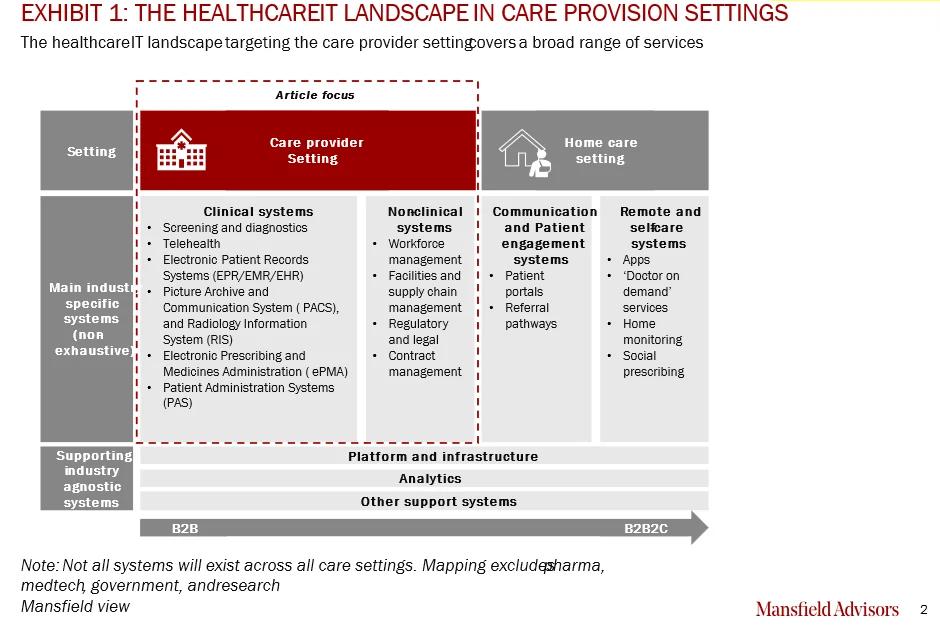
Grand View Research valued the European digital health market at $45.3bn in 2022, expecting it to grow at a CAGR of 16.0% from 2023 to reach $148.5bn by 2030.[i]
Turning to the UK, LaingBuisson estimates that HCIT spend in 2020 was £5bn, of which c. 33% went on clinical systems, c. 30% to staffing and workforce, c. 20% on infrastructure spending (e.g. hardware, networks), c. 15% went on non-clinical systems (e.g. HR, finance, governance), and c. 2% on so-called third generation technology (e.g. apps, patient facing services).[ii]
Three players dominate the UK market with a combined c.40% to c. 60% of the Electronic Prescribing and Medicines Administration (ePMA), EHR/EPR, and Patient Administration Systems (PAS) markets: Italy-based Dedalus (backed by Ardian), US-based Cerner (acquired by Oracle in 2022), and UK-based System C (backed by CVC Capital Partners). These markets however differ slightly however in in terms of exact make-up and who leads.
Remaining larger players in these markets tend to be US-based, and often listed. UK-based and privately held Nervecentre is a notable exception in the UK EHR/EPR market, and the company was recently announced as the preferred supplier for a new joint EPR system by two Derbyshire trusts.[iii]
Some trusts have also constructed their own EHR/EPRs (c. 8.3% or the market in England in 2022) and 10% of acute Trusts in England lack an EHR/EPR altogether. Further, c. 30% lack a ePMA system, and c. 50% to lack a digital document management system.[iv],[v],[vi]
[i] Grand View Research – Europe Digital Health Market Size, Share & Trends Analysis Report By Technology (Tele-healthcare, mHealth, Healthcare Analytics, Digital Health Systems), By Component, By Region, And Segment Forecasts, 2023 – 2030 – Press release
[ii] LaingBuisson – Digital Health UK Market Report – 3rd Edition
[iii] DigitalHealth.Net (3 November 2023): Two Derbyshire trusts pick Nervecentre as preferred supplier for joint EPR. Available at: https://www.digitalhealth.net/2023/11/two-derbyshire-trusts-pick-nervecentre-as-preferred-supplier-for-joint-epr/#:c. :text=for%20joint%20EPR-,Two%20Derbyshire%20trusts%20pick%20Nervecentre%20as%20preferred%20supplier%20for%20joint,patient%20record%20(EPR)%20system. (accessed 27 November 2023)
[iv] LaingBuisson – Digital Health UK Market Report – 3rd Edition
[v] Mansfield interview
[vi] NHS Digital (16 November 2023): 90% of NHS trusts now have electronic patient records. Available at: https://digital.nhs.uk/news/2023/90-of-nhs-trusts-now-have-electronic-patient-records (accessed 21 November 2023)
PE HCIT deals in Europe have seen record growth over the COVID pandemic
PE HCIT deals in Europe grew by a record CAGR of 18.6% deals between 2019 and 2021 (Exhibit 2), and growing faster than PE deals overall (4.3% CAGR). HCIT deals as a percentage of total PE deals also reached all-time highs of 1.5% of all PE deals in 2021 and 2022, and 1.6% in 2023 YTD.
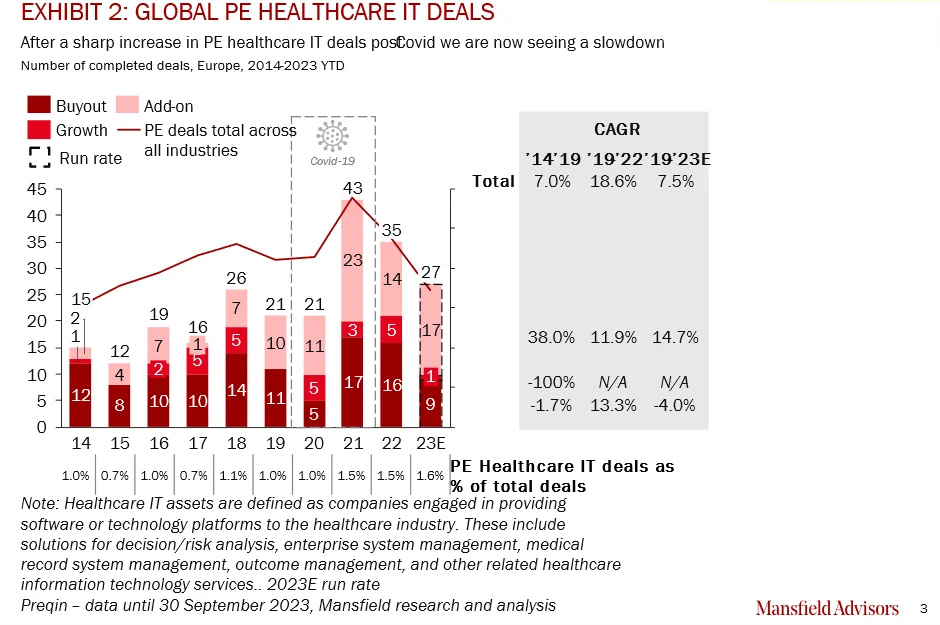
Though we are seeing a slowdown, 2023 is still positioned to be a strong year for HCIT
The number of completed HCIT deals has shrunk in the first three quarters of 2023 (Exhibit 3), reaching its lowest point since Q3 2020.
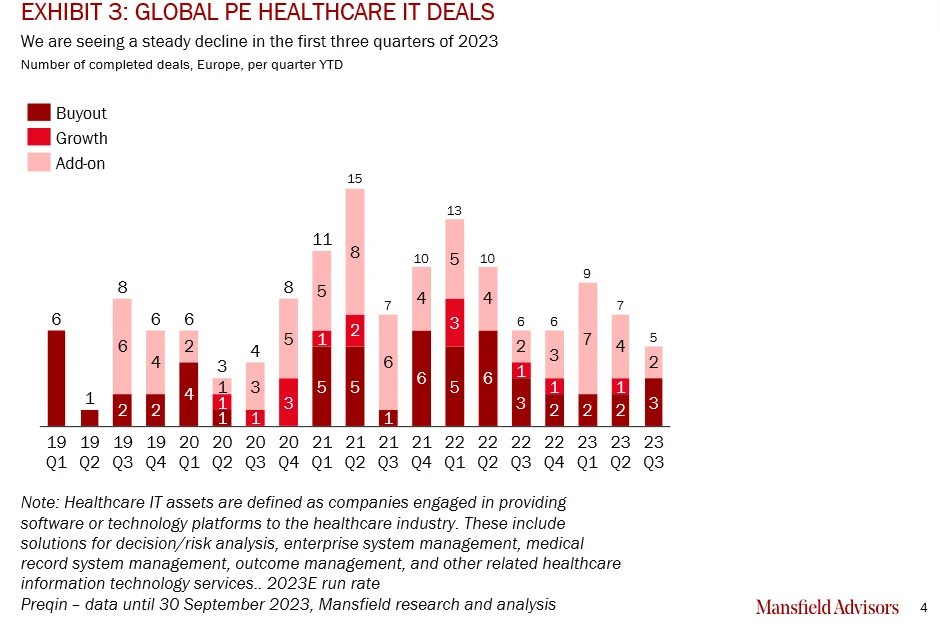
For HCIT companies relying heavily on future growth, inflation can diminish the value of future returns, especially for companies with lower pricing power. This coupled with a high interest rate environment impacting investor willingness to pay, we have seen a decrease in both buyout and growth investment deals.
Hence, Livingbridge’s investment in T-Pro (AI-powered speech technology and clinical documentation solutions) is the only growth investment in 2023 YTD. This is compared to five growth deals in 2022 and 2020, and three in 2021.
Finally, though add-ons have also been impacted with the number of deals falling both in Q2 and Q3 this year, these remain at similar levels per quarter as in 2022.
Run-rating all deals in 2023, this year is still positioned to be the third most active year for PE HCIT deals since 2014 evidencing that investor interest remains strong.
The UK is the largest European HCIT deal market in Europe
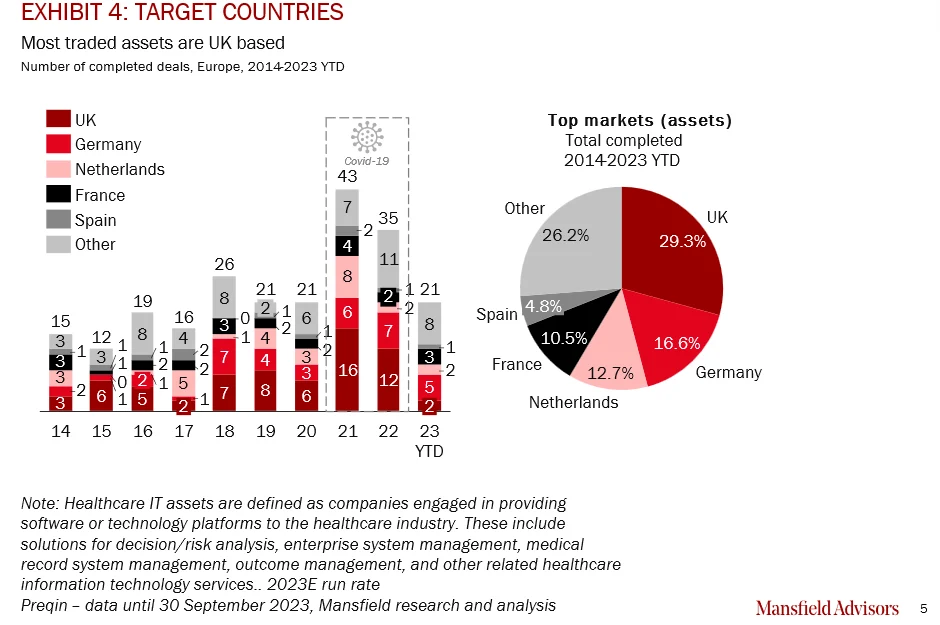
29.3% of all PE HCIT deals since 2014 have involved British assets, making it the most active market in Europe. The UK is followed by Germany (16.6%), and the Netherlands (12.7%)
Recent PE buyouts of UK HCIT assets include CVC Capital Partners’ acquisition of System C in 2021, mentioned above, Ardian backed Dedalus’ acquisition of swiftQueue Technologies in 2021 (healthcare appointment and patient engagement solutions), and Livingbridge’s acquisition of Nourish Care Systems in 2022 (digital care planning software).
The investor landscape is fragmented, though we are seeing some consolidators
The investor landscape is very fragmented, with c. 66% of HCIT investors having only completed one deal, and c. 18% only two deals in the past decade.[i]
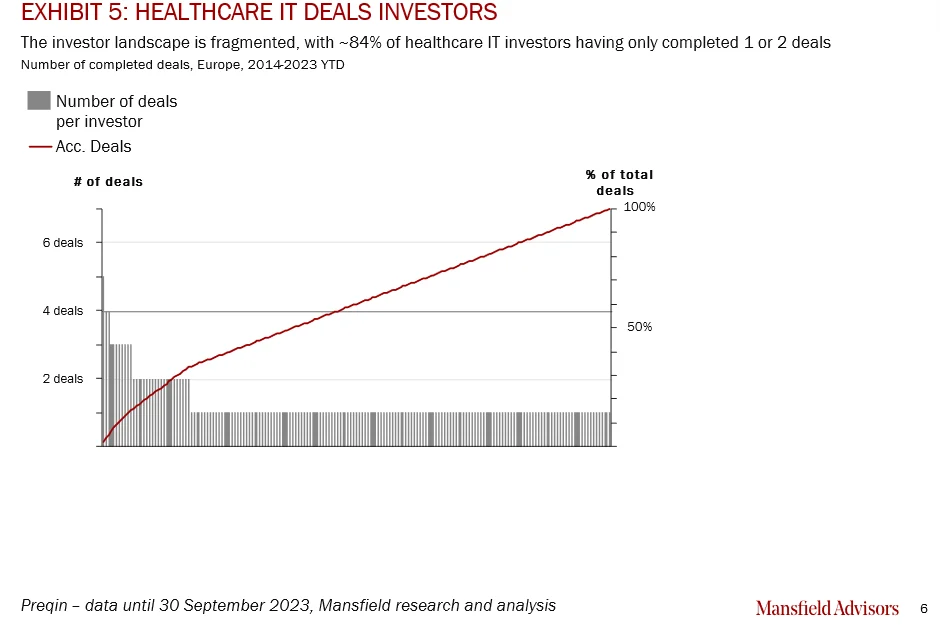
We have however also seen examples of PE asset roll-ups with HCIT add-ons growing more than both buyouts and growth investments in the past 10 years. A prominent example is RLDatix, a UK-based company which develops and supplies risk management and patient safety software (Exhibit 6).
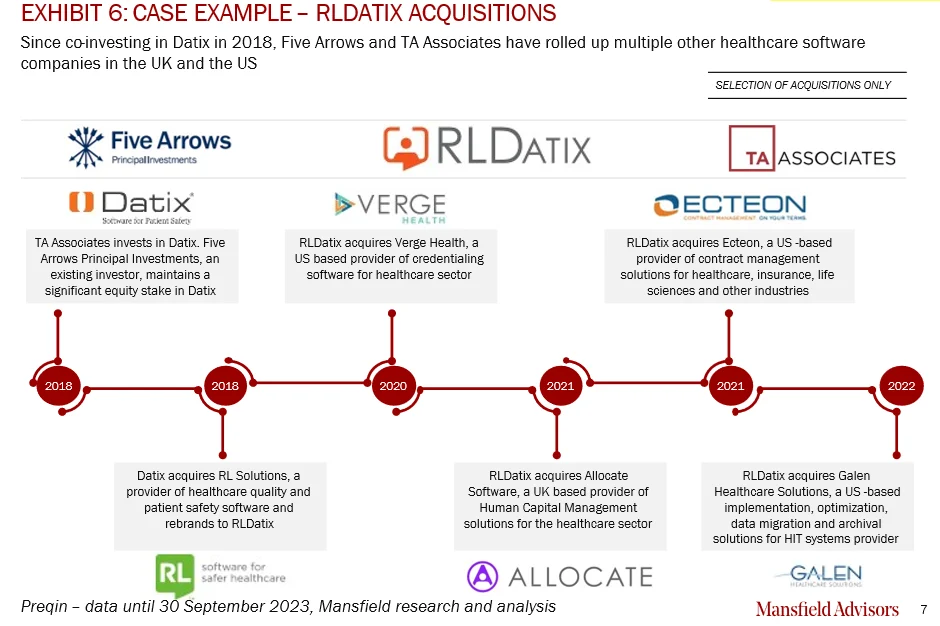
Since TA Associates invested in RLDatix in 2018, joining existing investor Five Arrows Principal Investments, the software company has proceeded to roll up multiple other healthcare software businesses in the UK and the USA. These include Verge Solutions in 2020 (credentialing software), Allocate in 2021 (Human Capital Management solutions), and Galen Healthcare Solutions in 2022 (implementation, optimization, data migration and archival solutions for HCIT systems provider).
Another example is Ardian backed Dedalus who has acquired Agfa HealthCare’s IT business in 2019 (healthcare information solutions and integrated care activities), as well as Dosing GmbH (SaaS medication safety solutions) and swiftQueue Technologies, both in 2021.
HCIT roll-ups makes sense to investors as it represents a shortcut to expanding an asset’s offering, and as it can offer salesforce synergies and economies of scope.
According to Martin Bell, a former board CIO in the NHS, the former Deputy MD of EMIS Health, and the author of the LaingBuisson Digital Health UK Market Report, Private Equity are particularly well suited for these roll-up plays.
“Especially medium to large sized companies can benefit from PE roll-ups. These companies often have quite a few bits missing that can’t be filled by third parties who may or may not be out there. It makes the cost of operations, partnerships, delivery operations so much higher. The ability to acquire add-ons and integrate them is what PE is good at. It’s a consolidation play.”
Conversely, some providers may be too small to succeed on their own, for instance lacking the salesforce or capabilities needed to compete in larger tenders, and will thus benefit from the scale offered by a consolidator.
We forecast future market growth driven by profitable drivers
System pressures and new models of care delivery
Demographic changes and staff shortages have led to significant pressures on healthcare systems, which have often been made worse by the pandemic and subsequent backlogs. Care providers thus need to find efficiencies which increased digitalisation can offer.
Further, models of care delivery are changing and patients will have a growing want and need for data accessibility to support care provision outside of, but linked to, a hospital setting.
As a consequence of the above, we are also seeing rapidly growing volume of healthcare data, with RBC Capital Market projecting global healthcare data to grow by a CAGR of 36% until 2025.[i] With these increasing volumes however also comes the need to store, transfer, and process this data. Here HCIT solutions play an important role.
Underpenetrated markets
The percentage of clinicians using digital technologies varies significantly between European countries. In a 2020 Deloitte survey, 97% of Dutch clinicians report using EHRs, versus 77% of German clinicians, and 69% of Italian clinicians. Similarly, digital prescription was used by 97% of Dutch clinicians, versus 73% or Danish clinicians, and only 13% of German clinicians.[i] Further, and as we saw above, 10% of acute Trusts in England lack an EPR, and 30% lack a ePMA system.[ii]
These disparities should provide significant headroom for growth for HCIT companies.
Funding tailwinds from governments across Europe
As the largest healthcare market outside of the US, Germany launched The German Hospital Future Act (KHZG) in 2020, making €4.3bn in funding available for investments into for instance patient portals, electronic documentation of care and treatment services, digital medication management, and the introduction or improvement of telemedicine.[i]
In France, the Ségur du digital en santé programme, also launched in 2020, includes a €2bn investment into development of digital health. The objective of the programme is to ensure the smooth and secure exchange of health data between health professionals and users.[ii]
At the European level, the EU has committed €1bn towards digitalising healthcare over the coming seven years. This includes the creation of the European Health Data Space (EHDS), which among other things aims to digitise all medical records in the bloc by 2025 to make it easier for individuals to access and share their data with medical professionals, particularly when in another EU country.[iii], [iv]
In England, the Frontline Digitisation programme launched by NHS England (NHSE) and the government in 2021 set a target that 90% of acute NHS trusts would have EPRs by December 2023, which was achieved in Mid-November 2023. The remainder were to follow by March 2025.[v], [vi], [vii], [viii]
However, a NHSE guidance letter sent to trusts in November 2023 suggested that parts of the Frontline Digitisation programme could be pulled from all but the least digitised trusts to counter the impact of strike action. The programme had already been reduced from £2.6bn to £2bn in FY23.[ix]
Funding will likely remain one of the key growth challenges in England. Hence, though 2020 digital health spending represented on average c. 2% of NHS Acute Trust turnover (up from the c. 1.4% a decade ago), this is significantly below for instance the Nordics at an estimated c. 6%-8%.[x]
Investors should focus on solutions that are geared towards clearly defined, and prioritised problems, and roll up assets with a proven track record of growth
Investors should focus on solutions that are geared towards clearly defined, and prioritised problems
For HCIT solutions to be attractive investments, these need to be geared towards clearly defined problems, and should ideally prove either substantial risk mitigation or improved patient outcome, increase efficiency and thereby reducing cost of increasing revenue (preferably in-year if targeting public sector clients), and/ or improved clinician experience.
Solving a problem is not enough however as healthcare providers will often have constrained budgets and will need to prioritise their spending.
“If you’re selling something that has ringfenced specific funding, and if it’s really fixing an urgent thing, then you can get traction” says Martin Bell.
Further, solutions, unless stand-alone, also need to easily integrate into the end users’ existing technology landscape, the end users’ broader organisational structure and ecosystem, and existing care pathways (both digital and physical).
Finally, solutions need to have high security standards (both cyber security and patient data compliance).
Assets will need to have a proven track-record of growth
Healthcare providers are typically risk averse when it comes to changing systems and will want to see robust evidence of safety and efficacy before adopting a new system. Further, changing systems requires a lot of effort in what are often strained organisations.
“The reason for stickiness is multifactorial” says Martin Bell. “One of the biggest things is the amount of effort required, write a business case, and go through procurement, while you have so many other priorities as a healthcare provider.”
This slow pace of technological adoption and long sales cycles/adoption mean that investors sometimes find it hard to validate returns. Companies that have a track-record of growth, by either displacing competition or growing accounts, and that have long customer relationships and are able to evidence surviving evaluation cycles, should provide attractive targets for HCIT investors.
Investors should focus on roll-ups
As seen above, roll-ups can enable investors to rapidly build their capabilities, while gaining clear salesforce synergies, and the possibility to provide scale to smaller assets.
For all investments, it is key that investors understand the local conditions of the markets in which the assets they are looking at operate. This includes understanding diverse and often fragmented commissioning landscapes, regulatory variations by region and country, clinical and patient models (for instance patient access to care and patient pathways), interoperability challenges, and privacy and data security concerns (mainly regulatory limitations, but sometimes also cultural perceptions). Though not all these challenges will be specific to HCIT, these can significantly limit the scalability of HCIT.
Conclusion
We have seen a lot of investor interest in the HCIT space in recent years which we forecast will continue.
The HCIT space offers an attractive theme for investors, and we also see favourable market drivers and strong funding tailwinds, coupled by underpenetrated markets leaving headroom for growth.
Investors interested in the HCIT space should focus on solutions that are geared towards clearly defined, and prioritised problems, and roll up assets with a proven track record of growth.
[1] Grand View Research – Europe Digital Health Market Size, Share & Trends Analysis Report By Technology (Tele-healthcare, mHealth, Healthcare Analytics, Digital Health Systems), By Component, By Region, And Segment Forecasts, 2023 – 2030 – Press release
[1] LaingBuisson – Digital Health UK Market Report – 3rd Edition
[1] DigitalHealth.Net (3 November 2023): Two Derbyshire trusts pick Nervecentre as preferred supplier for joint EPR. Available at: https://www.digitalhealth.net/2023/11/two-derbyshire-trusts-pick-nervecentre-as-preferred-supplier-for-joint-epr/#:c. :text=for%20joint%20EPR-,Two%20Derbyshire%20trusts%20pick%20Nervecentre%20as%20preferred%20supplier%20for%20joint,patient%20record%20(EPR)%20system. (accessed 27 November 2023)
[1] LaingBuisson – Digital Health UK Market Report – 3rd Edition
[1] Mansfield interview
[1] NHS Digital (16 November 2023): 90% of NHS trusts now have electronic patient records. Available at: https://digital.nhs.uk/news/2023/90-of-nhs-trusts-now-have-electronic-patient-records (accessed 21 November 2023)
[1] Preqin
[1] RBC Capital Markets: The healthcare data explosion. Available at: https://www.rbccm.com/en/gib/healthcare/episode/the_healthcare_data_explosion#:c. :text=Today%2C%20approximately%2030%25%20of%20the,for%20healthcare%20will%20reach%2036%25.https://emerj.com/ai-sector-overviews/where-healthcares-big-data-actually-comes-from/ (accessed 20 November 2023)
[1] Deloitte (September 2020): Digital transformation: Shaping the future of European Healthcare. Available at: https://www2.deloitte.com/content/dam/Deloitte/uk/Documents/life-sciences-health-care/deloitte-uk-shaping-the-future-of-european-healthcare.pdf (accessed 16 November 2023)
[1] LaingBuisson – Digital Health UK Market Report – 3rd Edition
[1] Healthcare IT News (22 September 2020): German hospitals to get €3 billion funding boost for digitalisation. Available at: https://www.healthcareitnews.com/news/emea/german-hospitals-get-3-billion-funding-boost-digitalisation (accessed 20 November 2023)
[1] Ministry of Solidarites and Health (Ministère de la Santé et de la Prévention): Le Ségur du numérique en santé. Available at: https://esante.gouv.fr/segur (accessed 16 November 2023)
[1] Healthcare IT News (8 June 2023): European healthcare digitalisation at inflection point. Available at: https://www.healthcareitnews.com/news/emea/european-healthcare-digitalisation-inflection-point (accessed 16 November 2023)
[1] European Commission: European Health Data Space. Available at: https://health.ec.europa.eu/ehealth-digital-health-and-care/european-health-data-space_en (accessed 17 November 2023)
[1] NHS England: Digitising the frontline. Available at: https://transform.england.nhs.uk/digitise-connect-transform/digitising-the-frontline/ (accessed 21 November 2023)
[1] NHS South, Central and West (SCW): Frontline digitisation programme supports ambitious Electronic Patient Records targets. Available at: https://www.scwcsu.nhs.uk/case-studies/frontline-digitisation-programme-supports-ambitious-electronic-patient-records-targets (accessed 21 November 2023)
[1] NHS Digital (16 November 2023): 90% of NHS trusts now have electronic patient records. Available at: https://digital.nhs.uk/news/2023/90-of-nhs-trusts-now-have-electronic-patient-records (accessed 21 November 2023)
[1] DigitalHealth.Net (25 July 2023): EPR frontline digitisation target declared “unachievable”. Available at: https://www.digitalhealth.net/2023/07/epr-frontline-digitisation-target-declared-unachievable/ (accessed 21 November 2023)
[1] DigitalHealth.Net (15 November 2023): Frontline digitisation funds at risk to cover industrial action costs. Available at: https://www.digitalhealth.net/2023/11/frontline-digitisation-funds-diverted-to-cover-industrial-action-costs/ (accessed 21 November 2023)
[1] LaingBuisson – Digital Health UK Market Report – 3rd Edition


