


Why Germany Has a Large Private Hospital Sector – and What the UK Can Learn

We recently compared UK and Spanish private hospitals, highlighting the significant differences in scale and scope, despite both having similar tax-funded universal healthcare systems, with complementary private health insurance. We concluded Spain created the conditions for large private hospitals to thrive by having a far larger privately insured population, and regional governments more willing to experiment with public-private solutions.
A little closer to home, Germany has an even larger private hospital sector. Eurostat data shows nearly 60% of hospital beds in the €114bn acute hospital market are private , while only 40% are run by public hospitals. This is in marked contrast to the UK, where roughly 5% of beds are in the private sector , and Spain, with 32% in the private sector (Figure 1).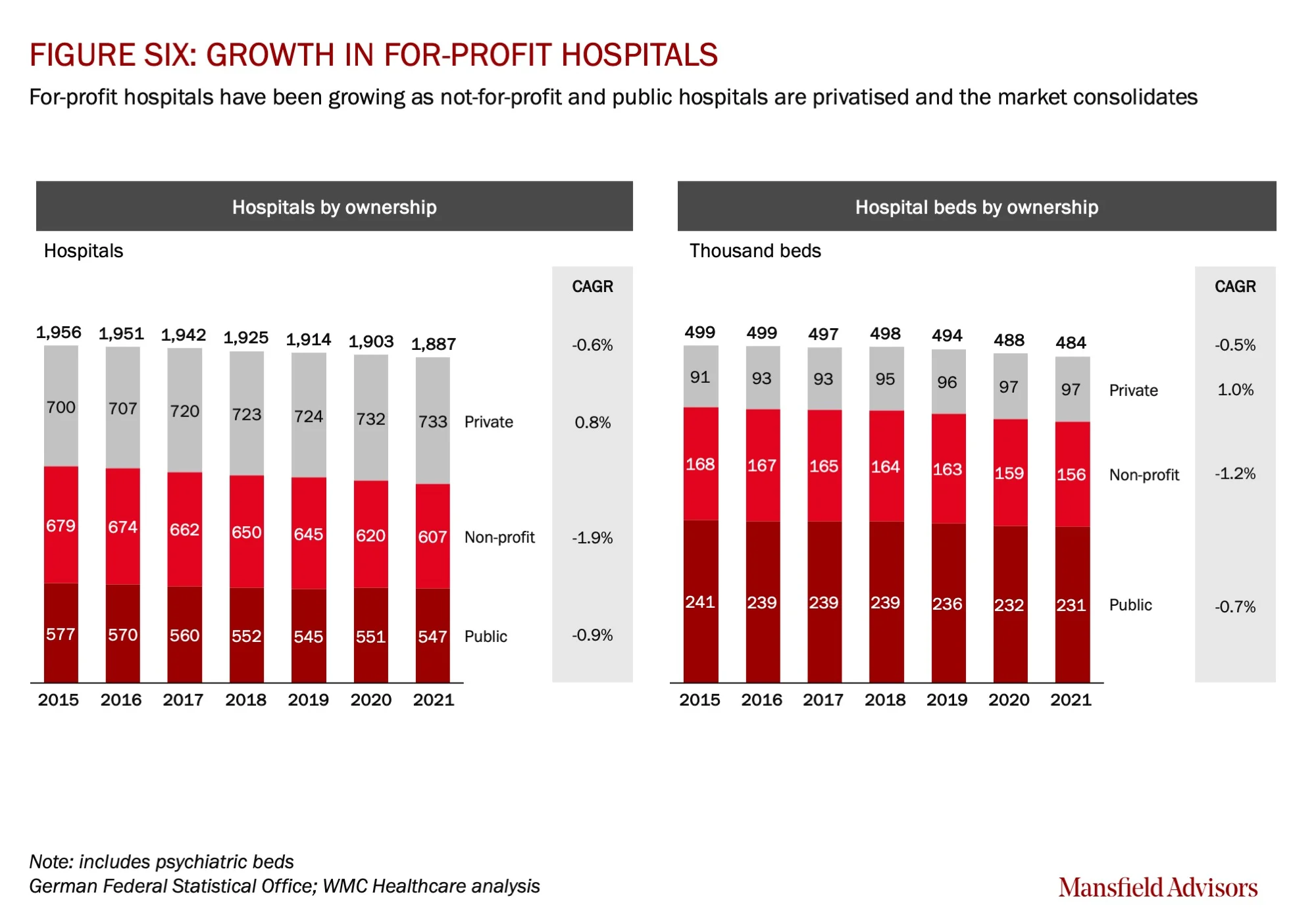 Like Spain, German private hospitals include ‘full-service’ general hospitals, in contrast to the UK’s small sites offering a limited range of elective procedures.
This article discusses why Germany has such a large private hospital sector, whether it is due to differences in the healthcare system, and whether any of the conditions which create this large private hospital sector are transferable to the UK.
Structure of Germany’s acute hospital sector
Germany has a lot of beds, both in absolute terms (437k) and relative to population.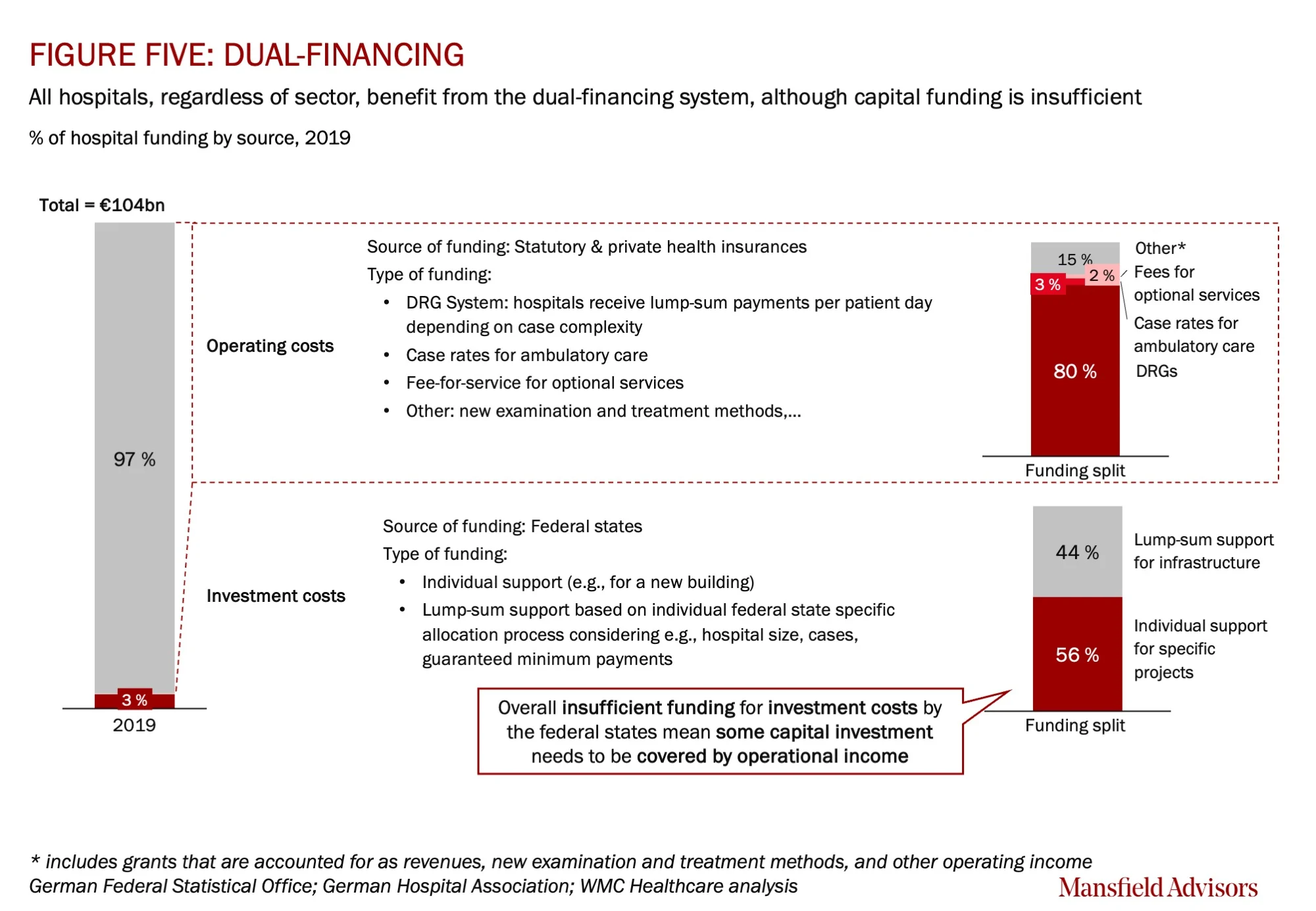
Excluding psychiatric beds, German federal statistics for 2021 show 33% of beds (146k) are not-for-profit and 19% (83k) are for-profit. The for-profit sector is highly concentrated, with the 4 biggest groups accounting for 61% of for-profit beds (12% of total beds). By contrast, the not-for-profit sector is much more fragmented (the top 5 have 15% of not-for-profit beds) and public hospitals are even more fragmented (Figure 3).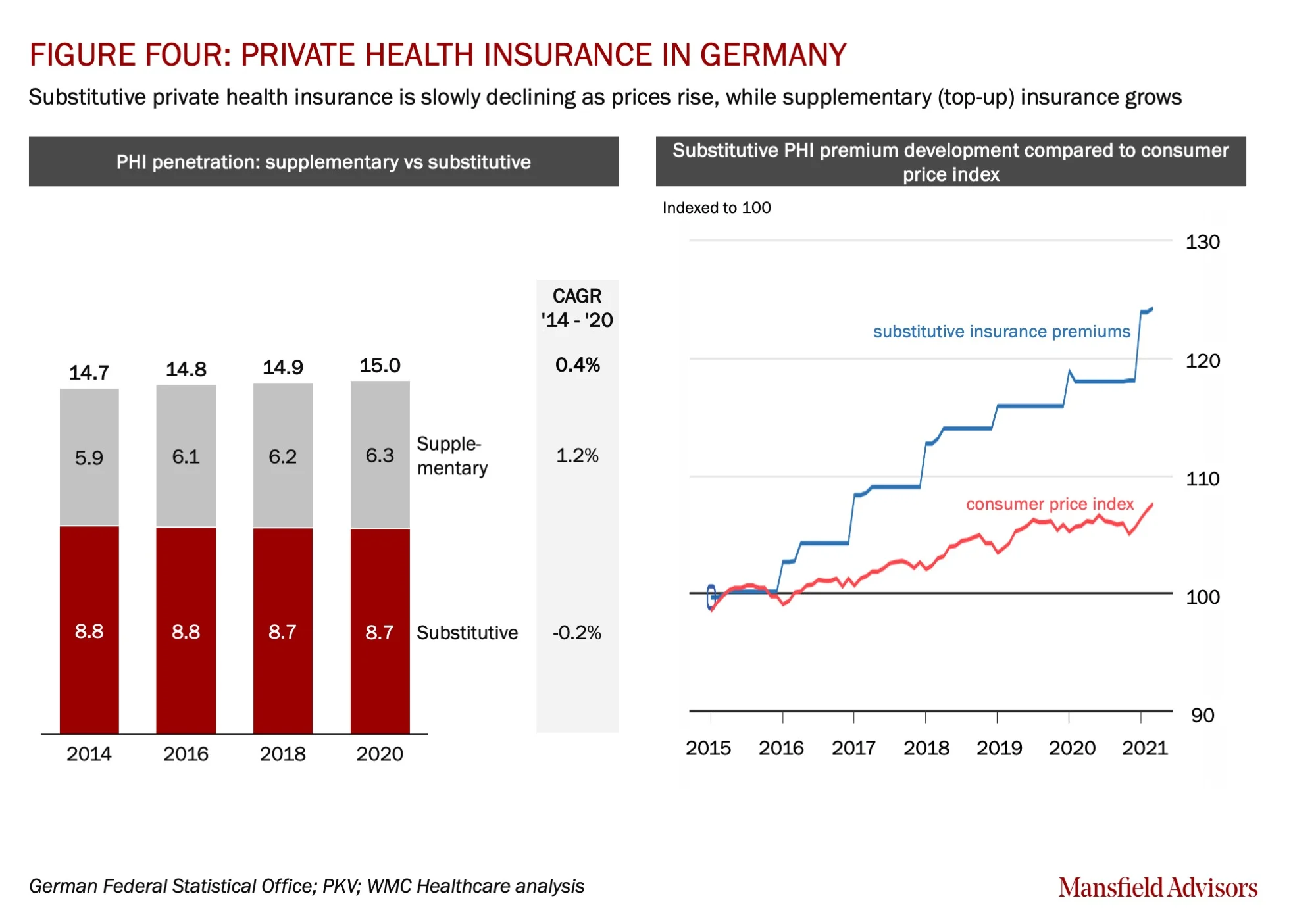
About half (48%) of all hospital beds are in large hospitals (>500 beds), and nearly two-thirds of these are in public hospitals. At the other extreme, 15% of beds are in small hospitals (<200 beds), and 42% of these are for-profit. The latter partly reflects the prevalence of highly specialised small hospitals, such as sports surgery, which can be highly profitable.
Social and private health insurance
Germany’s universal healthcare system is the original social insurance model. Employees and employers contribute to public health insurance funds, with the federal government setting a contribution rate for salaries up to ~€65k. These insurance funds then reimburse providers on behalf of their members. All Germans are required to have insurance, and the funds cover family members, retirees and the unemployed.
Superficially, the German and UK systems look similar: instead of general taxation, Germans are, in effect, ‘taxed’ through social insurance. Unlike the UK, though, where private insurance is complementary (we cannot opt out of paying taxation), Germans who earn over ~€65k can choose substitutive private insurance and opt out of the public insurance system entirely. (There are controls on re-joining the public system to prevent adverse selection.)
However, the payor model is not the driver of Germany’s large private hospital sector per se. First, the proportion of the German population with private insurance is not significantly greater than the UK. Around 12.5% have substitutive private insurance, compared with ~10% in the UK and ~25% in Spain covered by complementary private insurance, and this has been declining slowly as it becomes more expensive and relatively less attractive to Germany’s ageing population (Figure 4). 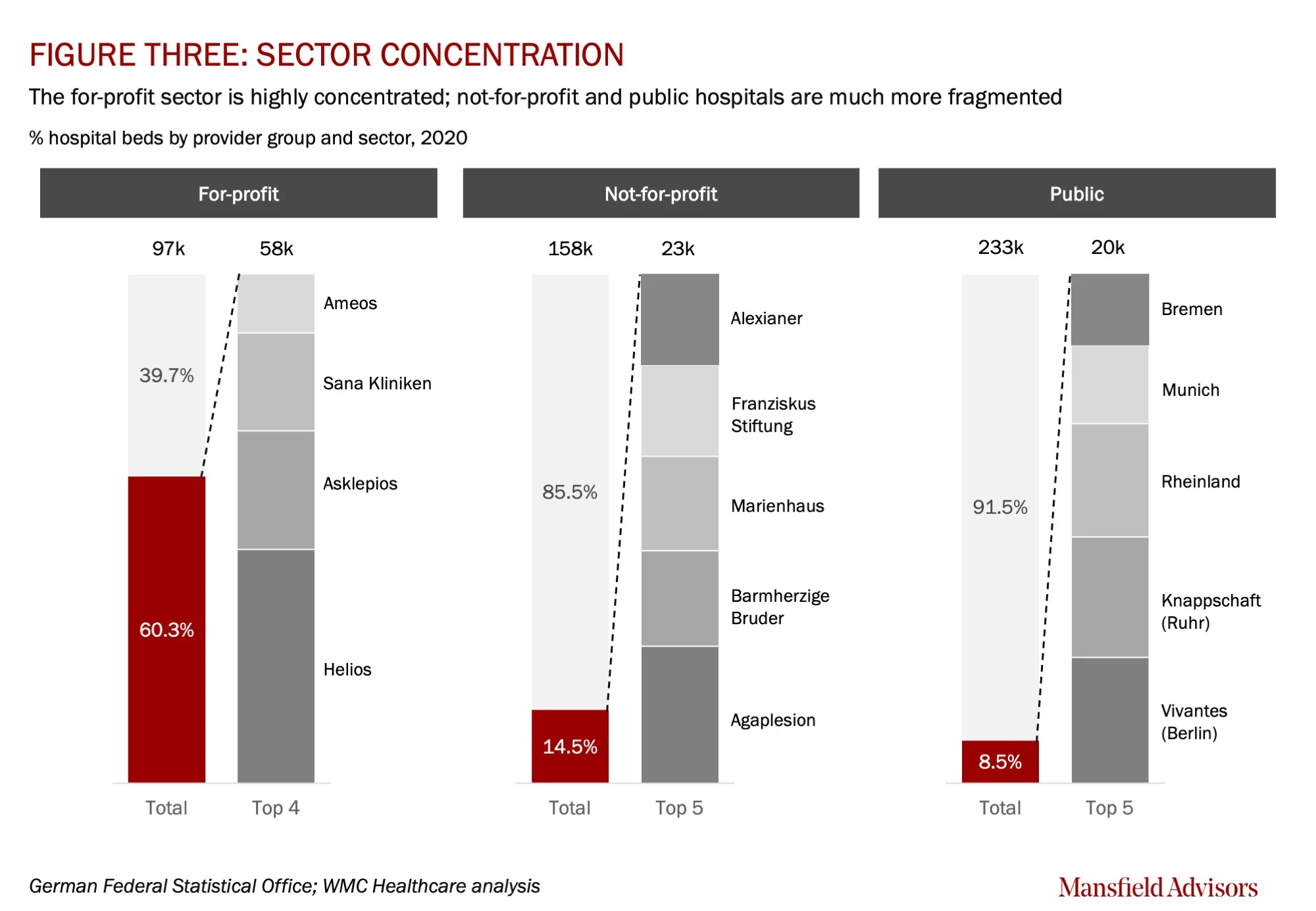 Secondly, private and social insurance payors are not limited to private or public hospitals exclusively.
Managed markets and dual-financing
The critical difference between the UK and German models is that the latter enables individuals to be consumers of healthcare (‘demand-led’), whereas healthcare in the UK is viewed as a public good/service (‘supply-led’). To be clear, Germany’s social insurance system does not in itself create a large private sector (France has a similar model, but only 38% of beds are private). It simply creates the conditions for healthcare markets to develop.
Theoretically, markets are self-regulating, but governments usually intervene where consumers and/or producers cannot make economically rational choices. For example, governments don’t directly control the market for cars, but do set safety and environmental standards. Similarly, Germany manages the market for hospital services, providing a level-playing field where patients choose where they are treated. Patient and payor can be agnostic about whether that is a private or public hospital.
Dual-financing is a key component of the managed market, with frameworks for supporting capital investment and to cover operating costs (Figure 5):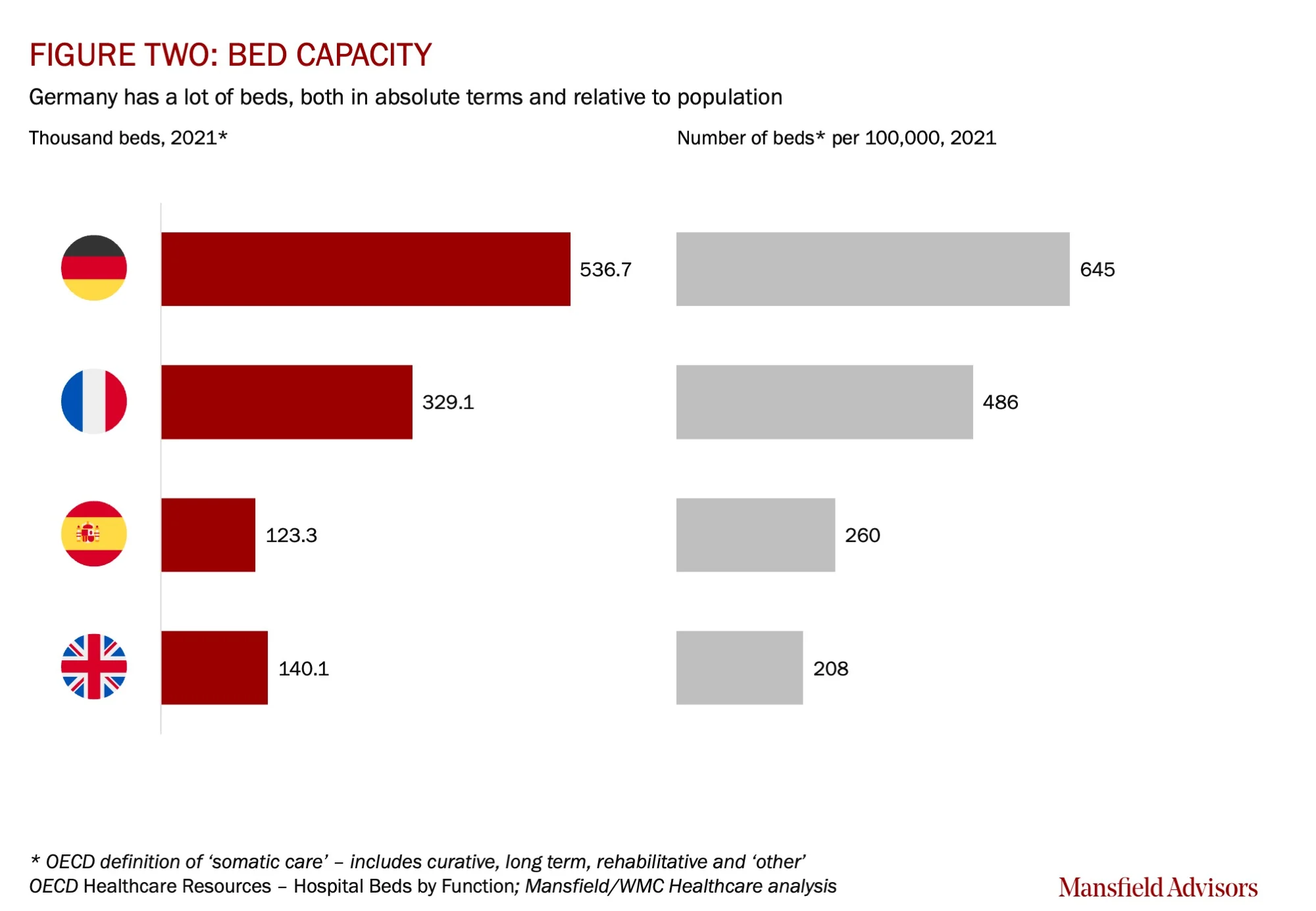
• Capital investment funds (3% of hospital funding) – administered by German states for new buildings and other projects. Public and private hospitals can bid for funding. States also plan hospital capacity, although this does not necessarily translate to explicit targets for bed numbers, nor the relative share of private and public sectors.
• Operating costs (97% of hospital funding) – German hospitals are reimbursed for activity delivered. A federal agency, InEK, defines services and sets prices using a Diagnosis-Related Group (DRG) system. DRG reimbursement covers ~80% of operating costs, and is the product of a base rate and points per case, depending on complexity. It is used by all payors to reimburse all hospitals for inpatient services.
There is a similar activity-based approach for reimbursing outpatient services, but different systems for social and private insurance. (Physicians receive 2.3 times more through private reimbursement.) Other services are generally billed on a fee-for-service basis.
In principle, the NHS in England is similar, and the architecture of hospital funding would be recognisable to German hospital operators. The National Tariff is comparable to the German DRG system, and private hospitals in England can contract to the NHS, receiving the appropriate tariff, just like their German counterparts. Capital funding for NHS hospitals is handled separately (although is not available to private operators). Yet, despite these similarities, we still do not have a large private hospital sector. What else is missing?
History, policy and culture
Different histories and cultures mean similar approaches to payment or organisation have different outcomes. When the NHS was founded in 1948, as an integrated, tax-funded service, there was still no reason why it had to own hospitals. However, the existing patchwork of charity, church and municipal hospitals needed reorganisation, renewal, rationalisation and expansion, and centralised public ownership was seen as the best way to achieve that, as in other newly nationalised industries.
German charity, church and municipal hospitals have similar origins to the UK, but social insurance is much older than the NHS . Its decentralised separation of payor and provider meant public hospitals continued to be owned by municipalities and private hospitals remained independent not-for-profit institutions. However, with a demand-led system, Germans also became comfortable with choice. This is exemplified by supplementary private insurance which tops-up statutory cover for greater choice of consultant, private rooms, etc. 10% of Germans have this and it has been growing. In the UK, there is resistance to anything which dilutes the idea of a universal ‘one-size-fits-all’ NHS.
It was the transition to dual-financing which stimulated the growth of for-profit hospitals by forcing the privatisation of public and not-for-profit hospitals. The DRG system has been blamed for losses, with smaller hospitals particularly vulnerable, since they struggle to generate case mix points to be profitable. Meanwhile, capital investment funds have left hospitals underinvested, and without sufficient resources, municipalities and even federal states have opted for privatisation. For example, Giessen-Marburg was sold by the state of Hesse in 2006, and became the first privatised university hospital. The number and share of private hospitals therefore continues to grow (Figure 6).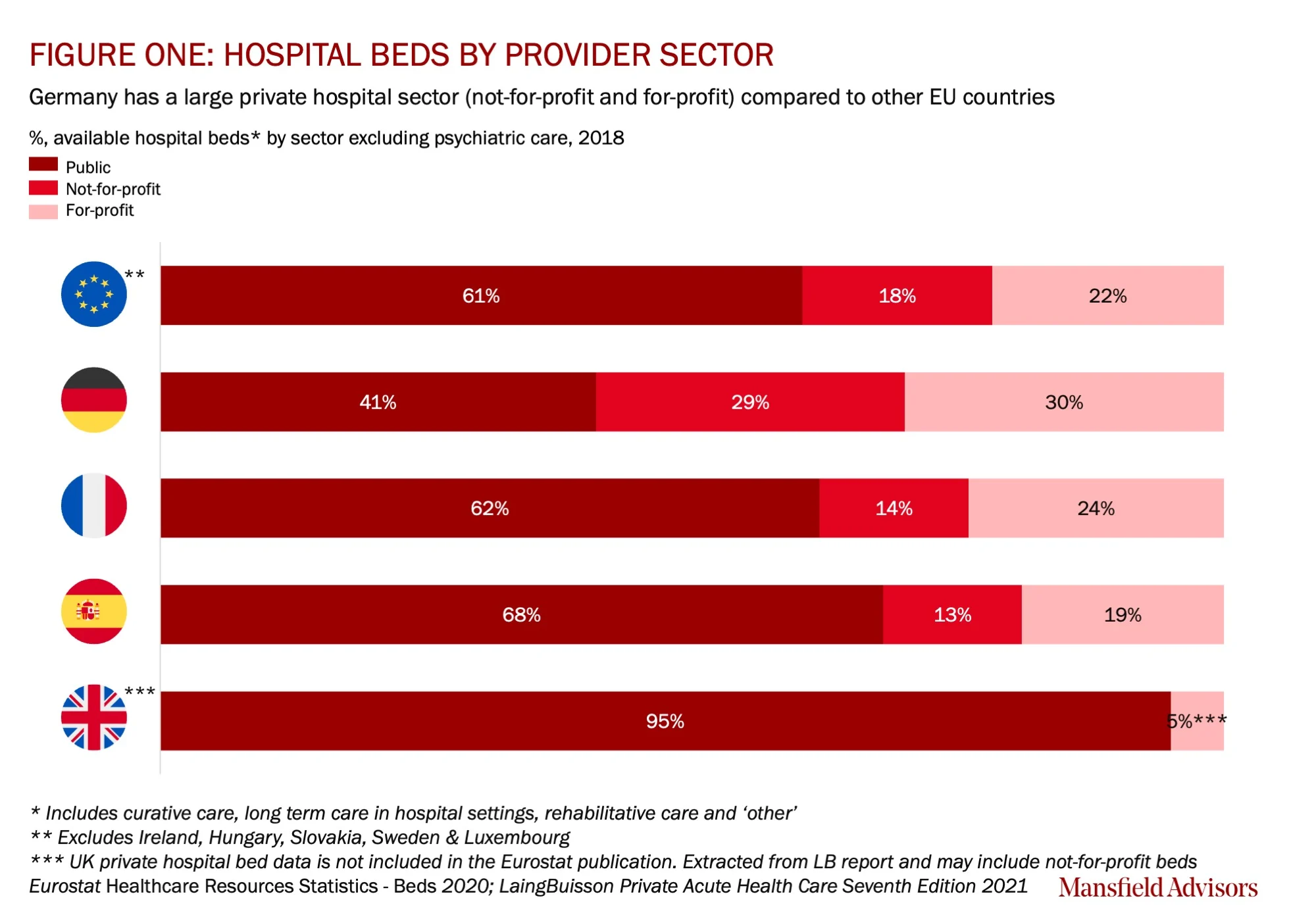
Overcapacity
There is, however, another factor at work. As the government stimulates the development of outpatient, day patient and other ambulatory services, to reduce reliance on inpatient services, the hospital system is consolidating. While there is no formal target for bed capacity, if Germany went as far as to converge on the EU27 average, there would be 173k fewer beds (almost as many beds as in the entire NHS across the UK). Hence, some hospitals will close.
Privatisation is seen as an alternative to closure. While the German public might be agnostic about who provides, and comfortable with choice and top-ups, they are perhaps still uncomfortable with the idea of making a profit out of ‘misfortune’. However, the private sector is also seen as a way to save hospitals which would otherwise be closed, and, for politicians, it is perhaps a way of shifting blame for those closures when they do happen.
Conclusions
Compared with the UK, Germany has a large private hospital sector because of a multitude of factors. One is undoubtedly the fundamental difference between healthcare systems, creating the conditions in which hospitals of any sector could thrive within a managed market. However, the tools of managed markets, such as DRG reimbursement, also made it more difficult for public and not-for-profit hospitals to survive. In the UK – or at least in England – we have those same tools, but the managed market still does not make large scale private general hospitals viable.
It is deliberate choice and culture which have played a much greater role. Culturally, Germans are accepting of their role as consumers of healthcare, and hence they are less concerned about whether the hospital is private, public, for-profit or not, as long as it meets their expectations on quality. In terms of choice, the owners of loss-making hospitals have deliberately chosen to privatise as a way to sustain hospitals which might struggle for investment or even close. The British are still a long way from seeing themselves as healthcare consumers, or accepting top-ups, and it would be a brave politician who decided to privatise a loss-making NHS trust.