


Every sector in health and care has its own nuances, however, in all of them, location is critical all the way down from the broad national level to individual site selection. Regarding site selection, when speaking to a real estate advisor, one might hear “many things matter and the first three are location, location, and location”. But, at Mansfield, we are strategy advisors so what does it mean to be strategic about site selection for healthcare businesses?
The topic comes up in several contexts:
- Market entry – which are the best markets to enter, and where within a market should one operate?
- Portfolio analysis – how can we optimally meet the needs of our customers? How are individual sites performing relative to the suitability of their locations? Which sites should be combined or split?
- Mergers and acquisitions – how do two companies fit together? Are the locations complementary or is there risk of cannibalisation? Should the merged portfolio be rationalised?
- Roll-up runway – what are the limiting factors of consolidation? How much further can the industry or any individual company go?
In healthcare services, location selection typically hinges on four dimensions: supply, demand, funding, and access to staff. The importance and scope of each varies by subsector, and many industry veterans will have an intuition for finding good locations, but oftentimes the interaction of variables is complex. For example, care home operators targeting the private-pay market might locate in affluent areas with an aging population, but staff costs can be 60% or more of revenue and many workers rely on public transportation. Care homes with few nearby transit links can go understaffed, become reliant on locum workers, and fall out of profitability quickly. We recently encountered a care home positioned a 10-minute walk up a steep hill from the nearest bus station. This walk was so troublesome that the operator had tried hiring a private driver and aligning shifts with the bus schedule, and they eventually bought a van to shuttle employees to and from the station. The lesson is, in care homes, access to staff is so key to profitability that well-connected homes near the boundaries between affluent and less-affluent areas often perform best.
One can develop heuristics like this via long years in industry, by speaking with experts, or via examining large portfolios to discover what works. However, even the savvy industry vet can learn something from intense data interrogation, and the application of geographical and social sciences, and advances in computing allow us to explain and discover location phenomena that drive access to care and sustainable growth.
In this article we will explore some of the supply-side market forces that drive location selection and the patterns that they create in the retail pharmacy, veterinary, and private medicine sectors.
Forces
Imagine a sunny Spanish beach in Menorca or Ibiza (you decide). The beach is butted on both ends by cliffs, and a boardwalk runs parallel to the sea. Two entrepreneurs, who are competitors, decide to sell sunscreen from rolling carts to the beachgoers who are distributed evenly along the beach. The competitors are the only sellers on the beach. Where do they choose to put their carts?
In the simplest case, if they both position themselves equidistant from the ends, anywhere along the beach, they share the market evenly. Regardless of the initial configuration, eventually one of the sellers will realize that moving either toward the other or the centre will gain him or her incremental market share. The other seller will react in turn by moving similarly, and so it goes until the carts are next to one another at the midpoint. Once there, the sellers reach a state of a Nash equilibrium, named after the mathematician John Nash, in which a unilateral move away from the midpoint would cost the mover market share. This scenario is described by Hotelling’s law and is one of the reasons you might see competitors like Starbucks and Pret a Manger sharing street corners.
Now imagine the beach is very long and the tourists prefer not to walk long distances for sunscreen. If the sellers recognize that the tourists bear search costs, a different configuration will arise. The carts will distance themselves, and each seller will be able to charge a premium up to the cost a tourist bears by walking all the way to the other cart. If the sellers get particularly wise, they may also realise that they can further change the “distance” to the next cart by offering differentiated products. In this case a buyer’s preference for a product may offset some of the burden of a far walk and win the seller with preferred products additional share. This phenomenon was first discussed by economists Edward Hastings Chamberlin and Joan Robinson and is known as monopolistic competition because the sellers remain in competition despite having small local monopolies. One may experience this market force when comparing prices between corner stores and supermarkets. In most cases, a shopper chooses the corner store for convenience so shop owners charge inflated prices for late-night snacks.
Let’s add yet another kernel of reality to the situation: imagine the sellers bear greater transportation and delivery costs the further they distance themselves from the beach access point. With this constraint, the sellers would place themselves at the points that balance the benefits and costs of distance. If the costs are significant, the sellers may end up next to each other once more. The sellers may even benefit from overall lower delivery costs because the other is nearby. In the field of urban economics, this network effect is called the agglomeration effect, which posits that businesses can profit from returns to scale not only as a single competitor grows but also as an industry within a region scales – perhaps without any single competitor growing. In the classical theory, the benefits come from transportation costs, labour availability, and knowledge distribution. As a knock-on effect of agglomeration, some regions become famous for a particular good or service and companies can benefit from the signalling that comes from being there. Examples include old-world tailors on Savile Row in London and new-world tech companies in Silicon Valley. Thinking more broadly about network effects in location strategy, one may also consider the presence of participants in other industries. For instance, restaurants, coffee shops, and clothing retailers thrive in areas with high foot traffic and are often seen together because they benefit from the presence of customers drawn by the other types of stores.
So how does this work in real-life healthcare sectors?
Patterns
Here we examine the distribution of competitors in three healthcare industries, retail pharmacy, veterinary, and private medicine across a portion of London. In the cases of veterinary and private medical practices, a visual inspection of each map can provide some quick insights, however, in the case of pharmacies, the pattern is more ambiguous. In general, humans are surprisingly bad at discerning patterns from randomness1, so we lean on statistical approaches to identify and measure patterns. In this case, we use an analysis called Ripley’s G, which allows us to measure the level of clustering or dispersion for a range of sizes of “neighbourhood” by measuring the proportion of locations whose nearest neighbour (think “competitor”) is within a given range. We then compare the observed distribution with a set of simulated random patterns: observed curves above the simulated curve exhibit clustering and curves below the simulated curve exhibit dispersion.
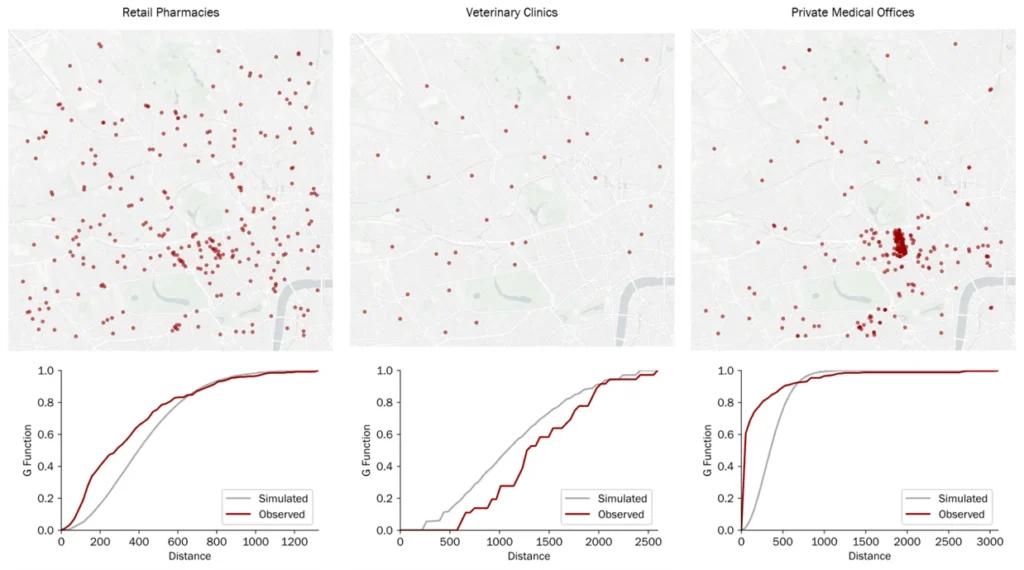
Retail pharmacy is a relatively undifferentiated industry, so the sector mostly follows Hotelling’s Law: chemists are often best off on high streets, where there is the most foot traffic, and they split the local market with co-located competitors. Whilst the distribution of pharmacies around London may visually appear random, nearly all have a competitor within a very short walking distance. The line graph demonstrates that chemists are more often very close to one another than they would be under a random process (~40% have another store within 200m), so the industry is exhibiting Hotelling-like features. Chemists are primarily fixed cost businesses, and sites can usually move within a few hundred metres without a change of license, so being subtle about exactly where the pharmacy is on the high street can be quite impactful. Furthermore, because competitors are piled onto the same street, there is opportunity to extend the “virtual distance” by investing in the environment or improving the service level to lure customers the 50m past competitors to a nicer experience.
Revisiting the chart, interestingly, the observed distribution mimics the random one in some cases, which indicates that there are some pharmacies that unexpectedly sit further apart from others. These more isolated locations may be on quieter streets with differentiated offerings, or they may be on streets with a supply/demand mismatch.
In contrast to pharmacies, and the simulated distribution, veterinary practices are particularly dispersed. In fact, in this region, no first-opinion practice has another one within 575m as the crow flies, an approximately 12-minute walk. In our own research, we found that proximity is the number one reason for choosing a first-opinion clinic and it ranked well above perceived value, which means that customers want convenience, and the market is likely exhibiting monopolistic competition. Importantly, this does not mean that veterinarians are exerting excess market power, it just means that customers are willing to pay for convenience and for many customers their nearest practice is a bit closer than others. On the contrary, we have also found that pet owners are perfectly willing to travel for differentiated services, for instance specialist care. On the other hand, one could also argue that general practice vets are distributed in urban areas because the purchasing decision is driven so much by proximity, the distances people are willing to travel are small, and the population density is generally low enough that there is only enough demand to support one practice within the range that pet owners are willing to travel. In either case, we primarily find veterinary clinics on quiet residential streets because vet clinics are actually damaged by an over-abundance of nearby activity – no one wants to walk their sick puppy through a crowded street – which is why there are no practices in the busiest parts of town (the gap near the centre and bottom of the map). Now that we know the typical distribution of practices, we can programmatically scour similar areas around the country to identify gaps in supply that could be attractive places to build new practices.
Whilst dispersion among veterinary clinics benefits many pet owners, dispersion among hospitals would benefit much of society. Emergency care is, tautologically, urgent, and universal access is in the mandate of state-sponsored care. However, as one can discern from cursory analysis of NHS Acute Trust catchment populations, services are not optimally located, and this is due to the constraints of the built environment. Veterinarians can open, close, and move clinics with ease, which allows market forces to promote an optimal configuration, but hospitals are huge and have important infrastructure requirements, which makes their location subject to path dependence, and the equality of an arrangement of services erodes as people and needs move.
Finally, private medical practices are intensely clustered, mostly around Harley Street, which has been a hub for private practitioners since the end of the 19th century. In earlier years, the benefits of the agglomeration effect (e.g., knowledge sharing, etc.) were likely more powerful than they are today, but most practices on Harley Street are single-specialty or few-specialty groups and they benefit from the ability to refer patients to nearby practices. Probably the greatest benefit of being on Harley Street today is the economic signal: most people in London assume that the best private doctors practice there. In addition to hefty lease payments, Harley Street doctors garner prestige from their choice of location. Economics professors would argue that much of the signal comes from the high rents – the ability to afford the space means those doctors must create significant value for their patients. Anyone wanting to establish a premium brand would struggle to find a better place than Harley Street for a flagship clinic. Moving up a level, spontaneously creating these types of networks is very difficult, but local government, property estates, and landlords play a very important role in either limiting or fostering their development.
So, where next?
We have examined some phenomena and how we measure them, and you might be thinking this is all a bit academic. But building models that really effectively evaluate whether a location is suitable for a business is both a commercial and an academic process. Much like in the beach example, we iteratively layer-in reality and theory and then test outputs using statistical methods. This requires deep understanding of how a market works, what makes a location good for a particular business, and the academic approaches to identify and quantify market opportunities. At Mansfield Advisors, we take pride in how we hire scientists and train them to be strategy consultants, and this doesn’t mean leaving the scientific training behind. In location strategy projects, we leverage analytical techniques developed for physical sciences like geology and resource prospecting, various social sciences, and computer science to help organisations identify areas with unmet needs and tailor their services to provide more effective and efficient care.
1. Williams, Joseph Jay and Thomas L. Griffiths. “Why are People Bad at Detecting Randomness? Because it is Hard.” (2008), princeton.edu.